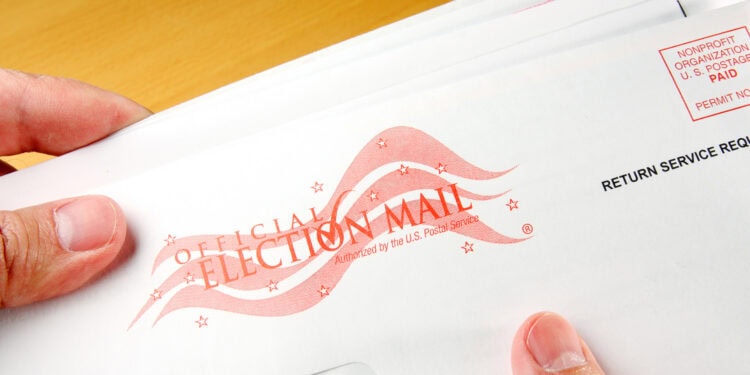
Does voting by mail make for better choices? A 2020 election study suggests it might
Mail-in ballots are usually discussed as a way to boost turnout. New research suggests they may also help voters make better choices, with mail voters more likely to pick the candidate aligned with their stated preferences.
Read moreDetails
Which cities dominated 2020 voter fraud talk? A city’s Black population was the best predictor
After the 2020 election, online talk of voter fraud zeroed in on cities with large Black populations. A new study suggests these racialized claims found a particularly receptive audience among White Americans who score high in racial resentment.
Read moreDetails
Does deliberating on politics make you look weak or wise? New research weighs in
People who take time to deliberate before choosing a side on a political issue tend to be judged as having better moral character by those who disagree with them, according to new research.
Read moreDetails
People who favor group-based inequality tend to have less gray matter in an empathy-linked brain region
A preference for social hierarchy may be linked to both brain structure and motivation. Researchers found that people scoring higher in social dominance orientation had less gray matter in a region tied to empathy and emotion.
Read moreDetails
Conservatives’ more rigid thinking styles don’t seem to make them likelier than liberals to toe the party line
Conservatives tend to report more rigid thinking styles than liberals, but that doesn't appear to make them more likely to follow their party's lead. Across dozens of issues, both groups shifted toward their party's stance about equally.
Read moreDetails
People who think the world lacks meaning are more prone to political violence
People who view the world as devoid of meaning are more likely to support political violence. A new study suggests that simple exercises to find everyday meaning could help reduce these violent extremist intentions.
Read moreDetails
Tripping during a political convention was linked to more support for political violence in a recent psychedelic study
Taking psychedelics on the Fourth of July is linked to decreased support for partisan violence, while using them during political conventions shows the opposite effect. A new study suggests the broader cultural mood heavily influences a psychedelic experience.
Read moreDetails
People shift their political opinions to match the room in small group chats
When politics comes up in small group chats, people often adjust their stated opinions to match the dominant viewpoint. New research using AI-simulated conversations reveals that social pressure can easily sway how we express our political beliefs.
Read moreDetails
Parents of transgender youth faced declining mental health after the 2025 inauguration
A recent study reveals that parents of transgender youth experienced worsening mental health and heightened anxiety following the 2025 presidential inauguration. The research highlights the immediate emotional toll that shifting political climates take on families.
Read moreDetails
How the TikTok algorithm changed political campaigning in 2024
A new analysis of the 2024 U.S. presidential election reveals how TikTok’s design encourages candidates to use short, emotional, and performance-based videos. The study highlights how algorithmic platforms favor rapid entertainment and visual spectacle over detailed policy discussions.
Read moreDetails
Celebrity admiration is linked to submission to authority, study finds
While celebrities often champion liberal causes, their biggest fans might lean another way. New research indicates that intense celebrity admiration is consistently linked to traditionalism and a desire to submit to dominant authorities.
Read moreDetails
Republican-aligned actors issued nearly three-quarters of fact-checked 2024 election hoaxes
During the 2024 U.S. presidential election, politicians and anonymous users openly used disinformation as a campaign strategy. A new study reveals who spread these hoaxes, how they shared them, and who was targeted by the fabricated claims.
Read moreDetails
Women and underrepresented minorities have higher tenure-track placement rates in the political science job market
What actually lands a PhD student a tenure-track professorship? A new study suggests a candidate's publication record, research field, and demographic identity are much stronger predictors of hiring success than the prestige of their university.
Read moreDetails
Psychologists identify “collective anti-mattering” as a key driver of modern political grievances
New research shows that feeling your social group is ignored by society triggers deep anger and anxiety. These emotions can lead to political mobilization, a desire for strong leaders, and support for punitive policies.
Read moreDetails
Americans often fail to notice when Democrats and Republicans are moving in the same direction
We often overestimate how divided our political opponents are from us. New research shows that highlighting shared trajectories of opinion change can soften partisan animosity, provided we don't dwell on today’s existing political gaps.
Read moreDetails