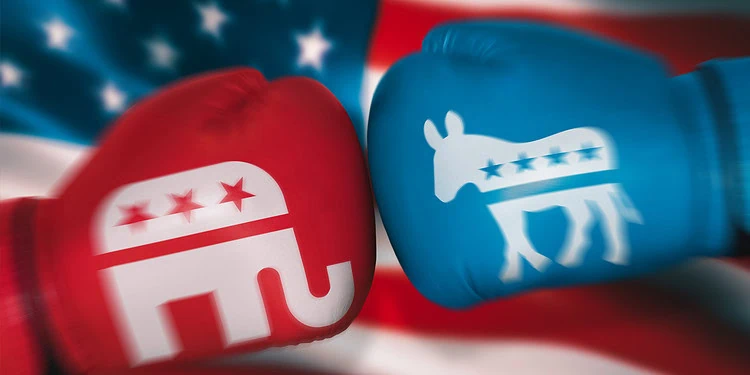
In today’s polarized political landscape, the ability to understand and empathize with those across the aisle has reached concerning lows. New research published in Personality & Social Psychology Bulletin reveals an asymmetry in this empathy deficit: liberals consistently show less empathy toward their conservative peers than vice versa.
President Joe Biden’s inaugural call to “stand in the other person’s shoes” highlighted empathy as crucial for healing national divisions. Yet many people find it hard to feel for political opponents. Empathy—defined as sympathy for and understanding of another’s suffering with the aim of reducing it—is widely seen as essential for improving intergroup relations, but tends to diminish when directed toward those outside one’s political or social group.
James P. Casey and colleagues conducted four preregistered studies examining how political ideology shapes intergroup empathy bias and why such differences arise. The researchers recruited 4,737 participants, roughly evenly split between liberals and conservatives, from online platforms including Prolific, CloudResearch, and MTurk.
Study 1 involved 549 U.S. participants, while Study 2 included 958 U.K. participants. Study 3 and Study 4 sampled 1,372 and 1,874 U.S. participants, respectively, with recruitment spanning both conservative and liberal administrations to account for political context.
Don’t miss the next big psychology finding
Every morning, PsyPost sends a short briefing on the most interesting new peer-reviewed research in psychology and neuroscience.
In each study, participants read a short scenario describing a person undergoing a mild hardship (e.g., a sprained ankle). The person was identified as politically conservative, liberal, or neutral. Participants then rated their emotional responses using several scales: empathic concern (e.g., sympathy), perspective-taking, empathic intentions (e.g., willingness to help), and empathic avoidance.
Mediating variables included perceptions of the target’s morality, likability, similarity to the self, and, in later studies, the perceived harm caused by the target’s political group. Ingroup political power was also measured to assess whether the party in power influenced empathic responses.
Across all four studies, participants consistently showed lower empathy for political outgroup members than for ingroup or neutral targets. However, this bias was not symmetrical. Liberals exhibited significantly less empathy for conservatives than conservatives showed for liberals. In Study 1, this asymmetry was driven by liberals’ stronger negative judgments of conservatives’ morality and likability. Conservatives’ empathic responses remained relatively stable regardless of the target’s political affiliation.
Study 2 confirmed these findings in the U.K. sample, where British liberals also exhibited stronger empathy bias against conservatives, mediated by perceptions of morality, likability, and similarity. Study 3 demonstrated that even after the shift to a Democratic administration in the U.S., liberals continued to judge conservatives as more harmful and immoral, leading to reduced empathy. Study 4 further validated this pattern with a larger sample, strengthening the evidence for the link between perceived group harm and diminished empathy.
One limitation is that findings rely on hypothetical scenarios rather than real-world interactions, which may limit generalizability of results to real-world political discourse or behavior.
The research, “Empathic Conservatives and Moralizing Liberals: Political Intergroup Empathy Varies by Political Ideology and Is Explained by Moral Judgment,” was authored by James P. Casey, Eric J. Vanman, and Fiona Kate Barlow.
