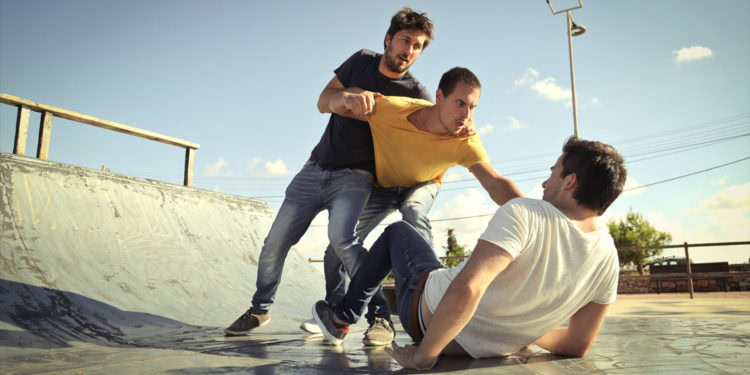

Across the Netherlands, South Africa, and the United Kingdom, national closed-circuit television (CCTV) data revealed that in 9 out of 10 public conflicts, at least one bystander, but more often several, will intervene to help. This research was published in the scientific journal American Psychologist.
A long tradition of psychological research provides evidence for the “bystander effect” – a phenomenon which describes bystander presence inspiring a diffusion of responsibility among individuals and constraining their motivation to intervene in emergency situations.
Traditionally, researchers have explored an individuals’ likelihood to intervene in the presence of others, rather than the aggregate likelihood that at least one person present at a conflict will intervene to help out. As well, most studies have utilized experimental designs and simulated emergency scenarios, rather than studying actual conflicts in the real-world.
In this work, Richard Philpot and colleagues gathered video surveillance data of public space conflicts in the urban areas of Amsterdam (Netherlands), Cape Town (South Africa), and Lancaster (United Kingdom). A total of 219 videos of aggressive incidents were included in the final dataset.
Trained research assistants coded the videos across various dimensions, such as the number of bystanders present, the number of interveners, and the duration of conflicts. A bystander was considered an intervener if they tried to placate the conflict through pacifying gestures, calming touches, blocking contact between conflict parties, holding, pushing or pulling an aggressor away, or providing help to a physically harmed victim.
Contrary to conventional wisdom, results revealed that at least one bystander intervened in approximately 91% of situations, with an average of 3.76 individuals intervening per video. This pattern was consistent across all three national contexts. Further, the number of bystanders present at a conflict was positively associated with the aggregate likelihood of someone intervening.
In other words, each additional bystander increased the odds of the victim receiving help from someone. The results of this study challenge the popular view that bystanders remain uninvolved during public emergencies.
The researchers suggest that we ought to leave behind the question of “why don’t individuals help?” and instead start asking, “what makes intervention successful?”
While these findings are promising, the researchers note three potential limitations. First, the behavioral definition of “bystander intervention” (e.g., calming touches), could be considered too inclusive. Second, the data was collected from inner-city areas which had a higher density of restaurants, bars, and nightclubs. As such, one plausibility is that a proportion of bystanders had consumed alcohol, which could have affected their risk assessment prior to intervening. Lastly, given the correlational design, the authors maintain caution in drawing causal inferences about the relations between bystander intervention, number of bystanders, and national context.
The study, “Would I be helped? Cross-national CCTV footage shows that intervention is the norm in public conflicts”, was authored by Richard Philpot, Lasse Suonperä Liebst, Mark Levine, Wim Bernasco, and Marie Rosenkrantz Lindegaard.