Visual functions, such as the perception of motion direction, start to develop soon after birth and continue to mature over time as infants gain more experience with the world. However, direct evidence of how this maturation process unfolds in the brain has been lacking because there has been no functional imaging study testing very young infants while awake and visually engaged.
A new study publishing in the Open Access journal PLOS Biology on September 29th provides for the first time a direct window into the maturation of vision-related areas of the cortex in the first weeks of life, showing that the visual brain of 7-week-old babies is surprisingly mature.
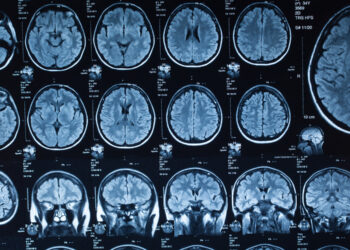
Maria Concetta Morrone of the IRCCS Stella Maris Foundation and the University of Pisa and her colleagues used functional magnetic resonance imaging (fMRI) to record brain activity in awake 7-week-olds while they were visually engaged and also during sleep. The authors provide the first maps of visual cortical function in human infants, shedding new light on neural plasticity very early in life: Unexpectedly, they find that the associative regions of the cortex responsible for motion processing respond similarly in 7-week-olds and adults. What seems to be lagging at this early age is the development of functional connections between these associative areas and the primary visual cortex, the major cortical target of visual input in adults.
Testing very young babies in an fMRI scanner while they’re awake and observing a screen is a huge challenge. This is the first fMRI study to overcome the technical difficulties of recording responses to visual stimuli in alert, cooperative infants. “To encourage infants to watch the visual stimulus, we made the stimulus very salient for that age, and reassured them by keeping them in the arms of the experimenter during the scan. They happily looked at the stimuli for long enough to yield reliable data acquisition. A vertical scan that could accommodate the mother with the infant on her lap would greatly facilitate the acquisition of these data, but these types of scanners are not yet available”, says Morrone.
In a first fMRI experiment, the team recorded brain activity in twelve 7-week-olds while they viewed dot patterns that moved either randomly or in coherent trajectories. The researchers found that, just like adults, babies showed greater responses to coherent motion compared to random motion in an extensive network of brain regions, including in areas associated with the perception of body-motion. “The similar activity of these regions in infants and adults suggests that infants may have a sense of vection and hence a sense of body position”, say the researchers.
In a follow-up fMRI experiment, Morrone and her team tested nine of the same infants while they were asleep. When they analysed activity patterns in the motion-sensitive regions identified in the first experiment, they found many similarities between infants and adults but also some notable differences: the patterns of correlation between some regions were different in infants compared with adults; in particular, primary visual cortex showed immature connectivity patterns.
Taken together, the findings show that the major areas serving motion processing in adults are operative by seven weeks of age. Perhaps most surprising is the evidence that infants at that age appear to be able to sense their own body position.
The findings may ultimately have important clinical implications, according to the authors. Vision is impaired in many neurodevelopmental disorders, such as autism and cerebral palsy. Studies such as this provide much needed knowledge about the precise location of different visual areas in the infant brain and the extent of their maturation, which can then guide clinicians in the effort to select appropriate rehabilitation strategies in appropriate time-windows.