PsyPost
  • Mental Health
  • Social Psychology
  • Cognitive Science
  • Neuroscience
  • About
No Result
View All Result
Join
My Account
PsyPost
No Result
View All Result
Home Exclusive Social Psychology

Building an other-minded society: Musical interaction cultivates empathy in children

by Eric W. Dolan
July 24, 2013
Reading Time: 2 mins read
Share on TwitterShare on Facebook

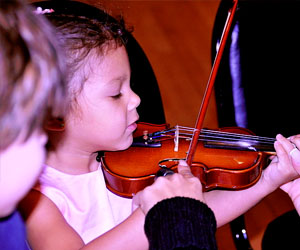
Photo of a child learning to play the violin by the Knight FoundationSchools could one day add “empathy education” to their curriculum. New research suggests that understanding the emotional state of others is something that can be learned and practiced.

According to a study published in the July issue of Psychology of Music, playing musical games can help cultivate a sense of empathy in children.

“Perhaps the most important thing the study tells us about the development of emotional empathy is that it is amenable to intervention,” Tal-Chen Rabinowitch of the University of Cambridge, the lead author of the study, told PsyPost. “We now have the (very friendly and enjoyable) tools to influence and enhance emotional empathy in children, a significant building block for shaping a more empathic and other-minded society.”

The study was co-authored by Ian Cross and Pamela Burnard of the University of Cambridge.

For their study, the researchers ran a musical program over the length of an entire school year. Children ages 8-11 participated in the program in several small groups. The program was comprised of various musical games, which were based on previous studies that uncovered the specific elements in musical group interaction that promoted empathy.

“What is special about musical interaction is that it relies on a remarkably rich and intense blend of social, cognitive and emotional skills that appear to be also important for emotional empathy (e.g. imitation, entrainment, unarticulated communication, etc.),” Rabinowitch explained. “We believe that this is not mere chance, but that it is the product of what we hypothesize to have been a co-evolution of music and social structure. This being said, there are of course other forms of interaction that may also positively impact empathy, but music seems to stand out.”

The researchers also established two control groups. One group participated in a program similar to the musical program, which included various games but no musical interaction. The second group of children didn’t participate in any program.

Rabinowitch and her colleagues measured the children’s emotional empathy before and after the study. They found a substantial increase in empathy scores following the musical program. In addition, the children in the musical program had higher average scores compared children in the control groups at the end of the study.

Google News Preferences Add PsyPost to your preferred sources

“As for caveats, in this type of study it is very difficult to control for experimenter bias,” Rabinowitch told PsyPost. “Although the actual scoring for emotional empathy was completely computerized and automatic, the musical and control interaction sessions were mediated by me. One might argue that, in principle, I could have somehow subconsciously induced more empathy in the music group compared to the control games group (it should be noted though that empathy or anything to do with it were never explicitly discussed with the children).”

“But on the other hand, this allowed me direct access to the various group dynamics and also rendered the music and control interventions more comparable, since the children from both groups met with the same mediator. In any case, we plan in the future to run a much larger scale study including specially trained mediators.”

TweetSendScanShareSendPinShareShareShareShareShare

Follow PsyPost

The latest research, however you prefer to read it.

Daily newsletter

One email a day. The newest research, nothing else.

Google News

Get PsyPost stories in your Google News feed.

Add PsyPost to Google News
RSS feed

Use your favorite reader.

Copy RSS URL
Social media
Support independent science journalism

Ad-free reading, full archives, and weekly deep dives for members.

Become a member

Trending

  • A specific thinking style explains why dark personality traits are linked to creativity
  • Adolescent narcissism brings brief popularity but not likeability among peers, study finds
  • A 20-minute workout protects memory after sleep loss just as well as a 90-minute nap
  • How personality and social context shape adolescent loneliness
  • Weightlifting offers large antidepressant effects for young women with anxiety, regardless of intensity

Science of Money

  • Why highly adaptable business clients aren’t always the most satisfied
  • The four ways underdog startups survive corporate giants
  • How AI-generated plain English changes investor interest in mutual funds
  • What 18 years of brokerage data reveals about selling losing stocks
  • When edgy brands meet manipulative consumers: The backfire effect of dark personalities

Recent

  • Researchers launch global tracking project to measure the daily mental health impacts of cannabis
  • New study challenges the core assumption behind the world’s most widely used implicit bias test
  • Common antidepressants might help liver cells clear a dangerous type of cholesterol
  • Massive study of over a million people identifies hundreds of genetic variants linked to personality
  • A child’s genetic profile for ADHD can predict their parents’ risk of separation
  • Universal two-child policy linked to increased depression among Chinese women
  • Are gender differences really power differences? Large-scale analysis finds strong behavioral parallels
  • Body roundness index linked to depression risk in older adults with dementia
  • A specific thinking style explains why dark personality traits are linked to creativity
  • Private touch matters more than public affection for relationship quality

PsyPost is a psychology and neuroscience news website dedicated to reporting the latest research on human behavior, cognition, and society. (READ MORE...)

  • Mental Health
  • Neuroimaging
  • Personality Psychology
  • Social Psychology
  • Artificial Intelligence
  • Cognitive Science
  • Psychopharmacology
  • Contact us
  • Disclaimer
  • Privacy policy
  • Terms and conditions

(c) PsyPost Media Inc

Welcome Back!

Login to your account below

Forgotten Password?

Retrieve your password

Please enter your username or email address to reset your password.

Log In

Add New Playlist

Subscribe
  • My Account
  • Cognitive Science Research
  • Mental Health Research
  • Social Psychology Research
  • Drug Research
  • Relationship Research
  • About PsyPost
  • Contact
  • Privacy Policy

(c) PsyPost Media Inc