Subscribe
The latest psychology and neuroscience discoveries.
My Account
  • Mental Health
  • Social Psychology
  • Cognitive Science
  • Neuroscience
  • About
No Result
View All Result
PsyPost
PsyPost
No Result
View All Result
Home Exclusive Cognitive Science

Melodic alarm clock sounds appear to counteract sleep inertia

by Eric W. Dolan
February 20, 2020
in Cognitive Science
Share on TwitterShare on Facebook

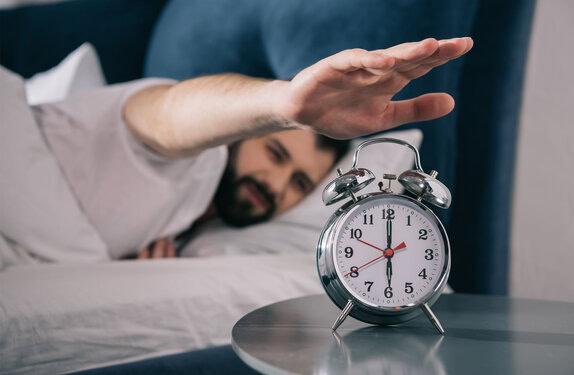
People with melodic alarms experience reduced levels of morning grogginess, according to preliminary research published in PLOS One. The findings provide new insights into how to lessen the impairment in performance that is often experienced upon waking from sleep.

“Through our research in auditory perception, cognition and sleep inertia (morning grogginess) it became apparent that although auditory alarms are a common method for awakening people, knowledge for the effectiveness of these stimuli on cognition post awakening was very slim,” explained Stuart McFarlane, the lead author of the study and a doctoral researcher at the Royal Melbourne Institute of Technology.

“Considering that sleep inertia inhibits human performance after waking, and that most digital devices today are capable of playing complex and easily accessible audio, we thought it was a particularly relevant topic that required more attention. In sum, this research is focused on the improvement of waking sound stimuli for the reduction of sleep inertia.”

In the study, 50 participants completed an online survey that allowed them to remotely log the type of sound they used to wake up, and then rated their grogginess and alertness levels.

The researchers found that alarm sounds rated as melodic were associated with lower levels of sleep inertia compared to sounds rated as unmelodic, somewhat unmelodic, neither unmelodic nor melodic, and very melodic.

“We think that a harsh ‘beep beep beep’ might work to disrupt or confuse our brain activity when waking, while a more melodic sound like the Beach Boys ‘Good Vibrations’ or The Cure’s ‘Close to Me’ may help us transition to a waking state in a more effective way,” said co-author Adrian Dyer.

The findings could have important implications for anyone who needs to perform safety-critical tasks soon after waking.

“People need to be aware of sleep inertia’s negative effects on human performance after waking up. The grogginess we may feel during this phase typically lasts for up to 30 minutes, however, periods from 2 to 4 hours have also been reported,” McFarlane told PsyPost.

Google News Preferences Add PsyPost to your preferred sources

“Not everyone will experience the full impacts, but for those that do, care should be taken when performing tasks that require peak performance within this period. This may include emergency responders, aircraft pilots, or people that have to drive in unforeseen circumstances. If we can counteract the symptoms of sleep inertia by any measure through the alarm sounds we use, it would be a great benefit to many. In this first study, we have found evidence that alarms perceived as melodic may be a factor to consider in reducing symptoms of sleep inertia.”

But there is still much to learn about the relationship between auditory alarms and sleep inertia.

“This study is the initial stage of ongoing research in a very complex field. The current results should be considered as positive reference points that we are utilizing to focus our research efforts moving forward. Our primary goal at this stage is to research and report results that have been derived from ecological conditions. The ultimate goal would be to take what we find and perform larger scale, controlled laboratory studies to clarify our understandings of this research area,” McFarlane explained.

“We are continuing to focus our research on the effects alarm sounds have on sleep inertia, and hope to share our results with the wider community in the near future.”

The study, “Alarm tones, music and their elements: Analysis of reported waking sounds to counteract sleep inertia“, was authored by Stuart J. McFarlane, Jair E. Garcia, Darrin S. Verhagen, and Adrian G. Dyer.

Previous Post

Perceptions of power may play an important role in the romantic relationships of narcissists

Next Post

Study finds rejected advances — but not accepted ones — influence our romantic standards

RELATED

Genetic factors likely confound the link between c-sections and offspring mental health
Cognitive Science

Neuroscientists just upended our understanding of Pavlovian learning

March 21, 2026
Your music playlist might reveal subtle clues about your intelligence
Cognitive Science

New neuroimaging study maps the brain networks behind scientific creative thinking

March 19, 2026
Your music playlist might reveal subtle clues about your intelligence
Cognitive Science

Your music playlist might reveal subtle clues about your intelligence

March 19, 2026
The psychological reason we judge groups much more harshly than individuals
Cognitive Science

First test of a new neuroscience theory shows how smart brains coordinate information

March 18, 2026
New psychology research identifies a key factor behind support for harsh leaders
Cognitive Science

New psychology research reveals the cognitive cost of smartphone notifications

March 18, 2026
Actively open-minded thinking protects against political extremism better than liberal ideology
Cognitive Science

Outdoor athletes show superior color detection in their peripheral vision

March 17, 2026
Actively open-minded thinking protects against political extremism better than liberal ideology
Cognitive Science

Actively open-minded thinking protects against political extremism better than liberal ideology

March 17, 2026
The disturbing impact of exposure to 8 minutes of TikTok videos revealed in new study
Cognitive Science

Excessive TikTok use is linked to social anxiety and daily cognitive errors

March 16, 2026

STAY CONNECTED

RSS Psychology of Selling

  • When saying sorry with a small discount actually makes things worse
  • How dark and light personality traits relate to business owner well-being
  • Why mobile game fail ads make you want to download the app
  • The science of sound reduplication and cuteness in product branding
  • How consumers react to wait time predictions from humans versus AI chatbots

LATEST

Primary dysmenorrhea: Severe menstrual pain is associated with lower cognitive and daily functioning

Neuroscientists just upended our understanding of Pavlovian learning

Poor sleep quality, not duration, linked to slower daily brain function in older adults

Happier people live longer, even in cultures that value emotional restraint

Why a widely disliked personality trait might actually protect your mental health

New research reveals why storytelling works better than bullet points in online dating

News chatbots that present multiple viewpoints tend to earn the trust of conspiracy believers

New study finds link between receptivity to “corporate bullshit” and weaker leadership skills

PsyPost is a psychology and neuroscience news website dedicated to reporting the latest research on human behavior, cognition, and society. (READ MORE...)

  • Mental Health
  • Neuroimaging
  • Personality Psychology
  • Social Psychology
  • Artificial Intelligence
  • Cognitive Science
  • Psychopharmacology
  • Contact us
  • Disclaimer
  • Privacy policy
  • Terms and conditions
  • Do not sell my personal information

(c) PsyPost Media Inc

Welcome Back!

Login to your account below

Forgotten Password?

Retrieve your password

Please enter your username or email address to reset your password.

Log In

Add New Playlist

Subscribe
  • My Account
  • Cognitive Science Research
  • Mental Health Research
  • Social Psychology Research
  • Drug Research
  • Relationship Research
  • About PsyPost
  • Contact
  • Privacy Policy

(c) PsyPost Media Inc