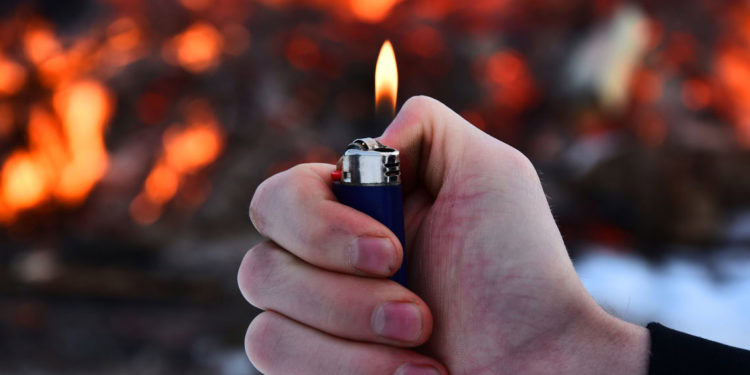

Psychopathy might be linked to pyromania. According to a new study published in Frontiers in Psychology, people with certain “dark” personality traits show a heightened interest in fire. The study examined a cluster of antisocial characteristics known as the Dark Tetrad.
There are four personality traits that make up the Dark Tetrad. They are narcissism, Machiavellianism, psychopathy, and sadism. Individuals who exhibit these traits tend to be manipulative, callous, and selfish. They often lack empathy and have a disregard for other people’s feelings. What’s more, they tend to be aggressive and take pleasure in causing pain.
Not surprisingly, people with Dark Tetrad personality traits are more likely to engage in criminal behavior. This led Caroline Wehner and her colleagues at Medical School Hamburg and Humboldt University of Berlin to wonder whether these traits were associated with the fascination with fire and the intentional act of setting a fire.
“Fire has always played an important role in humanity, either as a source of warmth and light, a means for cooking in traditional societies, or as a marker for social events and a source for entertainment in Western countries,” Wehner and her colleagues wrote.
“However, tragic cases like the recent wildfires in California and Greece or the Notre-Dame fire in 2019 also bring the destructive potential of fire to the public consciousness. When used deliberately or by accident fire causes severe damages to both humans and property… Due to this destructive potential, it is necessary to explore fire setting behavior and investigate which factors lead an individual to it.”
For their study, the researchers examined a sample of 222 psychology and medical students from German universities. The participants were presented with various fire-related situations (such as “Watching a house burn down” and “Watching a bonfire outdoors”) and were asked to rate how they would feel in each situation on a 7-point scale, which ranged from “most upsetting/absolutely horrible” (1) through “OK. doesn’t bother me” (4) to “very exciting. lovely, very nice” (7). The participants were also asked whether they had ever set a fire outside of socially accepted situations.
Psychopathy and direct physical sadism were positively correlated with fire interest and fire setting. In other words, those who agreed with statements such as “Payback needs to be quick and nasty” and “I enjoy physically hurting people” tended to exhibit heightened levels of fire interest and were more likely to report having set a fire. Importantly, these associations remained significant even after controlling for sensation seeking.
Machiavellianism was also positively correlated with fire interest, but this correlation was no longer statistically significant after the other variables were accounted for. Narcissism, on the other hand, was negatively associated with fire interest.
“Knowledge on the origins of fire interest and fire setting is relatively little, however, multiple factors such as childhood experiences or human evolution that led to cognitive patterns surrounding fire may play a role. Fire setting and fire interest have been hypothesized to be influenced by personality traits such as impulsivity and thrill-seeking. Our study indicates that, in a non-clinical sample, psychopathy and direct physical sadism could be a new addition to these factors improving the understanding of fire interest and fire setting,” the researchers concluded.
“The other constructs of the Dark Tetrad and sensation seeking do not seem to play an important role in the prediction of fire setting and fire interest beyond psychopathy and sadism. Finally, these results further strengthen the notion of separability between psychopathy and Machiavellianism.”
The study, “Bringing Light Into the Dark: Associations of Fire Interest and Fire Setting With the Dark Tetrad“, was authored by Caroline Wehner, Matthias Ziegler, Simon Kirchhof, and Lena Lämmle.