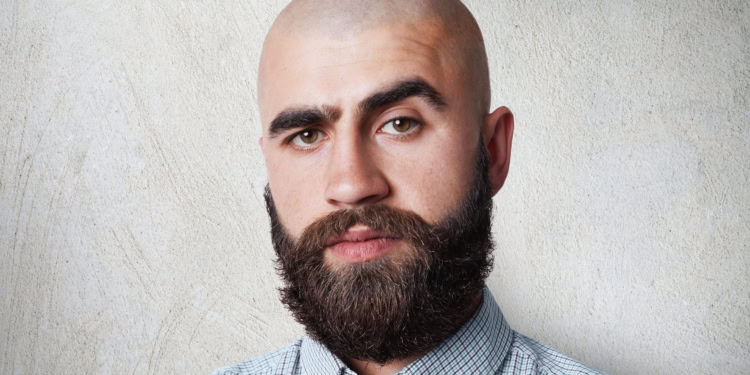
Women rate bald men as less attractive both physically and socially than men with hair. However, when character information is available, bald men are only rated as less physically attractive than their counterparts and not socially. This finding comes from a study published in Experimental Psychology.
A full head of hair is considered ideal when it comes to beauty standards. Social psychology research has identified something called the physical attractiveness stereotype (PAS), which refers to the tendency of people to believe that what is beautiful is good. If this is true, it should follow that women judge bald men as less attractive both physically and socially than nonbald men. However, findings on the subject are mixed.
A new study offers a possible explanation for these inconsistent findings. Researchers propose that the physical attractiveness stereotype can be activated implicitly, while not being applied at the behavioral level. They suggest that while bald men should still be rated as less physically attractive at the subconscious level, there may be a “hidden conflict” preventing people from rating them as less socially attractive at the explicit level. Specifically, they suggest that having access to information about a bald man might suppress the physical attractiveness stereotype.
Researchers carried out three experiments. The first one involved 106 women with an average age of 21 years, who were separated into two groups. Subjects were shown black and white images created using facial composite software, depicting men who were either bald or with hair. One group was given a character description pertaining to each man, and the other group was not. Descriptions included both positive and negative aspects and were balanced across conditions. Both groups rated the physical and social attractiveness of the men.
Results showed that the women who were only provided images of the men showed activation of the physical attractiveness stereotype, rating the bald men as less attractive both physically and socially than the men with hair. By contrast, the women who were given character descriptions of the men (along with their images) rated the bald men as less physically attractive than the nonbald men, but not as less socially attractive.
The second experiment looked at the implicit activation of stereotypes. For this one, 50 female university students completed an implicit association task where they had to correctly categorize faces and trait words while their response times were measured. Results showed that response times were faster and also more correct when bald targets were paired with negative social attributes and nonbald targets were associated with positive social attributes, compared to the opposite combinations. This shows evidence of the subconscious application of the physical attractiveness stereotype.
A final experiment involved 116 women of an average of 22 years who were shown two face portraits, one of a bald man and one of a man with hair. They were also given character descriptions of each man. Participants then completed a source monitoring task that required them to recall information from the character descriptions and assign them to the correct portrait. Results showed that subjects had better memory for associations that paired negative social attributes with nonbald targets and positive social attributes with bald targets, when compared to the opposite associations. This, again, suggests the application of the physical attractiveness stereotype at the implicit level.
This report found robust evidence that the physical attractiveness stereotype is activated at the implicit level. What’s more, findings suggest that being given information about a target person eliminates the stereotype against male baldness at the explicit level.
Researchers conclude, “Apparently, learning more about the diverse personality aspects of a bald man remarkably increases his social attractiveness. This “bald but nice” finding might encourage balding men to accept their condition rather than to struggle against it”.
The study, “Bald and Bad? Experimental Evidence for a Dual-Process Account of Baldness Stereotyping”, was authored by Dirk Kranz, Lena Nadarevic, and Edgar Erdfelder.