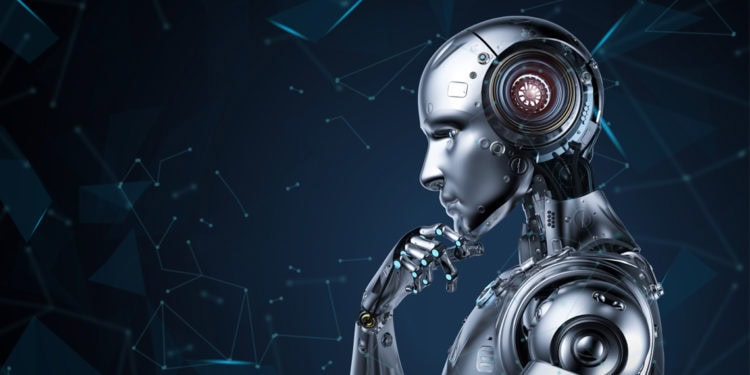
Humanoid robots have long been a staple of science fiction, but there is now real progress being made. A range of new models made by or backed by the likes of Boston Dynamics, Tesla and OpenAI are able to walk and move like humans, as well as perform feats of agility and dexterity.
But it’s the ability to incorporate artificial intelligence (AI) into these humanoid robots that could truly allow them to make the leap into everyday life. AI-enabled “brains” could help dramatically improve the ways that humanoid robots interact with humans and the outside world. This would give humanoid robots their “iPhone moment”, meaning they break through into the market in a big way.
Large language models, the technology behind AI chatbots like OpenAI’s ChatGPT, have shown they are good at learning from the vast amounts of data they are fed with and are good at selecting the right information and using it to reason with. They are the key to something called “embodied intelligence”.
Embodied intelligence refers to the integration of cognitive processes with physical actions, a bit like how our brains control our limbs. The aim of embodied intelligence is to enable robots to interact with the world in a similar manner to humans. This concept relies on large language models and visual AI systems to help computers make sense of objects in videos and pictures.
It establishes a machine logic about the relationships between the observer and the objects, and helps the robot understand how interactions could happen between them. LLMs alone wouldn’t be acting as the robot’s “brain” necessarily, but the technology could help improve how they generally interact with the world.
A good example is an AI system built by Google called PaLM-E. Engineers behind the development of PaLM-E trained it to directly ingest raw streams of robot sensor data. The resulting AI system allowed the robot to learn very effectively.
This field is advancing so quickly that by the time I finish writing this article, a new, innovative AI model or paradigm may be released. Advancements such as PaLM-E infuse humanoids with visual-spatial intelligence, allowing them to make sense of our world without requiring extensive programming.
From factories to homes
The potential applications of humanoid robots are vast and varied. Early modern research in humanoid robotics focused on developing robots to operate in extreme environments that are dangerous and difficult for human operators to access. These include Nasa’s Valkyrie robot, designed for space exploration. However, we will probably first see commercial humanoid robots deployed in controlled environments such as manufacturing.
Robots such as Tesla’s Optimus could revolutionise manufacturing and logistics by performing tasks that require precision and endurance. They could work alongside
human employees, enhancing productivity and safety.
For example, in a factory, Optimus could handle hazardous materials, perform quality control inspections, and assist in assembly processes. The new Boston Dynamics Atlas2, announced a few months ago, already demonstrates some use cases for use in factories, such as lifting and storing heavy components.
Beyond industrial applications, humanoid robots could also find a place in households. Imagine a future where Optimus helps with daily chores, such as cleaning, cooking, and even caring for the elderly.
Earlier this year, Stanford University’s Aloha robot went viral on the internet for demonstrating its ability to make Chinese food, load dishes into a dishwasher, prepare beds, and put laundry into the wardrobe on its own. Eventually, we may see humanoids deployed in more professional areas such as hospitals for care roles or in public security, requiring professional domain knowledge and high public acceptance.
Market viability
While the technological potential of humanoid robots is undeniable, the market viability of such products remains uncertain. Several factors will influence their acceptance and success, including cost, reliability, and public perception.
Historically, the adoption of new technologies often faces hurdles related to consumer trust and affordability. For Tesla’s Optimus to succeed commercially, it must not only prove its technical capabilities but also demonstrate tangible benefits that outweigh its costs.
There are ethical considerations too. For instance, who has access to all the data collected by the robot as they interact with humans, sometimes in what could be deeply private moments? There is also the potential for humanoid robots to displace jobs, such as in the elderly care sector where they could have a key role.
These ethical factors will play a critical role in shaping public opinion and regulatory frameworks. Science fiction author Isaac Asimov drafted Three Laws of Robotics for humans to interact with robots effectively. In abridged form, they stipulate that a robot may not injure a human being, that a robot must obey orders given it by human beings and that a robot must protect its own existence as long this doesn’t clash with the first or second law.
These laws may still be relevant, as current debates extend beyond just humanoid robots to include any high-level autonomous systems that could pose societal risks and cybersecurity issues.
But it’s important to remember that current AI is still far from the real intelligence we are familiar with, so the scenarios depicted in movies like AI: Artificial Intelligence, directed by Steven Spielberg, or I, Robot, starring Will Smith, are unlikely to happen anytime soon.
We need experts from various fields, including robotics, ethics and economics, to weigh in on the development of humanoid robots. Their insights will be crucial in navigating the challenges and opportunities presented by the technology.
As we stand on the brink of this new technological frontier, it is essential to consider not only what is possible but also what is desirable for our collective future. Meanwhile, as I watch my garden’s grass grow steadily upwards, all I can think about is having a humanoid robot trim it – after it has made me a relaxing cup of tea.
This article is republished from The Conversation under a Creative Commons license. Read the original article.