Subscribe
The latest psychology and neuroscience discoveries.
My Account
  • Mental Health
  • Social Psychology
  • Cognitive Science
  • Neuroscience
  • About
No Result
View All Result
PsyPost
PsyPost
No Result
View All Result
Home Exclusive Cognitive Science

Conceptual representation: Researchers use brain imaging to read minds

by Radboud University Nijmegen
April 19, 2014
in Cognitive Science
Photo credit: NIMH

Photo credit: NIMH

Share on TwitterShare on Facebook

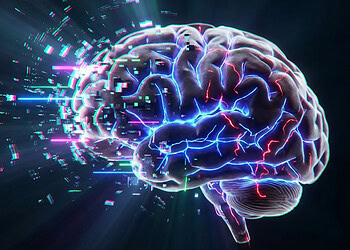
Your measured brain signals can reveal whether you are thinking about an animal or a tool. That’s what neuroscientist Irina Simanova discovered during her PhD at Radboud University, where she investigated the conceptual representation of words and objects in the human brain. This knowledge is useful for the development of tools that convert brain signals into speech.

Our memory for word meaning is compartmentalised. When you think of a non-living object like a tool, a specific population of neural cells becomes active. In contrast, when you think of something living, such as an animal, that thought is processed by a different set of neurons. Irina Simanova’s examination of the neural networks behind this categorisation offers insight into how we perceive objects, understand words, and produce language.

Cat

Using EEG and fMRI, Simanova was the first to investigate whether the same neurons process different representations of one object – an image of a cat and the word ‘cat’. This proved to be true.

‘This shows that there is a common neural component for images and words within one category’, Simanova explains. ‘That is interesting knowledge for scientists who develop tools to convert brain signals into speech.’

Predicting speech

She also tried to predict the category of a word that the test subject still had to pronounce by using magnetoencephalography (MEG), a technique that makes it possible to track the brain signal accurately in time. She succeeded in approximately 65 percent of the cases.

‘A nice result, especially because this was such an explorative study. Of course, ideally we aim for 100-percent correct predictions.’ Her next step is to study more objects within a single category. ‘In the current study, we used very mainstream objects, for instance cats and dogs. Now I want to find out if the same principles apply for exotic species, like naked cats.’

Google News Preferences Add PsyPost to your preferred sources

Irina Simanova (Russia) studied Human and Brain Physiology at Moscow State University. She moved to Nijmegen for a job as a research assistant at the Max Planck Institute for Psycholinguistics. In 2009, she started her PhD project in the Neurobiology of Language research group.

She will defend her thesis on 12 May 2014, at Radboud University Nijmegen. Currently, Simanova is working as a postdoctoral researcher at the Donders Institute for Brain, Cognition and Behaviour of Radboud University, within the Language in Interaction programme. This programme received a 27.6 million euro Gravitation grant (Zwaartekrachtsubsidie) in 2012.

Previous Post

American Psychiatric Association’s DSM Task Force found to have major conflicts of interest

Next Post

‘Date at your own risk’: Coworkers perceptions of workplace romances

RELATED

Schemas help older adults compensate for age-related memory decline, study finds
Cognitive Science

Your body exhibits subtle physiological changes when you engage in self-deception

April 3, 2026
Psychotic delusions are evolving to incorporate smartphones and social media algorithms
Cognitive Science

Brain scans shed light on how short videos impair memory and alter neural pathways

April 3, 2026
Cannabis intoxication broadly impairs multiple memory types, new study shows
Cannabis

Cannabis intoxication broadly impairs multiple memory types, new study shows

April 3, 2026
ChatGPT acts as a “cognitive crutch” that weakens memory, new research suggests
Artificial Intelligence

ChatGPT acts as a “cognitive crutch” that weakens memory, new research suggests

March 30, 2026
Verbal IQ predicts political participation and liberal attitudes twice as strongly as performance IQ
Cognitive Science

Trying harder on an intelligence test does not actually improve your score

March 27, 2026
Brain rot and the crisis of deep thought in the age of social media
Cognitive Science

Massive analysis of longitudinal data links social media to poorer youth mental health

March 27, 2026
High meat consumption may protect against cognitive decline in people with a specific Alzheimer’s gene
Cognitive Science

Asking complex questions improves creative project scores but hurts multiple-choice exam grades

March 26, 2026
Chronic medical conditions predict childhood depression more strongly than social or family hardships
Cognitive Science

What brain waves reveal about people who can solve a Rubik’s Cube in seconds

March 24, 2026

STAY CONNECTED

RSS Psychology of Selling

  • The salesperson who competes against themselves may outperform the one trying to beat everyone else
  • When sales managers serve first, salespeople stay longer and sell more confidently
  • Emotional intelligence linked to better sales performance
  • When a goal-driven boss ignores relationships, manipulative employees may fight back
  • When salespeople fail to hit their targets, inner drive matters more than bonus checks

LATEST

Hostile sexism is linked to higher rates of social sabotage and gossip among young adults

Can a psychedelic journey change what you value most?

Family dynamics predict whether parents and children agree on choosing a romantic partner

Job seekers mask their emotions and act more analytical when evaluated by artificial intelligence

Your body exhibits subtle physiological changes when you engage in self-deception

The exact political location where conspiracy theories thrive

When made to feel sad, men with psychopathic traits shift their visual focus to anger

Different types of childhood maltreatment appear to uniquely shape human brain development

PsyPost is a psychology and neuroscience news website dedicated to reporting the latest research on human behavior, cognition, and society. (READ MORE...)

  • Mental Health
  • Neuroimaging
  • Personality Psychology
  • Social Psychology
  • Artificial Intelligence
  • Cognitive Science
  • Psychopharmacology
  • Contact us
  • Disclaimer
  • Privacy policy
  • Terms and conditions
  • Do not sell my personal information

(c) PsyPost Media Inc

Welcome Back!

Login to your account below

Forgotten Password?

Retrieve your password

Please enter your username or email address to reset your password.

Log In

Add New Playlist

Subscribe
  • My Account
  • Cognitive Science Research
  • Mental Health Research
  • Social Psychology Research
  • Drug Research
  • Relationship Research
  • About PsyPost
  • Contact
  • Privacy Policy

(c) PsyPost Media Inc