Psychiatrists in India have detailed the unusual case of a man whose heavy alcohol use led to a rare and distressing condition involving complex sexual and threatening hallucinations. This in-depth account, published in The Primary Care Companion for CNS Disorders, sheds light on a poorly understood phenomenon known as incubus syndrome, especially its appearance in male patients.
The condition, incubus syndrome, is named after a mythological demon believed to sexually assault women in their sleep, with its name stemming from a Latin verb meaning “to lie down upon.” Today, the phenomenon is understood not as a supernatural attack but as a complex type of sleep disorder known as a parasomnia.
The authors of the case report documented this particular instance because scientific literature on the syndrome is scarce. What little exists focuses primarily on women experiencing psychotic disorders like schizophrenia. Documented cases in men are exceedingly rare and often associated with substance use or neurological issues, making this report an important addition to the field. The experience is thought to arise from a dissociation of sleep phases, where elements of rapid-eye-movement sleep, the stage where most dreaming occurs, intrude into a state of wakefulness. This can produce intense, dream-like hallucinations that feel entirely real.
A 2022 study compared the prevalence of incubus phenomenon in two different groups: psychiatric inpatients and university students. Researchers found that the lifetime rates of experiencing the syndrome were surprisingly similar between the patients (12%) and the students (9%).
However, the episodes were reported as being more severe and recurring more frequently in the patient group, where every person who had sleep paralysis also experienced the incubus phenomenon. The study also noted that in both groups, individuals from non-Western European backgrounds were more likely to report these experiences, suggesting that cultural familiarity with the concept may play a significant role.
The patient at the center of the new report was a 36-year-old man who arrived at a psychiatry emergency service seeking help for a three-day period of perceptual disturbances, unusual bodily sensations, and an inability to sleep. He had a history of alcohol dependence that began in his teenage years and had progressed to a daily consumption of about half a liter of brandy. His family had noticed a recent change in his behavior; he had reduced his alcohol intake, but this was accompanied by increased fearfulness, disrupted sleep, and a new belief that ghosts were present. His last drink had been the day before he was admitted.
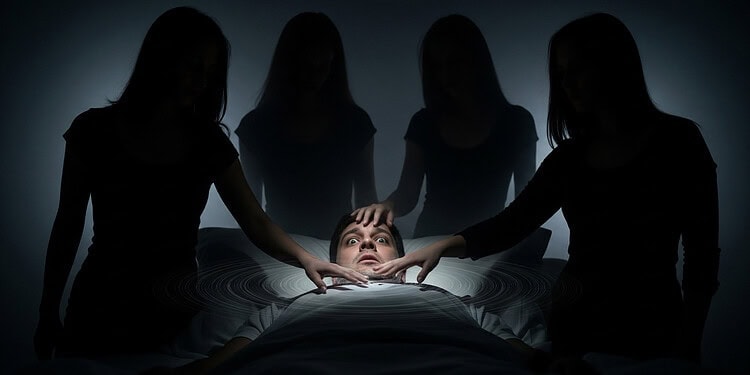
He described a complex and unsettling series of experiences to the medical staff. He reported feeling “vibrations” in his fingers, which he did not perceive as random. Instead, he believed these sensations were a form of communication from four women dressed in black. He had gone so far as to create his own alphabet chart, believing the figures were guiding his fingers to spell out responses to his questions. His hallucinations were not limited to touch. He also heard indistinct sounds, such as the noise of anklets, and had visual hallucinations of partially unclothed women.
These experiences occurred primarily at night. He claimed the figures would touch him and approach him sexually, which led to him experiencing orgasms. While these encounters were initially a source of pleasure for him, their nature soon shifted to become deeply distressing. He began to perceive threats from the figures. They made ominous statements to him, including the terrifying warning, “We will take you to the deathbed.” This escalation of fear prompted him to seek medical assistance.
Upon examination, the man was found to be anxious and was experiencing hallucinations across multiple sensory modalities, including sight, sound, and touch. He was alert and oriented to his surroundings and retained some awareness that his experiences might not be real, a state known as partial insight. A computed tomography scan of his brain showed no abnormalities. His blood tests were mostly normal, though they did reveal mildly elevated liver enzymes, a common finding in individuals with a long history of heavy alcohol consumption.
The medical team concluded that his symptoms were most likely a form of alcohol-induced psychotic disorder. This diagnosis was supported by the timing of the hallucinations, which began shortly after he reduced his chronic and heavy alcohol use. His condition was distinct from delirium tremens, a more severe form of alcohol withdrawal, because his consciousness was stable and he was fully oriented.
A primary psychotic disorder like schizophrenia was considered less probable because he had no personal or family history of psychiatric illness prior to this episode. The hallucinations were also not considered to be typical sleep-related phenomena, as they persisted outside of the moments of falling asleep or waking up.
The man’s treatment was centered on managing his alcohol withdrawal. He was given benzodiazepines, a class of medication commonly used to safely manage the symptoms of withdrawal, and his hallucinations resolved quickly. In addition to medication, he received supportive counseling and his family was educated about his condition to help prevent a relapse and improve his understanding of the illness.
Case reports like this one have specific limitations. Because they focus on a single person, their findings cannot be generalized to the broader population. The experience of this one man does not mean every person with alcohol dependence will develop similar symptoms. The details are specific to his biology, psychology, and life history.
However, case reports remain a fundamental tool in medicine and psychology for several reasons. They can be the first to identify and describe rare conditions or unusual presentations of more common ones. They provide rich, detailed narratives that can offer insights missed by large-scale statistical studies. For clinicians, these reports can raise awareness of uncommon diagnoses, helping them to recognize and treat similar cases they may encounter in their own practice.
For researchers, a compelling case report can generate new hypotheses and inspire further investigation into the mechanisms behind a particular illness. This specific report enriches the very limited collection of data on incubus syndrome in men, highlighting a potential link with alcohol withdrawal that warrants further study.
The report, “Incubus Syndrome in a Man With Alcohol Dependence,” was authored by Tanvi Mittal and Nishanth Jalaja Haridas.