New research published in Presidential Studies Quarterly provides evidence that racial resentment was a significant predictor of personal economic evaluations among white voters in 2012 and 2016. The findings suggest that how people judge their economic situation is not only influenced by partisan bias, but also by racial bias.
“My colleague, Dr. Angie Maxwell, and I were working on a larger project examining the evolution of politics in the South and how those fundamental changes continue to drive political outcomes across the entire country, including our current crises,” said study author Todd Shields, a political science professor at the University of Arkansas.
“That project resulted in, The Long Southern Strategy: How Chasing White Voters in the South Changed American Politics (Oxford University Press, 2019). We were surprised to find, among white Americans, that some of our most financially ‘well off’ participants in post-presidential election surveys in 2012 and 2016 also reported that their financial situation had gotten worse during the past year and they expected their financial situations to be even worse during the next year.”
“We wondered why white participants who were employed with a high family income would simultaneously report that they were ‘worse off’ and that they expected their financial situations would continue to decline,” Shields told PsyPost.
For their study, the researchers analyzed data from two nationwide Blair Center surveys, which included 7,274 respondents in total and were conducted about one week after the 2012 and 2016 presidential elections. They also examined data from 6,556 white Americans who participated in the 2012 or 2016 American National Election Studies.
Racial resentment was assessed by asking the respondents how much they agreed or disagreed with statements such as “Generations of slavery and discrimination have created conditions that make it difficult for blacks to work their way out of the lower class” and “It’s really a matter of some people not trying hard enough; if blacks would only try harder they could be just as well off as whites.”
All four surveys showed a similar pattern of results. In 2012, following the re-election of Barack Obama, those higher in racial resentment were more likely to say that their economic situation had declined over the past year and were less likely to believe that their economic situation would improve in the near future.
But in 2016, when Barack Obama was leaving the White House and Donald Trump was preparing to become president, racially resentful respondents were more likely to express optimistic economic outlooks compared to less racially resentful respondents.
This was true even after controlling for factors such as partisanship, ideology, income, unemployment, and approval of President Obama’s job performance.
“Political theorists, scholars of public opinion, and political observers argue that retrospective economic evaluations (What is your financial situation compared to a year ago?) and prospective economic evaluations (What do you think your financial situation will be a year from now?) are the basic evaluations citizens use to ‘reward or punish’ elected officials at the ballot box,” Shields told PsyPost.
“It is hoped that these economic evaluations are based on objective or ‘real’ personal economic considerations. What we find, however, is that at least during President Obama’s administration, some white participants’ economic evaluations were biased and based on their levels of racial resentment.”
“Despite controls for current economic standing, partisanship, ideology, and other alternative explanations, white respondents with substantial racial resentment were more pessimistic about their current and future economic outlooks. These findings suggest that in the 2012 and 2016 presidential elections, governmental representatives were unfairly evaluated and were ‘punished and rewarded’ not just on economic reality, but also on white Americans’ levels of racial resentment,” Shields explained.
“White respondents who expressed a great deal of racial resentment were more likely to view their economic situation in a negative light, despite their objective economic position, and despite controls for other influences.”
When it comes to the upcoming 2020 presidential election, the researchers believe a similar dynamic could be in effect.
“At this point, we are not sure if the presence of an African American president was a necessary condition to activate racial resentment and bias economic evaluations among whites in both the 2012 and 2016 presidential elections. While we currently do not have an African American in the White House, we are unfortunately experiencing significant racial tension across the country. It is possible that these racial tensions may activate racial resentment and bias evaluations among whites again during the upcoming presidential election,” Shields said.
The study, “Polls and Elections: Racial Resentment and Personal Economic Evaluations in the 2012 and 2016 Presidential Elections“, was authored by Todd Shields and Angie Maxwell.
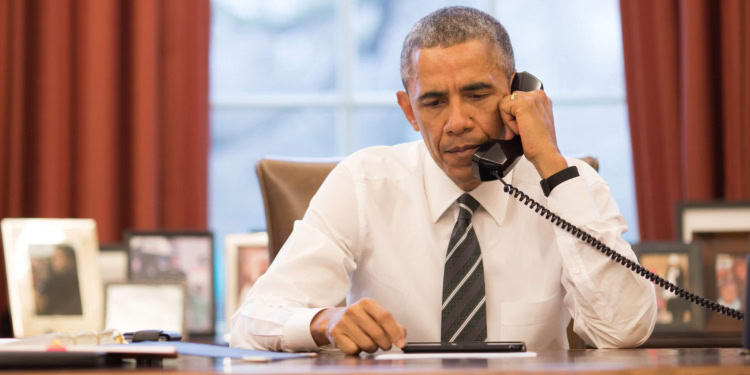
(Official White House photo by Pete Souza)