
A new study published in the Journal of Medicinal Chemistry suggests that a novel vaccine candidate can protect against fentanyl and its many illicit variants by training the immune system to recognize a broad molecular signature rather than a single specific structure. These findings provide evidence that next-generation drug vaccines could outpace the rapid development of synthetic designer opioids.
Fentanyl and related synthetic opioids are responsible for a massive number of overdose deaths globally. In high doses, these synthetic drugs rapidly cross into the brain and disrupt the neural signals that control breathing. Illicit drug manufacturers constantly alter the chemical structure of fentanyl to create new designer variants, which helps the drugs evade detection by law enforcement and outpace standard medical interventions.
“I think the value of this study is quite far reaching in that synthetic opioids are here to stay, heroin is basically dead,” said Kim D. Janda, a professor of chemistry and immunology and director of the Worm Institute of Research and Medicine at Scripps Research. “With this said, the government is going to continue to crack down on the synthetics, but because the costs of goods are so cheap ($800 will get you about 650k of a synthetic) the people selling the drugs are not going to give this line up but rather just keep tweaking the drugs structure to keep potency (give the best product to the buyer) but avoid the surveillance.”
Traditional medical countermeasures, including experimental vaccines, usually rely on the exact chemical structure of the original drug to teach the immune system what to target. This standard approach treats molecular recognition as highly dependent on mimicking the exact physical framework, or scaffold, of the target drug. The immune system typically creates antibodies that act like a specific key designed to fit a singular molecular lock.
Because the illegal drug landscape evolves so quickly, this traditional vaccine design has a built-in disadvantage. By the time a vaccine is formulated and tested for one specific variant, clandestine laboratories have often moved on to a newly tweaked version of the drug.
“The bottom line is the drug cartels/clandestine laboratories making these synthetics are always trying to skirt DEA surveillance by creating new analogues of fentanyl,” Janda noted. “Instead of continuously making a new vaccine for every variant, we created a vaccine that would allow the immune system to in a sense act like AI playing chess where each of their moves we would hope would create a checkmate with the immune system.”
The scientists behind this new research wanted to test a different hypothesis regarding how antibodies interact with small molecules. They proposed that the immune system might not need an exact replica of the target molecule to mount a successful defense. Instead, adaptive immunity might be able to recognize an entire drug class based on a shared spatial arrangement and chemical logic.
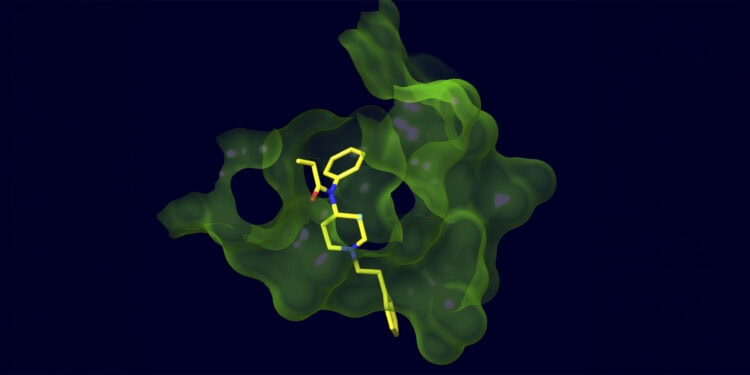
If this proved accurate, a structurally modified vaccine could potentially generate a flexible immune response capable of intercepting a wide variety of emerging synthetic opioids. To test this idea, the researchers created a completely new vaccine molecule. They started with the core framework of fentanyl but replaced a central ring-shaped component, known as a piperidine ring, with a different, more constrained chemical structure.
This chemical replacement radically changed the three-dimensional shape and presentation of the molecule. Even though the new molecule looked physically distinct from standard fentanyl, it retained some of the underlying spatial and electrical features common to the fentanyl drug class.
The scientists then attached this modified molecule, called a hapten, to a larger carrier protein to ensure it would provoke an immune response. A hapten is simply a small molecule that can only trigger an immune reaction when it is attached to a larger protein structure. The novel approach was not a guaranteed success.
“I think it surprised the students working on it,” Janda told PsyPost. “They did not think my idea would work.”
The authors evaluated their newly designed vaccine in female Swiss Webster mice. They assigned the animals into groups of six to ensure statistical reliability. One group received the structurally modified vaccine, another received a standard fentanyl-derived vaccine for direct comparison, and a third control group received only the carrier protein with no active drug molecule.
The vaccines were injected into the animals’ abdominal cavities across four doses spread over eight weeks, specifically at weeks zero, two, four, and eight. Blood samples were collected at weeks three, five, and nine to measure the level and type of antibodies the mice produced. The scientists then ran multiple tests to see how well the antibodies recognized and neutralized fentanyl and its diverse variants.
In test-tube laboratory assays, the blood serum from mice given the modified vaccine showed broad recognition of the fentanyl drug class. The antibodies successfully bound to fentanyl and several dangerous variants, including carfentanil, acetylfentanyl, and furanylfentanyl. At the same time, the antibodies completely ignored standard medical opioids like morphine, methadone, and oxycodone.
The researchers also tested the physical responses of the vaccinated mice by exposing them to escalating doses of fentanyl, ranging from 50 to 4,800 micrograms per kilogram of body weight. They measured pain responses using standard heated surface and tail-reflex tests. In the control group, mice showed strong drug effects at low doses, typically around 150 micrograms per kilogram.
The vaccinated mice required much higher doses to show similar effects, signaling that the circulating antibodies were successfully blocking the drug. For the mice with the modified vaccine, the required dose shifted up to between 1,400 and 1,800 micrograms per kilogram. This massive shift provides evidence that the non-traditional vaccine protected the animals just as well as the standard fentanyl-based vaccine.
To measure protection against the most dangerous effect of overdoses, the authors placed the mice in special observation chambers to monitor their breathing. Unvaccinated mice experienced a rapid and severe drop in breathing function within ten minutes of fentanyl exposure, plummeting to nearly 40 percent of their normal baseline. The vaccinated mice maintained normal breathing patterns throughout the entire 45-minute observation period, showing a high level of protection against respiratory failure.
Finally, the scientists measured the concentration of fentanyl in the animals’ blood and brain tissues exactly fifteen minutes after a controlled exposure. In the control group, brain fentanyl levels averaged 61.9 nanomolar, a measurement indicating the concentration of the drug present in the brain tissue. In the mice that received the modified vaccine, brain fentanyl levels dropped significantly to just 17.2 nanomolar.
At the same time, the amount of fentanyl in the bloodstream of the vaccinated mice increased dramatically, reaching 1,719 nanomolar compared to just 15 nanomolar in the control group. This massive shift in drug distribution indicates that the vaccine worked exactly as intended. The circulating antibodies trapped the fentanyl molecules in the blood, preventing them from crossing into the brain where they cause fatal respiratory depression.
A potential misinterpretation of this work is that such a vaccine acts as a cure for opioid addiction itself. This vaccine is designed solely to trap the drug in the bloodstream and prevent fatal overdoses, rather than addressing the neurological cravings or psychological components of substance use disorders. Janda highlighted this specific caveat regarding how the treatment fits into broader medical strategies.
“Vaccines are not a catch all per se to end substance abuse disorders, rather they are more like another tool in the medicinal playbook to try and prevent overdose/substance use disorders with these opioids,” Janda explained. It would serve as a biological safety net to prevent death rather than a standalone treatment for the underlying addiction.
Another limitation is that animal models do not always perfectly predict how the human immune system will respond to a newly introduced vaccine. The immune physiology of mice is distinct from humans, meaning the required dosing and overall efficacy might change during clinical translation. Future studies will likely need to test live-animal reactions to a wider array of synthetic variants to confirm universal protection.
Moving forward, the authors suggest that this molecular design platform could be expanded to target other highly changeable biological threats. The next scientific steps will involve refining the vaccine formulation and preparing for eventual clinical trials to evaluate safety in human subjects. However, rather than commercializing this specific vaccine, the research team opted for a different path.
“I put this work out there patent free to let anyone who has an interest in trying to curb addiction to have at it,” Janda noted. “I decided long ago I am not going to try and profit on other people’s miseries and misfortunes.”
The study, “Redefining Drug Immune Recognition: A Radically Reconfigured Molecular Architecture Enables Broad Fentanyl-Class Protection“, was authored by Arran W. Stewart, Lisa M. Eubanks, Bin Zhou, Rachel C. Steinhardt, and Kim D. Janda.