Subscribe
The latest psychology and neuroscience discoveries.
My Account
  • Mental Health
  • Social Psychology
  • Cognitive Science
  • Psychopharmacology
  • Neuroscience
  • About
No Result
View All Result
PsyPost
PsyPost
No Result
View All Result
Home Exclusive Cognitive Science

Smelling fear? Study provides evidence that chemosensory anxiety signals reduce trust and risk-taking in women

by Eric W. Dolan
September 12, 2021
in Cognitive Science
Share on TwitterShare on Facebook

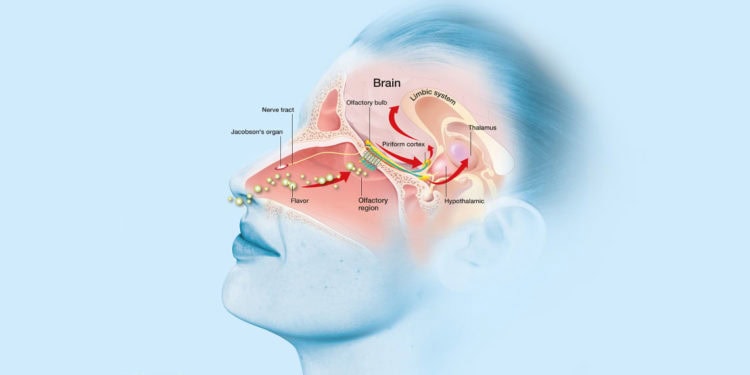
The odor of anxiety-induced body sweat can make women become more risk adverse and less trusting of others, according to new research published in the journal Biological Psychology. The new findings indicate that chemosensory anxiety signals can act contagiously but predominantly affect women.

Animals commonly use their sense of smell to detect predators and other threats in their environment. Recent findings have also provided evidence that stress can be communicated between individuals via chemosensory cues.

“Most intriguing for me is that people communicate their motivational and emotional state via sweat derived chemosignals, but without being conscious about this process. Meanwhile, we know a lot about the brains’ response to these chemosignals but much less about effects on overt behavior. That’s why this study was very important to me,” said study author Bettina M. Pause, a psychology professor at Heinrich-Heine-University DĂĽsseldorf.

The researchers conducted a series of five studies with 159 non-smoking women and 55 non-smoking men to examine whether chemosensory anxiety signals reduced trust and risk behavior.

An experimentally-verified task known as The Trust Game was used to measure trustworthiness. In the game, one participant is given a small amount of money and then chooses how much he or she wants to transfer to a fictional co-player (the trustee). Any amount of money that is invested is then tripled. The participants are told that the trustee will subsequently decide how much of this money to give back.

To assess the willingness to take risks, the researchers also used a variant of The Trust Game (known as The Risk Game) in which participants were told the co-player was a computer and the amount of money retransferred back to them after the initial investment would be random.

As they played through multiple trials of either game, the participants were exposed to various odors just before they had to decide how much money to invest. The odors included sweat that was collected from men experiencing anxiety during a Trier Social Stress Test and sweat collected from men during mild exercise. The participants wore a hospital oxygen mask that was hooked up to an olfactometer, allowing the researchers to precisely control the level of odor the participants were exposed to.

The researchers found that women tended to transfer less money after being exposed to chemosensory anxiety signals compared to the other odors. This was true even when the odor from anxiety-induced sweat was not consciously detectable.

“Anxiety states are communicated below the perceptual threshold through chemosensory signals derived from axillary sweat,” Pause told PsyPost. “Like in most other animal species, some emotions are probably transmitted contagiously. Thus, in women, the anxiety of the sender is transmitted to the perceiver via chemosignals. Experiencing anxiety reduces the intention for risky decisions, and therefore also the willingness to trust other individuals in bargaining situations.”

“It seems that men are less reactive to chemosensory anxiety signals,” Pause noted. However, men do not appear to be totally unresponsive. Previous research has found that the smell of putrescine, a chemical produced by decaying tissue of dead bodies, initiates threat management responses among both women and men.

Another study found that exposure to stress-induced chemosignals activated brain regions responsible for emotional processing, regardless of sex. “Here, fight-flight behavior seems to be activated through the chemosignals,” Pause said.

The study, “It’s trust or risk? Chemosensory anxiety signals affect bargaining in women“, was authored by Lukas Meister and Bettina M. Pause.


RELATED

Spacing math practice across multiple sessions improves students’ test scores and helps them accurately judge their learning
Cognitive Science

Boys and girls tend to use different strategies to solve math problems, new research shows

January 15, 2026
New research highlights the emotional and cognitive benefits of classical music ensembles for youth
Cognitive Science

Music training may buffer children against the academic toll of poverty

January 14, 2026
Children with autism show different patterns of attention during shared book reading, new study finds
Cognitive Science

Swapping screen time for books boosts language skills in preschoolers

January 14, 2026
Brain scan MRI images showing detailed views of brain structures for neurological and psychological research.
Cognitive Science

Scientists identify five distinct phases of brain structure across the human lifespan

January 13, 2026
Alcohol use disorder may exacerbate Alzheimer’s disease through shared genetic pathways
Memory

Random signals in support cells help cement long-term memories

January 10, 2026
Conservatives and liberals tend to engage in different evidence-gathering strategies
Cognitive Science

Conservatives and liberals tend to engage in different evidence-gathering strategies

January 9, 2026
Scientists find eating refined foods for just three days can impair memory in the aging brain
Cognitive Science

Scientists find eating refined foods for just three days can impair memory in the aging brain

January 8, 2026
Scientists identify a fat-derived hormone that drives the mood benefits of exercise
Artificial Intelligence

Conversational AI can increase false memory formation by injecting slight misinformation in conversations

January 7, 2026

PsyPost Merch

STAY CONNECTED

LATEST

Scientists show humans can “catch” fear from a breathing robot

Remaining single in your twenties is linked to lower life satisfaction

Neuroscientists find evidence meditation changes how fluid moves in the brain

Boys and girls tend to use different strategies to solve math problems, new research shows

Religious attendance linked to better mental health in older adults

How social status psychologically shapes racial bias in children

Childfree people are viewed as competent but lacking in warmth compared to parents

MIND diet may protect the brain by slowing biological aging

RSS Psychology of Selling

  • Researchers track how online shopping is related to stress
  • New study reveals why some powerful leaders admit mistakes while others double down
  • Study reveals the cycle of guilt and sadness that follows a FOMO impulse buy
  • Why good looks aren’t enough for virtual influencers
  • Eye-tracking data shows how nostalgic stories unlock brand memory
         
       
  • Contact us
  • Privacy policy
  • Terms and Conditions
[Do not sell my information]

Welcome Back!

Login to your account below

Forgotten Password?

Retrieve your password

Please enter your username or email address to reset your password.

Log In

Add New Playlist

Subscribe
  • My Account
  • Cognitive Science Research
  • Mental Health Research
  • Social Psychology Research
  • Drug Research
  • Relationship Research
  • About PsyPost
  • Contact
  • Privacy Policy