A new study sheds light on the role of religion and spirituality in violent intergroup conflict. The research found that people primed with thoughts of supernatural support had enhanced confidence prior to a paintball battle — and were more likely to view themselves as victors afterward.
The findings were recently published in the journal Human Nature.
“Religious conviction has been broadly associated with confidence and aggressiveness in the face of violent opposition in prior research. However, the great majority of studies investigating this relationship have relied on indirect laboratory or online methods,” said study author Colin Holbrook, an assistant professor of cognitive and information sciences at the University of California, Merced.
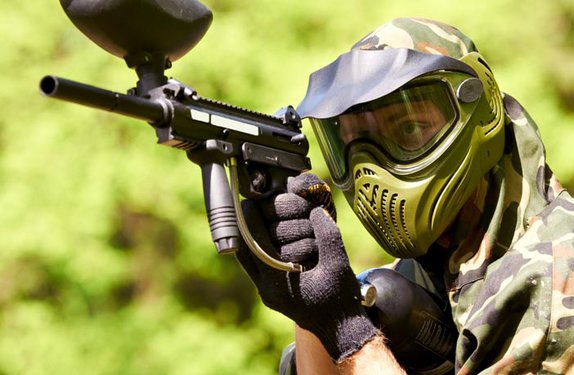
“In this experiment, my collaborators and I tested whether simulating group prayer for supernatural aid would increase battle confidence in a realistic model of violent group combat—team paintball.”
The researchers recruited 59 US paintball players and split them into four teams with about 15 members each. The teams competed in five-minute games of “Capture the Flag.”
Players were randomly assigned to one of two conditions: some completed a guided visualization exercise that evoked thoughts of supernatural support while others (the control group) completed a guided visualization exercise that involved imagining a tree. The players were led to believe that they were participating in a study about the effects of mental visualization on athletic performance.
(Listen to the God and the control visualization exercises below.)
The researchers found that those who listened to the supernatural visualization tended to report greater confidence in their team prior to the battle. The supernatural visualization was also associated with better assessments of their personal performance and their team’s performance after the match.
“We found that visualizing the presence of benevolent, powerful supernatural agents led paintball players to feel more confident in victory before their battle, and also to perceive their teams as having performed more skillfully when surveyed after the battle,” Holbrook told PsyPost.
“The comparison group in this study visualized positive nature imagery, indicating that the effect of the supernatural visualization cannot be explained by mere positive feelings.”
“These results accord with real-world observations of persons and groups possessed of religious faith engaging in risky, sometimes violent behavior, ranging from acts of heroism to acts of terrorism,” Holbrook said.
The study — like all research — includes some caveats.
“First, this study utilized a relatively small sample of paintball players and should be replicated — although it bears noting that many of the same results have since been conceptually replicated in a study which looked at simulated knife combat rather than paintball,” Holbrook explained.
“It is also not clear whether visualizing supernatural aid would comparably boost the confidence of committed atheists, or of people living in traditional cultures which lack beliefs in benevolent supernatural forces that are inclined to help you.”
“Probably the biggest unanswered question is whether visualizing supernatural support actually influences battle performance. Our participants rated themselves as having fought with greater skill than their enemies — it would be fascinating to determine whether this was an illusion or whether they actually did perform better during combat,” Holbrook noted.
He also emphasized that the research shouldn’t be misunderstood as suggesting that religion is good or bad.
“At first blush, some may reflexively interpret these results as taking a position against (or for) religious faith. For example, one can imagine readers thinking that linking religiosity with confidence in aggression implies that faith inherently promotes antisocial forms of violence,” Holbrook remarked.
“We — and the data — take no such position. Our findings equally pertain to aggressive acts of valor or slaughter insofar as either can be facilitated by perceptions of one’s group as in league with powerful spirits. We would also stress that, in many contexts, religious beliefs bolster pacifism, and that this, too, may be related to perceptions of oneself as supported by the supernatural.”
The study, “May God Guide Our Guns: Visualizing Supernatural Aid Heightens Team Confidence in a Paintball Battle Simulation“, was authored by Jeremy Pollack, Colin Holbrook, Daniel M. T. Fessler, Adam Maxwell Sparks, and James G. Zerbe.