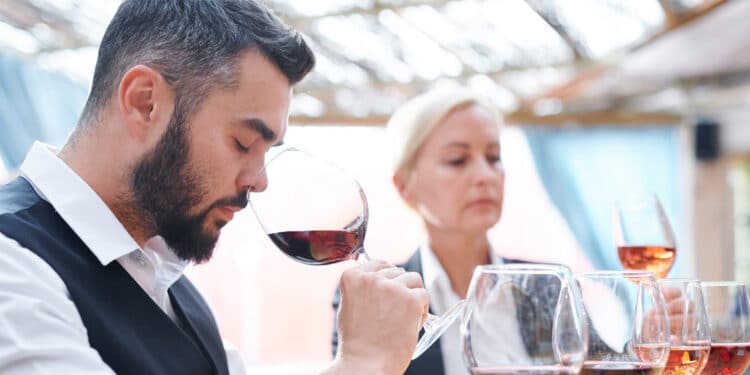

Language does not appear to play a causal role in recognition memory for wine odors, according to new research published in the Journal of Experimental Psychology: General. The results suggest that wine experts’ odor memory does not rely on their ability to name wine odors.
“In previous research, we found that wine expertise shapes the language for wines. We found wine experts are better at describing wine than coffee experts describing coffee,” explained study author Ilja Croijmans (@icroy), a postdoctoral researcher at Utrecht University and member of the Netherlands Olfactory Science Exchange.
“With the linguistic relativity hypothesis in mind, we wanted to explore the relationship between language and thought. Extreme versions of this hypothesis state that language is thought — no thinking without language. Less extreme versions state that language may shape thought, or that language directs attention which in turn shapes our thinking. We wanted to test whether there was a relationship between memory for wine (and other smells) and being able to describe wine.”
For their study, the researchers asked 48 participants to memorize a set of 24 odors, which included wine odors, wine-related odors, and common odors. Half of the participants were wine experts, and worked as vinologists, sommeliers or wine producers. The other half were novices.
Half of the participants were told to name the odor as quickly and precisely as possible after smelling it, while the other half were instructed to remain silent during the memorization task. To test their odor memory, the participants then smelled the original 24 odors again, along with 24 new odors. They were instructed to indicate whether they had in fact smelled an odor previously.
The researchers found that the wine experts were better at remembering wine odors compared to novices. However, being told to name the odors had no impact on wine experts’ performance.
“Experience shapes thought,” Croijmans told PsyPost. “Anyone can become better at things with enough practice. Even something that seems very difficult at first, like naming odors — something that most people struggle with or just don’t start with at all — can be improved with practice. Memory for a specific domain can similarly be improved with practice.”
But participants in the silent condition may have still named the odors covertly. To test for this, the researchers conducted a second experiment with another 146 participants, including 66 wine experts.
As in the first study, the participants were asked to memorize 10 wine odors and 10 common odors. However, to interfere with the verbal encoding of the odors, some of the participants were randomly assigned to a condition in which they had to keep a series of digits in working memory while smelling the odors.
Croijmans and his colleagues again found that the wine experts had better recognition memory for wine odors than the novices. But they found no evidence that the verbal interference task disrupted the wine experts’ recognition memory, providing more evidence that naming the odors does not improve memory.
However, that’s not to say that language has no relationship with wine expertise. The researchers noted that language could still play an important role in how wine experts acquire their ability to identify wine odors.
“We found no effect of language on memory, but we only tested a very narrow hypothesis: that semantic working memory is responsible for long term memory for wine. It is still possible that language shapes thought in other ways – it is hard to conceive of a way to train and practice without using language, for example,” Croijmans explained.
“Another thing is that we found that wine expertise is domain specific — wine experts have better language and memory but only for wine, not for other smells. But we don’t know what the boundaries of this effect are. Is a German Riesling expert still better at describing and remembering Californian Pinot Noirs? And if so, why? We don’t really know.”
“It’s really fun to work with wine and wine experts, especially if it gives you insights into how the human mind works,” Croijmans said.
The study, “Wine Experts’ Recognition of Wine Odors Is Not Verbally Mediated“, was authored by Ilja Croijmans, Artin Arshamian, Laura Speed, and Asifa Majid.