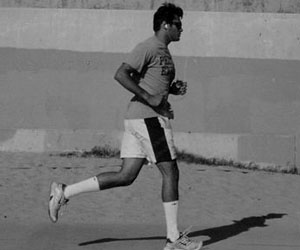
 People with Parkinson’s disease swing their arms asymmetrically — one arm swings less than the other — when walking. This unusual movement is easily detected early when drugs and other interventions may help slow the disease, according to Penn State researchers who used inexpensive accelerometers on the arms of Parkinson’s disease patients to measure arm swing.
“Scientists have known for some time that people with Parkinson’s disease exhibit reduced arm swing during the later stages of the disease, but no one had come up with an easy way to measure this,” said Stephen Piazza, associate professor of kinesiology. “We found that not only do people with the disease exhibit reduced arm swing, but they also exhibit asymmetric arm swing, and this asymmetric arm swing can easily be detected early in the disease’s progression.”
No cure for Parkinson’s disease exists, but according to Piazza, if taken early, certain drugs can improve some of the disease’s symptoms and even reduce the likelihood of death, making early diagnosis important. Some people also believe that changes in nutrition and other lifestyle factors can modify the progression of the disease.
The researchers attached inexpensive accelerometers to the arms of eight Parkinson’s disease patients who were in the early stages of the disease — within three years of clinical diagnosis. They also attached the accelerometers to the arms of eight age- and sex-matched people who did not have the disease. The team asked the subjects to walk continuously for about eight minutes at a comfortable pace. The researchers downloaded the acceleration data and used software they developed — that will be available free to interested doctors — to analyze it. They published their results in the current issue of Gait & Posture.
The scientists found significantly higher acceleration asymmetry, lower cross-correlation between the arms and reduced synchronization of the arms in the early Parkinson’s disease patients. According to Joseph Cusumano, professor of engineering science and mechanics, the lower cross-correlation and reduced synchronization suggest that the arm movements are poorly coordinated.
“In other words, if I measure the location of your right arm, it is difficult to use that measurement to predict the location of your left arm,” he said. “It is well known that Parkinson’s disease has an impact on how people move — neurologists have been using this fact as the basis for clinical examinations for a very, very long time — but here we are for the first time precisely quantifying how the disease not only affects the relative amount of limb movements, but also how well coordinated in time these movements are.”
To diagnose patients with Parkinson’s disease early, some doctors and scientists have proposed the use of a smell test, because people with the disease lose their ability to distinguish odors, according to Xuemei Huang, movement disorders physician, Penn State Milton S. Hershey Medical Center. “But conditions other than Parkinson’s disease also can affect a person’s ability to smell,” she said.
The Penn State team’s method of evaluating arm swing can be applied quickly and inexpensively by primary care physicians in their own offices when the smell test is inconclusive and before the application of an expensive brain scan.
“Measuring arm swing asymmetry and coordination with our method may be the cheapest and most effective way to detect Parkinson’s disease early in patients’ lives when it still is possible to treat the symptoms of the disease and to improve longevity,” said Piazza.
The scientists plan to further investigate whether the arm swing evaluation in combination with a smell test can enhance early diagnosis even more. They also plan to further develop their technique so that the accelerometers give immediate readings, which, they said, would save the extra step of downloading the data to a computer and analyzing it, thereby making the arm swing assessments of Parkinson’s disease even easier.
Penn State graduate students Joseph Mahoney, Mechelle Lewis and Guangwei Du also worked on this project.