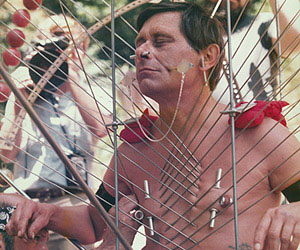
 Human beings in cultures across the world engage in extreme rituals that involve self-mutilation or enduring other types of suffering. Why do these extreme rituals — in which people willingly put themselves through harm — continue to persist?
A new study published online in Psychological Science suggests that such rituals promote social cohesion and charity. Anthropologists long suspected that extreme rituals enhanced prosocial behaviors, but that hypothesis lacked direct evidence — until now.
“We offer the first natural demonstration that suffering predicts prosociality by capitalizing on intense, real-world stimuli that would be hard to manipulate in the laboratory,” Dimitris Xygalatas of Aarhus University and his colleagues wrote in the study.
For their research, Xygalatas and his colleagues examined two rituals associated with the annual Hindu festival of Thaipusam. The first ritual involved singing and collective prayer. The second ritual, called the Kavadi, was a bit more extreme. To symbolize debt bondage in the Kavadi, the performers often insert lances, hooks, skewers and other objects into their body.
The study of 86 males in Mauritius found both observers and performers of the Kavadi were more charitable than those who only participated in the collective prayers. The researchers also found that higher levels of pain were positively associated with larger donations and a more inclusive self-identity. The researchers controlled the potentially confounding factors of age, religiosity, and temple attendance.
“Empathic arousal likely has an important role, but this role is also mediated by social factors,” Xygalatas explained to PsyPost via email. “In a previous study (Konvalinka et al. 2011; Xygalatas et al. 2011), my colleagues and I found that there was synchronous arousal between performers and related spectators of a Spanish fire-walking ritual, but these responses were mediated by social proximity. In other words, the empathic responses were only triggered for those who shared the same social background.”
“Another psychological pathway in which such extreme rituals may influence prosocial behaviour is described by various attribution theories,” he added. “For example, it is well established that paying a high price to enter a group makes people value their membership more, which might cause participants in such rituals to bond with the community and behave in more prosocial ways.”
Though eurocentric Westerners might view religious festivals that involve self-harm as primitive or barbaric, such extreme rituals are by no means limited to the Eastern world.
“There are many high-ordeal rituals in Western societies, both religious and secular,” Xygalatas told PsyPost. “For example, fire-walking rituals are performed in Greece by the communities of the Anastenaria (I’ve written a book called The Burning Saints on these rituals), as well as in Spain. Fire-walking rituals are also performed in the U.S. and elsewhere by New Age groups or are organized by companies (for a steep fee) as self-empowerment or corporate team-building techniques.”
“Other such rituals are performed by Catholic flagellants in Colorado, New Mexico, and Italy, or the Spanish ’empalaos’ (the impaled), who are bound very tightly with ropes on a crucifix that they have to carry in a procession for hours,” he said. “And also of course think of the various military rituals, gang initiations, or hazing in North American colleges.”