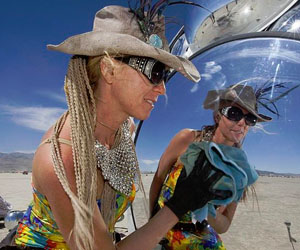
 No need for psychedelic substances: The cultural milieu at the week-long annual art festival known as Burning Man is enough to alter your mind.
Research published in the scientific journal Frontiers in Emotion Science in July found that an individual’s social and cultural environment influenced how they controlled their emotional responses.
“I think the most striking thing that this study demonstrates is that emotion regulation can change due to sociocultural context far more quickly than previously reported,” Kateri McRae of the University of Denver, the lead author, told PsyPost. “Most previous research focuses on culture as defined by long-standing shared values and norms (and compare groups like those living on mainland China to those living in the U.S.), and the fact that we see similar changes when people attend an event for a week is very cool.”
“To me, that indicates that how we regulate our emotions in accordance with social norms is a very dynamic process. Another way to think about it is that ‘culture’ might be something that is much more local and changeable than we previously thought.”
The Burning Man event is based on radical self-expression and radical self-reliance. Attendees, known as “Burners,” gather at a barren desert in northern Nevada and collectively construct a temporary city. Burners often wear elaborate costumes, drive around in funky “mutant” vehicles and build large artistic structures. They participate in a wholly gift-based economy. The social and cultural environment of Burning Man is unique, to say the least.
“What first drew me to study emotion regulation at Burning Man is that Burning Man has very explicit values (the ten principles of Burning Man) and one of them is radical self-expression,” McRae explained. “I thought it would be really interesting to see how that explicit value impacted the types of emotion regulation that people use when they’re there. And indeed, we find that people inhibit their emotional expression less often when they’re at Burning Man than typically at home.”
For their study, the researchers surveyed 16,227 individuals at Burning Man over the course of four years to investigate two emotional regulation strategies, expressive suppression and cognitive reappraisal.
Going to Burning Man made individuals less likely to inhibit the expression of both positive and negative emotions. Those at Burning Man were more open about their emotions in general, but were more likely to feel uninhibited about expressing positive emotions rather than negative ones. McRae and her colleagues found decreases in the suppression of positive emotion were considerably stronger than the decreases in the suppression of negative emotion.
“What was most surprising to us was that this decreased inhibition was not global,” McRae told PsyPost. “In other words, people aren’t ‘letting loose’ in every sense when they are at Burning Man (which is one stereotype that some people hold about the event). In fact, people use an emotion regulation strategy called reappraisal MORE often when they’re there.”
“So the paradox of Burning Man is that people are more open, less inhibited when expressing their emotions, but also more thoughtful in terms of reframing, reconsidering or reevaluating their emotions (which is what reappraisal entails).”
The researchers found a general increase in cognitive reappraisal. But there was no difference between the reappraisal of positive and negative emotions.
McRae acknowledge her study had some caveats.
“The biggest one is that we asked people to indicate how often they used different emotion regulation strategies at Burning Man and typically at home, but we asked both questions while people were at Burning Man,” she explained. “Relying on retrospective (not in the moment) responding can often mean that people answer what they think they do at home, rather than what they actually do.
“Because their answers on average defied normal stereotypes, I think that it’s unlikely that this is a huge problem with the study, but we’re definitely trying to figure out way to get participants to respond both typically at home, while not at Burning Man, and then again when at Burning Man. It’s hard to do that without getting identifying information like names or phone numbers or email addresses, but we have some work-arounds that we’re considering!”
The study was co-authored by Sara A. Snyder, S. Megan Heller, and Daniel S. Lumian.