
Damage to a specific area of the brain limits a person’s ability to let their mind wander, according to a small study. Researchers found that this frontal brain region is necessary for generating the internal thoughts and memories that pull our attention away from the present moment. The findings were published in the journal Neuropsychologia.
The human mind frequently detaches from the immediate environment to focus on internal matters, such as planning for the future or recalling past events. Psychologists refer to this phenomenon as stimulus-independent and task-unrelated thought. In everyday language, it is more commonly known as mind-wandering.
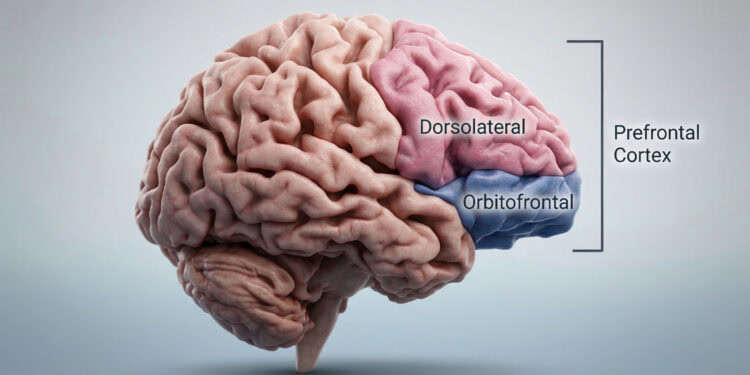
Brain imaging studies have linked mind-wandering to the default mode network. This is a group of interconnected brain regions that activate when a person is resting or engaged in internal mental processes. One specific region in this network is the ventromedial prefrontal cortex, an area located in the lower front of the brain.
Past research indicated that damage to the ventromedial prefrontal cortex reduces mind-wandering, but the exact mechanism remained elusive. Scientists debated whether this brain region actually generates the wandering thoughts, or if it simply allows a person to become aware that their mind has wandered. A team of researchers based in Italy, led by Elisa Ciaramelli of the University of Bologna, designed an experiment to test these competing ideas.
If the ventromedial prefrontal cortex only controls a person’s awareness of their thoughts, damage to the region would cause individuals to underreport all types of distractions. However, if the region is responsible for generating internal thoughts, patients would specifically lack mind-wandering while still noticing external distractions. The researchers recruited 42 participants for a small study to investigate this distinction.
The study sample included nine patients with localized damage to the ventromedial prefrontal cortex. The researchers also included a control group of 14 patients with brain damage in other areas, along with a second control group of 19 healthy adults.
In the first phase of the experiment, known as the standard condition, participants completed a repetitive attention task on a computer. They watched a screen and pressed a button every time a pattern of vertical lines appeared among frequent patterns of horizontal lines.
Roughly every 40 trials, the program paused and asked the participants to rate their attention. If participants reported that their attention had drifted away from the task, they had to categorize the nature of the distraction.
Participants noted whether their distraction was an internal thought, a thought related to the repetitive nature of the task itself, or an external distraction like a noise in the room. If they reported an internal thought, they also specified whether the mental image was focused on the past, the present, or the future.
The patients with damage to the ventromedial prefrontal cortex reported drastically fewer internal thoughts compared to both the healthy adults and the other brain-damaged patients. They specifically lacked wandering thoughts focused on the past and the future.
These patients experienced the same amount of task-related thoughts and external distractions as the other groups. This suggests that their brains could still lose focus on the main activity, but they lacked the internal mental content needed to drift into true mind-wandering.
In a separate phase of the experiment, called the cued condition, the researchers altered the repetitive line task. Random cue words like the word seaside occasionally appeared on the screen beneath the center fixation point.
These words were designed to act as subtle triggers for autobiographical memories and wandering thoughts. When the thought probes appeared in this version of the task, participants could report if their mind-wandering had been sparked by one of the specific cue words.
When provided with these external cues, patients with damage to the ventromedial prefrontal cortex still struggled to generate wandering thoughts. They reported fewer internal thoughts triggered by the cue words than the healthy adults did.
As in the first experiment, this reduction was isolated to internal mind-wandering. The patients continued to report typical levels of external distractions and thoughts regarding the test itself.
The combined results indicate that the ventromedial prefrontal cortex is necessary for the spontaneous construction of internal events. The researchers propose that without this brain region initiating personal memories and future projections, a person’s attention is less likely to turn inward.
This finding aligns with the idea that the ventromedial prefrontal cortex helps build the mental scenes that fuel our daydreams. Because the patients retained the ability to notice external distractions, their lack of mind-wandering cannot be explained by a general failure to monitor their own thoughts.
The small number of participants in the study limits the sensitivity of the statistical analysis, meaning subtle differences between the patient groups might have gone undetected. The study format also required participants to be self-aware enough to categorize their own thoughts when prompted by the computer.
Future research will need to measure instances where people spontaneously catch themselves daydreaming, rather than relying on external computer prompts. This would help researchers confirm that the reported lack of mind-wandering holds true across different methods of measuring human attention.
Researchers might also investigate how this specific type of brain damage impacts daily functioning. A reduced capacity for mind-wandering could limit a person’s ability to plan for the future, reflect on past experiences, and engage in creative problem solving.
The study, “vmPFC damage reduces mind-wandering, but not other classes of off-task thought,” was authored by Elisa Ciaramelli, Virginia Pollarini, Andrea Crisafulli, Alessia Ferretti, and Manila Vannucci.