PsyPost
  • Mental Health
  • Social Psychology
  • Cognitive Science
  • Neuroscience
  • About
No Result
View All Result
Join
My Account
PsyPost
No Result
View All Result
Home Exclusive Cognitive Science

The congruency effect: Study shows walking can boost your math abilities

by Brooke Meyer
May 24, 2015
Reading Time: 2 mins read
Photo credit: Konstantin Yuganov/Fotolia

Photo credit: Konstantin Yuganov/Fotolia

Movies often show someone pacing around their office while thinking about a problem they are stumped on. But have you ever wondered why pacing is associated with problem solving? As it turns out, researchers believe body movements may help individuals solve certain types of problems.

More specifically, different types of body movements may help solve particular arithmetic problems. Researchers have shown that our math abilities can be influenced by a variety of movements, including our head movements, hand movements, and horizontal/vertical motions.

Some researchers have begun focusing on how whole body movements like walking can influence individuals’ math abilities. Past research has found that our addition and subtraction skills show a “congruency effect”. These researchers discovered that people perform addition better when moving upward (like in an elevator or walking up the stairs), and perform subtraction better when moving downwards. Interestingly, this effect was seen when participants performed passive actions, such as going up or down an elevator.

Other researchers have found a congruency effect for horizontal movements as well. For horizontal congruency effects, smaller numbers are congruent to the left side, and larger numbers are congruent to the right side.

In an article published last December in Frontiers in Psychology, a team of researchers from the University of Bologna and the Italian National Research Council examined whether whole body movements could influence our math abilities. In the study, fifty-two individuals performed addition and subtraction problems while walking.

During the study, each participant was first given a starting number (e.g. 245), then were told what type of calculation they would be required to perform (addition or subtraction). Next, participants began walking and were then told to turn either right or left. They then performed the calculation aloud. If they answered incorrectly, they were given a new problem to solve.
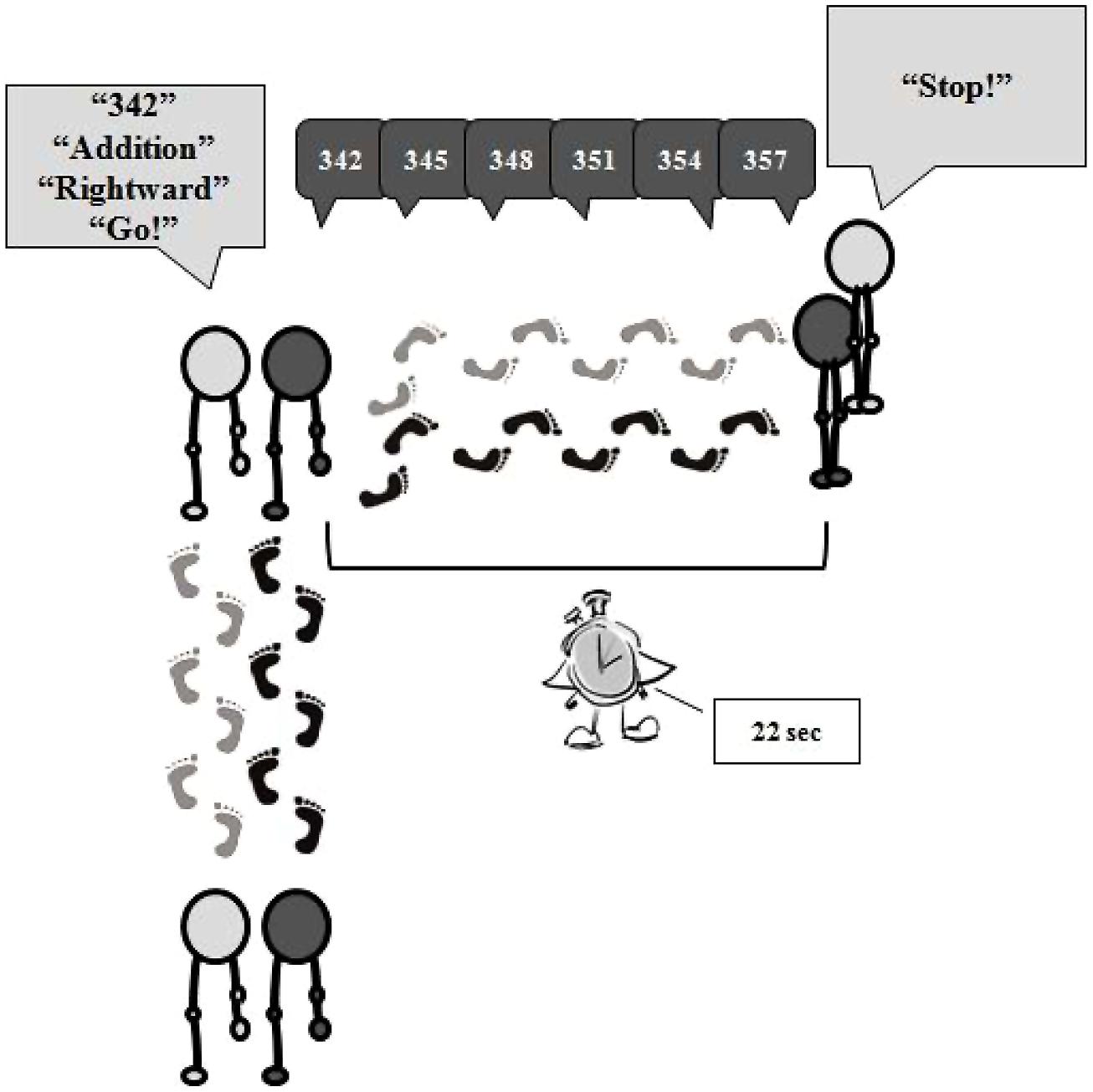
fpsyg-05-01459-g001

Results showed that we perform additions better after turning right, and perform subtractions better after turning left. These results offer further support for the “congruency effect” other researchers have suggested.

This research adds to the growing evidence that our math and movements are intertwined through what has been called a “congruency effect”. These results have important implications for a variety of people—all of us have to do mental math sometimes.

“Our study adds to previous evidence in favor of an embodied nature of number processing by showing that numbers representation is influenced by whole body motions,” the researchers wrote.

“The present findings confirm the existence of a connection among numbers, space, and motor processes, by showing the emergence of a congruency effect when subtractions and additions were calculated while moving also along an horizontal axis,” they concluded.

So next time you’re stumped by a mental math problem, try walking in a circle or taking an elevator. Research suggests that doing so may help more than you think!

TweetSendScanShareSendPinShareShareShareShareShare

Follow PsyPost

The latest research, however you prefer to read it.

Daily newsletter

One email a day. The newest research, nothing else.

Google News

Get PsyPost stories in your Google News feed.

Add PsyPost to Google News
RSS feed

Use your favorite reader.

Copy RSS URL
Social media
Support independent science journalism

Ad-free reading, full archives, and weekly deep dives for members.

Become a member

Trending

  • Women want to talk about sex with their close friends more often, study finds
  • Scientists uncover how a tiny reflection of light helps us navigate the social world
  • Over 10 percent of factual claims in Google’s AI search summaries aren’t backed by their cited sources, study finds
  • Inflammation briefly dampens pleasure and the desire to socialize, placebo-controlled study finds
  • Narcissistic parents tend to lean on their children for emotional support, and that is linked to depression later on

Science of Money

  • For male startup founders, average looks may pay off best in the pitch room, according to new Shark Tank study
  • Why struggling with bills feels even worse when you think the economy is booming
  • Feeling stuck in an unwanted work location takes a measurable toll on mental health
  • Why having a self-sacrificing boss can feel like a trap, according to psychology
  • News about shortages only triggers stockpiling when shoppers start searching online, study finds

Recent

  • Loving-kindness meditation fails to beat muscle relaxation for pain or social well-being in online trial
  • Losing childhood weight by adulthood might erase later depression risks
  • Women don’t find deeper-than-average voices more attractive when they can see the man
  • Voters value long-term economic growth more than previously thought, study finds
  • Scientists map a blood protein fingerprint of menopause tied to brain health
  • Social anxiety might not warp how we perceive eye contact
  • In female mice modeling schizophrenia, a single dose of psilocybin restored sensory filtering for days
  • Could psychedelics aid therapy for personality disorders? An unusual case offers a first look
  • Schizophrenia is linked to broad difficulty reading emotions from body language and faces
  • Socially isolated and lonely people tend to be biologically older than their years

PsyPost is a psychology and neuroscience news website dedicated to reporting the latest research on human behavior, cognition, and society. (READ MORE...)

  • Mental Health
  • Neuroimaging
  • Personality Psychology
  • Social Psychology
  • Artificial Intelligence
  • Cognitive Science
  • Psychopharmacology
  • Contact us
  • Disclaimer
  • Privacy policy
  • Terms and conditions

(c) PsyPost Media Inc

Welcome Back!

Login to your account below

Forgotten Password?

Retrieve your password

Please enter your username or email address to reset your password.

Log In

Add New Playlist

Subscribe
  • My Account
  • Cognitive Science Research
  • Mental Health Research
  • Social Psychology Research
  • Drug Research
  • Relationship Research
  • About PsyPost
  • Contact
  • Privacy Policy

(c) PsyPost Media Inc