Subscribe
The latest psychology and neuroscience discoveries.
My Account
  • Mental Health
  • Social Psychology
  • Cognitive Science
  • Neuroscience
  • About
No Result
View All Result
PsyPost
PsyPost
No Result
View All Result
Home Exclusive Cognitive Science

The congruency effect: Study shows walking can boost your math abilities

by Brooke Meyer
May 24, 2015
in Cognitive Science
Photo credit: Konstantin Yuganov/Fotolia

Photo credit: Konstantin Yuganov/Fotolia

Share on TwitterShare on Facebook

Movies often show someone pacing around their office while thinking about a problem they are stumped on. But have you ever wondered why pacing is associated with problem solving? As it turns out, researchers believe body movements may help individuals solve certain types of problems.

More specifically, different types of body movements may help solve particular arithmetic problems. Researchers have shown that our math abilities can be influenced by a variety of movements, including our head movements, hand movements, and horizontal/vertical motions.

Some researchers have begun focusing on how whole body movements like walking can influence individuals’ math abilities. Past research has found that our addition and subtraction skills show a “congruency effect”. These researchers discovered that people perform addition better when moving upward (like in an elevator or walking up the stairs), and perform subtraction better when moving downwards. Interestingly, this effect was seen when participants performed passive actions, such as going up or down an elevator.

Other researchers have found a congruency effect for horizontal movements as well. For horizontal congruency effects, smaller numbers are congruent to the left side, and larger numbers are congruent to the right side.

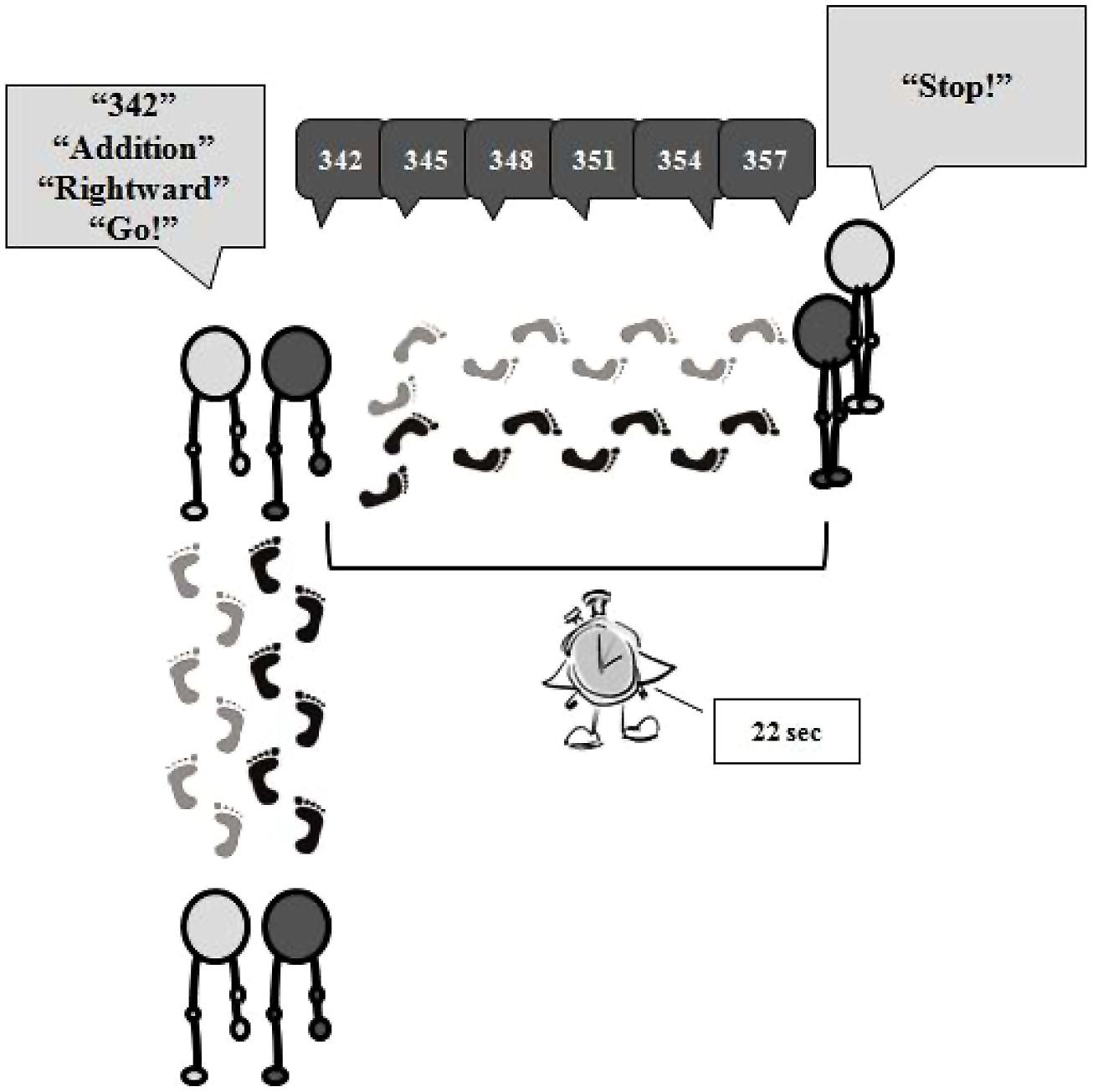
In an article published last December in Frontiers in Psychology, a team of researchers from the University of Bologna and the Italian National Research Council examined whether whole body movements could influence our math abilities. In the study, fifty-two individuals performed addition and subtraction problems while walking.

During the study, each participant was first given a starting number (e.g. 245), then were told what type of calculation they would be required to perform (addition or subtraction). Next, participants began walking and were then told to turn either right or left. They then performed the calculation aloud. If they answered incorrectly, they were given a new problem to solve.
fpsyg-05-01459-g001

Results showed that we perform additions better after turning right, and perform subtractions better after turning left. These results offer further support for the “congruency effect” other researchers have suggested.

Google News Preferences Add PsyPost to your preferred sources

This research adds to the growing evidence that our math and movements are intertwined through what has been called a “congruency effect”. These results have important implications for a variety of people—all of us have to do mental math sometimes.

“Our study adds to previous evidence in favor of an embodied nature of number processing by showing that numbers representation is influenced by whole body motions,” the researchers wrote.

“The present findings confirm the existence of a connection among numbers, space, and motor processes, by showing the emergence of a congruency effect when subtractions and additions were calculated while moving also along an horizontal axis,” they concluded.

So next time you’re stumped by a mental math problem, try walking in a circle or taking an elevator. Research suggests that doing so may help more than you think!

Previous Post

Depression in new mothers can change a child’s stress reactions for life

Next Post

‘Pain sensing’ gene discovery could help in development of new methods of pain relief

RELATED

Psychologists implant false beliefs to understand how human memory fails
Memory

Psychologists implant false beliefs to understand how human memory fails

March 14, 2026
Researchers identify two psychological traits that predict conspiracy theory belief
Cognitive Science

The hidden brain benefit of getting in shape that scientists just discovered

March 11, 2026
Scientists use “dream engineering” to boost creative problem-solving during REM sleep
Cognitive Science

Genetic factors drive the link between cognitive ability and socioeconomic status

March 10, 2026
Scientists use “dream engineering” to boost creative problem-solving during REM sleep
Cognitive Science

Everyday mental quirks like déjà vu might be natural byproducts of a resting mind

March 10, 2026
Scientists use “dream engineering” to boost creative problem-solving during REM sleep
Cognitive Science

Scientists use “dream engineering” to boost creative problem-solving during REM sleep

March 10, 2026
Researchers identify two psychological traits that predict conspiracy theory belief
Artificial Intelligence

Brain-controlled assistive robots work best when they share the workload with users

March 8, 2026
How common is anal sex? Scientific facts about prevalence, pain, pleasure, and more
Cognitive Science

New psychology research reveals that wisdom acts as a moral compass for creative thinking

March 6, 2026
Hemp-derived cannabigerol shows promise in reducing anxiety — and maybe even improving memory
Alcohol

Using cannabis to cut back on alcohol? Your working memory might dictate if it works

March 5, 2026

STAY CONNECTED

LATEST

Psychologists implant false beliefs to understand how human memory fails

Terry Pratchett’s novels held clues to his dementia a decade before diagnosis, new study suggests

Women who are open to “sugar arrangements” tend to show deeper psychological vulnerabilities

Ashwagandha shows promise as a treatment for depression in new rat study

Early exposure to a high-fat diet alters how the adult brain reacts to junk food

How sexual orientation stereotypes keep men out of early childhood education

Your personality and upbringing predict if you will lean toward science or faith

Veterans are no more likely than the general public to support political violence

PsyPost is a psychology and neuroscience news website dedicated to reporting the latest research on human behavior, cognition, and society. (READ MORE...)

  • Mental Health
  • Neuroimaging
  • Personality Psychology
  • Social Psychology
  • Artificial Intelligence
  • Cognitive Science
  • Psychopharmacology
  • Contact us
  • Disclaimer
  • Privacy policy
  • Terms and conditions
  • Do not sell my personal information

(c) PsyPost Media Inc

Welcome Back!

Login to your account below

Forgotten Password?

Retrieve your password

Please enter your username or email address to reset your password.

Log In

Add New Playlist

Subscribe
  • My Account
  • Cognitive Science Research
  • Mental Health Research
  • Social Psychology Research
  • Drug Research
  • Relationship Research
  • About PsyPost
  • Contact
  • Privacy Policy

(c) PsyPost Media Inc