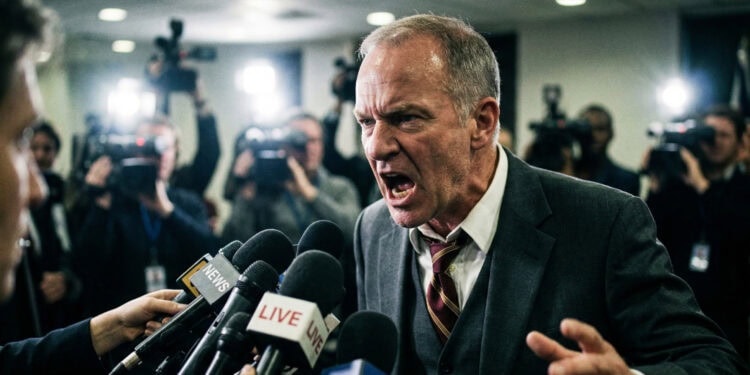

A recent study published in PNAS Nexus provides evidence that politicians who frequently use personal insults gain massive media attention but fail to achieve better legislative or electoral success than their more policy-focused peers. This suggests a shift in political strategy where some lawmakers prioritize national visibility and celebrity status over traditional lawmaking duties. These findings highlight a growing trend in American politics where the pursuit of media spotlight sustains a toxic form of public discourse.
Surveys consistently indicate that American voters dislike political incivility and prefer lawmakers to focus on substantive policy debates. Despite this clear public preference, hostile rhetoric involving name-calling and character attacks appears to be rising in American politics.
“Wherever we look—in the news media, social media, even floor debate in Congress—it seems that at least some politicians have become much more insulting in what they say,” said study author Marc S. Jacob, an assistant professor at the University of Notre Dame.
“These personal attacks have nothing to do with substantive policy debate and undermine substantive discussions that we need to resolve urgent issues the U.S. and other democracies face, from infrastructure to building economic opportunities. We wanted to bring observable facts to this debate to understand two important questions: how common are legislators who prefer to attack others on personal grounds over substantive engagement with policy, which we call conflict entrepreneurs? And are there any tangible benefits that conflict entrepreneurs reap from personally attacking others?”
The researchers wanted to test the assumption that negative rhetoric actually provides tangible rewards to politicians. Many commentators assume that hostile speech results in increased campaign donations or better chances of winning an election. By examining the true incentives behind divisive speech, the scientists hoped to explain the persistence of this aggressive political language.
To investigate this behavior, the researchers analyzed a massive dataset of elite political communication. They collected over 2.2 million public statements made by members of the 118th United States Congress. This sample included daily floor speeches, press releases, official newsletters, and posts on the social media platform X, formerly known as Twitter.
The scientists fed these statements into an artificial intelligence tool called a large language model. A large language model is a computer program trained on vast amounts of text to recognize patterns and categorize language. They programmed the model to specifically identify personal attacks in the political statements.
A personal attack was defined as a statement targeting a specific individual or group and criticizing their personal characteristics, morality, or integrity. This was distinct from critical policy debate, which involves objecting to the merits of a specific law or government action. The researchers found this advanced model was much better at distinguishing between legitimate policy criticism and actual personal insults than older text analysis tools.
The scientists then linked these classified statements to records of media coverage, including cable television transcripts. They also connected the text data to campaign finance records from the Federal Election Commission. Finally, they cross-referenced the statements with 2022 midterm election returns and official financial disclosure reports.
The data reveals that a small group of lawmakers, labeled “conflict entrepreneurs,” are responsible for an outsized portion of these personal attacks. While personal insults occur in both political parties, they are more frequent among conservative Republicans. The vast majority of representatives in both parties still dedicate most of their communication to substantive policy issues rather than insults.
The scientists also tracked exactly who was on the receiving end of these verbal assaults. They found that lawmakers consistently target the leaders of the opposing party, such as presidential candidates, rather than focusing on low-profile politicians. The opposing political parties as a whole were also frequent targets of these insults.
The data shows that lawmakers tend to adapt their tone based on the platform they are using. Personal attacks are roughly three times more common on social media than they are during formal speeches on the House or Senate floor. Official press releases and newsletters feature a moderate amount of insulting language falling somewhere in the middle.
The researchers found that engaging in personal attacks strongly correlates with increased media visibility. Lawmakers who frequently insult their peers receive substantially more mentions on major cable news networks. They also gain significantly more engagement, such as likes and shares, on social media platforms.
“The attention that conflict entrepreneurs receive from insulting others is remarkable,” Jacob told PsyPost. “A legislator who devotes just 5 percent of their communication to personal attacks receives a level of cable news coverage comparable to a colleague dedicating 45 percent of their time to substantive policy debate. The 25 most combative members of Congress receive more cable news attention than the 75 least combative members combined.”
Despite this massive boost in visibility, the researchers found no corresponding positive relationship with traditional political rewards. Conflict entrepreneurs do not raise more money from out-of-state or local donors. They also do not win their elections by larger margins compared to their policy-focused peers after adjusting for how competitive their home districts are.
These highly visible politicians also tend to be less effective at actual lawmaking. The data indicates that conflict-driven lawmakers are less likely to co-sponsor legislation. They also receive fewer assignments to prestigious legislative committees, suggesting that party leaders do not reward this behavior with institutional power.
“In short, conflict entrepreneurship undermines the ways in which elected officials interact with one another to discuss policy and leaves the public with news of unconstructive insults rather than informing them how their representatives stand on important issues,” Jacob said.
The researchers also examined changes in the politicians’ personal net worth during their time in office. A common public suspicion is that lawmakers use their media visibility to enrich themselves. The scientists found no evidence of immediate financial enrichment tied to their hostile rhetoric while serving in Congress.
The scientists also compared the politicians’ statements to the political attitudes of their constituents. They used a large survey dataset of 140,000 Americans to estimate the level of partisan hostility in each congressional district. The analysis indicates no correlation between a lawmaker’s use of insults and the actual level of partisan animosity among their local voters.
This disconnect suggests that conflict entrepreneurs are not simply reflecting the anger of their local districts. Instead, they appear to be adopting a confrontational style to cultivate a national media audience. This pursuit of celebrity status sustains a form of discourse that can be harmful to democratic norms.
While the study relies on a vast dataset, the text-based classification system has some limitations. The artificial intelligence model cannot easily detect implicit attacks, sarcasm, visual memes, or coded language. This means the true number of personal attacks is likely higher than the researchers reported.
“Our results are descriptive and not causal; there may be other factors that are related to both legislators’ choice to insult and how they perform in elections, etc,” Jacob noted. “For instance, conflict entrepreneurs tend to be more extreme in their ideology too. But it is hard to think of a third factor that would explain away why conflict entrepreneurs get this much higher level of media attention than their policy-oriented colleagues.”
“Conflict entrepreneurs have been elected not just in safe but also competitive districts. It remains to be seen in the upcoming midterms whether the ones in competitive seats will be confirmed in office or whether voters take issue with those personal attacks.”
The scientists plan to continue monitoring political polarization through the Polarization Research Lab. These future studies will help clarify how divisive rhetoric ultimately impacts democratic institutions and voter behavior.
“This research is part of the work at the Polarization Research Lab, which studies polarization among politicians and the public in the US. The Lab will continue to study why citizens and elected officials are divided along partisan lines and what implications this has for American democracy. The Lab also provides tools for tracking legislator and candidate statements across the U.S.: https://americaspoliticalpulse.com/elites.”
The study, “Entrepreneurs of conflict: A descriptive analysis of when and how political elites use divisive rhetoric,” was authored by Marc S Jacob, Yphtach Lelkes, and Sean J Westwood.