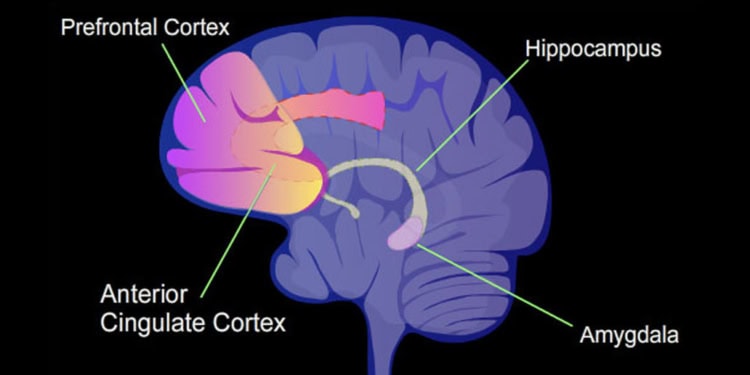
Cravings for gambling, food, sex and drugs all seem to activate the same brain networks, according to new research published in the journal European Neuropsychopharmacology.
The research, which examined fMRI data from 176 studies, concluded that the neural basis of cravings for gambling, food, sex and drugs are associated with brain areas regulating emotional responses (anterior cingulate and insula) along with areas responsible for forming habits (dorsal striatum and cerebellum) and self-control (anterior cingulate, adjacent prefrontal cortex, and striatum).
PsyPost interviewed the study’s corresponding author, Hamid R. Noori of the Max Planck Institute for Biological Cybernetics in Tuebingen, Germany. Read his explanation of the research below.
PsyPost: Why were you interested in this topic?
Noori: The way we view psychiatric disorders is quite dynamical. Particularly, the diagnostic criteria are evolving and hopefully will converge to neurobiological characterization of diseases. This is critical. While over 100 neuropsychiatric drugs are currently in clinical use, treatment success is very modest. And this is because we lack a clear understanding of the underlying mechanisms of psychiatric conditions. Several initiatives such as the Research Domain Criteria project of the National Institutes of Health aim to pave the way to overcome this problem. And some may consider the improvements of the recent version of the Diagnostic and Statistical Manual of Mental Disorders (DSM-5) as a first step in this direction. And this is why I got interested in the topic.
I believe it is necessary that we ensure that our first steps are robust and accurate such that we can build on them. Else, we may fall back to our old habits.
Craving is an ill-defined term with fundamental conceptualization issues, yet it was included as a diagnostic criterion for substance and alcohol use disorders in DSM-5. It is often measured by reactivity to rewarding cues, for instance the picture or smell of beer for an alcoholic are such cues. Yet, all of us experience some type of craving every now and then. We may walk past a restaurant and crave for our favorite food or just watch drink a coke and feel the urge to drink coke or something sweet.
So, we asked ourselves whether there are common and distinct neuronal pathways for craving of drugs of abuse and natural rewards.
What should the average person take away from your study?
Your brain reacts very similarly to drugs as it does to high calorie food or to erotic movies. We react almost unconsciously and rather impulsive to rewarding cues. Many smoke cigarettes and try to withdraw it. Knowing that there are fundamental, strong cue-induced mechanisms in the brain that govern their desire or urge to smoke in abstinence may help them to avoid situations that expose them to such critical stimuli.
And most importantly, our work shows you the impact of your environment on your life and “habits”. If you want to be abstinent, sober for a long time, or even lose weight, it makes sense to change your environment too.
Are there any major caveats? What questions still need to be addressed?
This study is robust and reproducible yet it is still a meta-analysis of averaged data based on cue reactivity measured by functional magnetic resonance imaging (fMRI). It lacks the necessary consideration of individual variability, history and heterogeneity. Furthermore, cue reactivity is not a perfect measure for craving and we do not know yet what the blood oxygen level dependent signal of fMRI really means. Thus, the study must be considered as a first step towards a quantitative, hypothesis-free understanding of the processes related to craving.
Is there anything else you would like to add?
If we want to arrive at new destinations, we need to take new, probably unknown, paths. The need for biological classification criteria for psychiatric disorders is clear. To date, we cannot heal a single disorder, since they are all characterized in a traditional way, namely through qualitative phenomenological observations. In my opinion, it is necessary that we started rethinking our approaches and get rid of our old research habits.
The study, titled “Largely overlapping neuronal substrates of reactivity to drug, gambling, food and sexual cues: A comprehensive meta-analysis“, was also co-authored by Alejandro Cosa Linan and Rainer Spanagel.
