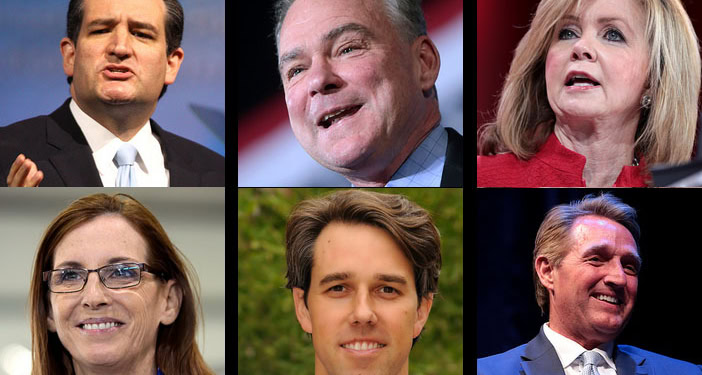

Conservative voters in the United States are more likely to vote for candidates who have Republican-looking faces, according to research published in the journal Political Psychology.
The new study suggests that Republican candidates facing conservative electorates benefit more from looking stereotypically Republican than Democrats facing liberal electorates benefit from looking stereotypically Democratic. In other words, Republicans are more likely to vote according to facial stereotypes.
“Voting is the lifeblood of democracy, yet democracy can only be as good as the quality of the decision making process that voters use to elect their leaders. The fact that voters rely on facial appearances to elect politicians is therefore something we should be concerned about (particularly with the upcoming midterm elections in the U.S.),” said study author Christopher Y. Olivola, an assistant professor at Carnegie Mellon University.
“Moreover, the fact that some voters rely on political facial stereotypes to select candidates is particularly surprising, given that candidates’ political party affiliations are provided on the voting ballots! Therefore, it is really interesting (and concerning) that some voters seem to put more weight on the extent to which a candidate’s face makes him/her look like a member of a particular political party rather than relying on that candidate’s actual party affiliation (as indicated on the ballot).”
Research has found that people tend to associate particular facial features with political ideologies. A study published in PLoS One even found that people could accurately discern the political affiliations of individuals based on photos of their faces.
In their new study, Olivola and his colleagues used headshots from 256 pairs of Democrat and Republican rivals drawn from the 1995–2006 gubernatorial and 2000–2008 Senate elections in the United States. A group of 51 participants were asked to identify the political affiliation of these candidates based on their headshot alone. Their responses were then compared to data from exit polls.
The researchers found that Republican voters were more likely to vote for a candidate (even a Democrat) the more stereotypically Republican-looking the candidate was. But the same was not found among Democratic voters, whose voting choices did not appear to be influenced by facial stereotypes.
“We find that, all else being equal, Republicans/conservatives are more likely to vote for candidates who have stereotypically Republican-looking faces (than they are to vote for candidates who have less Republican-looking faces), whereas Democrats/liberals are not influenced by political facial stereotypes (i.e., Democrats/liberals are neither more nor less likely to vote for candidates who have Republican-looking faces),” Olivola told PsyPost.
“In some cases, this may even lead Republicans to vote for a Democrat merely because that person happens to have a face that makes him/her look more stereotypically like a Republican than his/her (actual) Republican rival.”
The researchers controlled for the effects of the candidates’ incumbency status, gender, ethnicity, and age. But the findings have some caveats.
“First, we are not saying that candidates with Republican-looking faces will automatically win elections in conservative states,” Olivola explained. “Many other factors guide votes (including actual political affiliations). What we are showing is that political facial stereotypes also predict voting, even though they should have zero impact.”
“Second, this research should not be taken to mean that Republican voters are generally more superficial than Democrats in their voting choices. Previous research (including our own) has shown that both Republicans and Democrats are more likely to vote for candidates who have competent-looking faces than to vote for candidates who have less competent-looking faces.”
“For whatever reason (we don’t know why), Republican voters seem to be more influenced by political facial stereotypes than Democratic voters. However, for other dimensions (e.g., facial competence), voters on both sides of the political spectrum seem to be impacted,” Olivola said.
The findings also indicate that Democrats may have a general advantage, since they can pick up Republican votes simply by running a candidate with a more Republican-looking face.
“Researchers have argued that political knowledge and strong partisanship should both reduce the tendency to vote based on candidate appearances (since more knowledgeable voters need not rely on superficial cues, while strongly partisan voters would tend to just vote based on actual party affiliation),” Olivola added.
“Yet, here we find a particular tendency to vote based on candidate appearances that seems resistant to political knowledge and seems to be amplified by partisanship (since Republican voters are more likely rely on this particular facet of candidates’ appearances).”
The study, “Republican Voters Prefer Candidates Who Have Conservative-Looking Faces: New Evidence From Exit Polls“, was authored by Christopher Y. Olivola, Dustin Tingley and Alexander Todorov.