PsyPost
  • Mental Health
  • Social Psychology
  • Cognitive Science
  • Neuroscience
  • About
No Result
View All Result
Join
My Account
PsyPost
No Result
View All Result
Home Exclusive Aviation Psychology and Human Factors

Neuroscience study uncovers unique brainwave patterns in pilots

by Eric W. Dolan
January 8, 2020
Reading Time: 2 mins read
(Photo credit: hiro)

(Photo credit: hiro)

Share on TwitterShare on Facebook

Viewing landing scenes appears to activate the “Mirror Neuron” system in pilots more than it does in non-pilots, according to preliminary research published in Frontiers in Human Neuroscience.

The “Mirror Neuron” system is a network of neurons that are activated both during a motor action and also when observing a similar action performed by another person.

In the study, 9 pilots and 8 individuals with no piloting experience viewed landing scenes as researchers monitored their electrical brain activity. The scenes were viewed from the perspective of the cockpit, and the participants were asked to gauge the distance of the runway number.

“The use of a simple distance estimation task enabled us to easily include in the study a non-expert population to be compared with pilots, avoiding the potential complications that may arise from including technical flight-related aspects in the task,” the researchers explained.
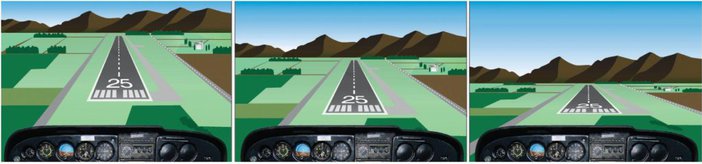
The researchers observed differences between pilots and non-pilots in mu rhythm brainwaves. Mu brainwave patterns are considered a marker of Mirror Neuron system activity because they are suppressed whenever a person performs an action and they are also suppressed when a person observes someone else performing an action.

Pilots tended to have increased mu suppression when observing the landing scenes, indicating greater activation of the Mirror Neuron system.

But what is the significance of increased mirror neuron activation among pilots? As the researchers explain in their study, the findings suggests that the brains of pilots process aircraft as “a sort of extension of a pilot’s body.” Observing an aircraft landing might be like observing someone trying to reach for an object — in this case, “reaching” for a runway.

Google News Preferences Add PsyPost to your preferred sources

“Critically, in a landing task, the angle-under-the-horizon has the functional property to express the location of an aircraft in terms of glide angle to a specific point on the ground. This importantly, allows the pilot to directly differentiate between locations on the ground that are within the glide range and that can hence be reached with the airplane, from those that are outside the glide range, that are hence unreachable,” the researchers wrote.

“It follows that for a pilot, a seemingly perceptual task such as distance judgment is framed in terms of the action capabilities of an aircraft (e.g., the glide angle)… However, in the case of aviation, the action capabilities of the aircraft would not be generally experienced by most humans.”

The study, “Investigating Neural Sensorimotor Mechanisms Underlying Flight Expertise in Pilots: Preliminary Data From an EEG Study“, was authored by Mariateresa Sestito, Assaf Harel, Jeff Nador, and John Flach.

RELATED

A robust vocabulary of curse words signals strong verbal fluency
Cognitive Science

A robust vocabulary of curse words signals strong verbal fluency

May 7, 2026
New research challenges the idea that logical thinking diminishes religious belief
Cognitive Science

New research challenges the idea that logical thinking diminishes religious belief

May 6, 2026
Video games linked to better neuropsychological performance in adults with multiple sclerosis
Cognitive Science

How video game habits act as a window into cognitive health

May 2, 2026
These four factors predict maladaptive daydreaming in neurodivergent individuals
Cognitive Science

Dreams and daydreams share unexpected patterns of bizarreness

May 2, 2026
Music therapy might improve quality of life and emotion regulation in depressed women
Cognitive Science

General intelligence explains the link between math and music skills

May 1, 2026
Gold digging is strongly linked to psychopathy and dark personality traits, study finds
Artificial Intelligence

High trust in AI leaves individuals vulnerable to “cognitive surrender,” study finds

April 30, 2026
Science debunks the fashion myth that vertical stripes are always slimming
Attractiveness

Science debunks the fashion myth that vertical stripes are always slimming

April 30, 2026
Scientists observe “striking” link between social AI chatbots and psychological distress
Cognitive Science

Brain halves become less alike as kids grow, especially in highly intelligent teens

April 29, 2026

Follow PsyPost

The latest research, however you prefer to read it.

Daily newsletter

One email a day. The newest research, nothing else.

Google News

Get PsyPost stories in your Google News feed.

Add PsyPost to Google News
RSS feed

Use your favorite reader. We also syndicate to Apple News.

Copy RSS URL
Social media
Support independent science journalism

Ad-free reading, full archives, and weekly deep dives for members.

Become a member

Trending

  • The human brain appears to rely heavily on the thighs to accurately judge female body size
  • Fox News viewership linked to belief in a racist conspiracy theory
  • What your personality traits reveal about your sexual fantasies
  • Both men and women view a partner’s financial investment in a rival as a major relationship threat
  • Brain scans of 800 incarcerated men link psychopathy to an expanded cortical surface area

Science of Money

  • What traders actually look at: Eye-tracking study finds the price chart is largely ignored
  • When ICE ramps up, U.S.-born workers don’t fill the gap, study finds
  • Why a blue background can make a brown sofa look bigger
  • Why brand names like “Yum Yum” and “BonBon” taste sweeter to our brains
  • How the science of persuasion connects to B2B sales success

PsyPost is a psychology and neuroscience news website dedicated to reporting the latest research on human behavior, cognition, and society. (READ MORE...)

  • Mental Health
  • Neuroimaging
  • Personality Psychology
  • Social Psychology
  • Artificial Intelligence
  • Cognitive Science
  • Psychopharmacology
  • Contact us
  • Disclaimer
  • Privacy policy
  • Terms and conditions
  • Do not sell my personal information

(c) PsyPost Media Inc

Welcome Back!

Login to your account below

Forgotten Password?

Retrieve your password

Please enter your username or email address to reset your password.

Log In

Add New Playlist

Subscribe
  • My Account
  • Cognitive Science Research
  • Mental Health Research
  • Social Psychology Research
  • Drug Research
  • Relationship Research
  • About PsyPost
  • Contact
  • Privacy Policy

(c) PsyPost Media Inc