PsyPost
  • Mental Health
  • Social Psychology
  • Cognitive Science
  • Neuroscience
  • About
No Result
View All Result
Join
My Account
PsyPost
No Result
View All Result
Home Exclusive Cognitive Science

40 days of mindfulness meditation leads to structural brain changes and improved quality of life

by Christian Rigg
March 24, 2020
Reading Time: 2 mins read
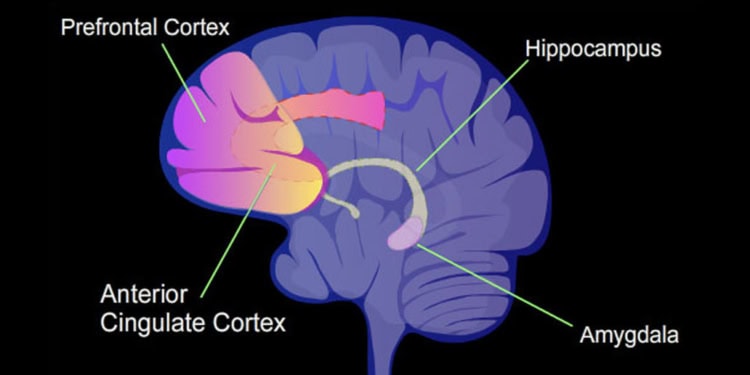
Illustration of brain regions studied in mental illness: ACC, amygdala, hippocampus, prefrontal cortex. [NIH]

Illustration of brain regions studied in mental illness: ACC, amygdala, hippocampus, prefrontal cortex. [NIH]

Share on TwitterShare on Facebook

A study in Scientific Reports has helped reinforce our understanding of how meditation and mindfulness affect change in the structure and functioning of certain brain areas, and how these changes lead to increased wellness.

In the study, fourteen university students participated in a 40-day meditation training course. None of the students had any prior training in meditation, which allowed the researchers to evaluate changes in the function and structure of a number of brain regions. In addition, subjects were given self-assessment questionnaires before and after the meditation course to monitor any changes in mood and wellbeing.

After 40 days of mindfulness training, imaging techniques revealed alterations in the precuneus and posterior cingulate cortex. These two brain regions are thought to be involved at various levels in self-awareness and consciousness. They also play critical roles in the Default Mode Network, a vast network of interconnected structures that contributes to certain fundamental aspects of personhood, including the perception of one’s own emotional state, understanding others’ thoughts and emotions, and moral reasoning.

In addition to these neurological changes, participants also showed a marked decrease in both depressive and anxious tendencies, as evaluated by the self-assessment questionnaires. More significant reductions in depression and anxiety scores correlated with greater structural changes in the aforementioned brain regions, lending support to previous research in the same domain.

The study, as noted by researchers, should be considered in light of certain methodological limitations. First and foremost, a relatively small sample size of 14 participants limits the study’s generalizability. There was also no control group, which is unfortunate, as this makes it difficult to be sure that the observed changes were, in fact, a result of the meditation practice, and not some other, external factor.

Nonetheless, the study’s findings are both intriguing and promising: they contribute to our understanding of how brain structures are changed by meditation and mindfulness, and provides a number of opportunities for future research. The most striking finding of the study is that a mere 40 days of meditation was needed to both alter the structure and function of participant’s brains, and improve the participants’ quality of life as measured by depression symptomatology and anxiety.

The study, “Alterations in Brain Structure and Amplitude of Low-frequency after 8 weeks of Mindfulness Meditation Training in Meditation-Naïve Subjects“, was authored by Chuan-Chih Yang, Alfonso Barrós-Loscertales, Meng Li, Daniel Pinazo, Viola Borchardt, César Ávila, and Martin Walter.

Google News Preferences Add PsyPost to your preferred sources
TweetSendScanShareSendPin1ShareShareShareShareShare

Follow PsyPost

The latest research, however you prefer to read it.

Daily newsletter

One email a day. The newest research, nothing else.

Google News

Get PsyPost stories in your Google News feed.

Add PsyPost to Google News
RSS feed

Use your favorite reader.

Copy RSS URL
Social media
Support independent science journalism

Ad-free reading, full archives, and weekly deep dives for members.

Become a member

Trending

  • Emotional distress when stopping antidepressants appears to be due to withdrawal, not relapse
  • Disgust predicts conservative views most strongly in people with low bodily awareness
  • New study highlights key differences in how relationship dynamics relate to sexual desire in men and women
  • Consciousness may have evolved to solve a problem that pure intelligence couldn’t handle, fascinating new theory suggests
  • Psychologists pinpoint the dividing line between problematic romance and severe love addiction

Science of Money

  • Customer-created shelf gaps reduce purchase intentions
  • How personality traits help graduates avoid the overeducation trap
  • How surviving a health crisis changes cryptocurrency investment behavior
  • The psychological weight of debt: how financial obligations influence mental health
  • How high school jobs impact mid-life career success

Recent

  • Suicidal behaviors are more heritable than depression, new twin study finds
  • Negative feelings about life are more common among teens on Instagram and TikTok
  • Indoor gardening improves mental health and quality of life for cancer patients
  • New study of Brazilian twins sheds light on the heritability of our creative confidence
  • The neuroscience of pity: how attractiveness and morality shape empathy
  • Emotional distress when stopping antidepressants appears to be due to withdrawal, not relapse
  • Large analysis connects specific personality traits to problematic internet pornography use
  • Scientists replace mouse cortex with human brain tissue to study neurological disorders
  • Your worldview might dictate how you perceive neutral faces
  • A political shift decades in the making explains Trump’s grip on Congress

PsyPost is a psychology and neuroscience news website dedicated to reporting the latest research on human behavior, cognition, and society. (READ MORE...)

  • Mental Health
  • Neuroimaging
  • Personality Psychology
  • Social Psychology
  • Artificial Intelligence
  • Cognitive Science
  • Psychopharmacology
  • Contact us
  • Disclaimer
  • Privacy policy
  • Terms and conditions

(c) PsyPost Media Inc

Welcome Back!

Login to your account below

Forgotten Password?

Retrieve your password

Please enter your username or email address to reset your password.

Log In

Add New Playlist

Subscribe
  • My Account
  • Cognitive Science Research
  • Mental Health Research
  • Social Psychology Research
  • Drug Research
  • Relationship Research
  • About PsyPost
  • Contact
  • Privacy Policy

(c) PsyPost Media Inc