

In both Europe and the US, people spend up to 90% of their time indoors. But spending so much time inside can have consequences for your mental health.
The World Health Organization estimates that 5% of adults globally suffer from depression. Stress, depression and anxiety also accounted for 55% of all working days lost in the UK during the year 2021-22. Small improvements in our mental health can bring significant personal and financial rewards.
For those of us who are stuck inside all day, houseplants are an easy way of connecting with nature. This is particularly true for young people, many of whom may lack access to a garden.
Indoor plants have several mental and physical health benefits. Research has linked houseplants to reduced stress, lower blood pressure and an improved state of mind. And office environments with plants have been associated with higher job satisfaction and reduced health complaints.
Houseplants make us feel good due to our inherent desire to connect with nature, and because we consider the green colours of most houseplants to be calming. Adding just a single plant can brighten up a dull space and boost your mood. But which should you choose?
Lush greenery
Last year, with colleagues from the University of Reading and the Royal Horticultural Society, I investigated the psychological responses of 520 people to the appearance of different houseplants through an online photo-questionnaire. Participants viewed 12 photographs of plants in various different shapes, and answered questions based on their opinion of the plant’s appearance.
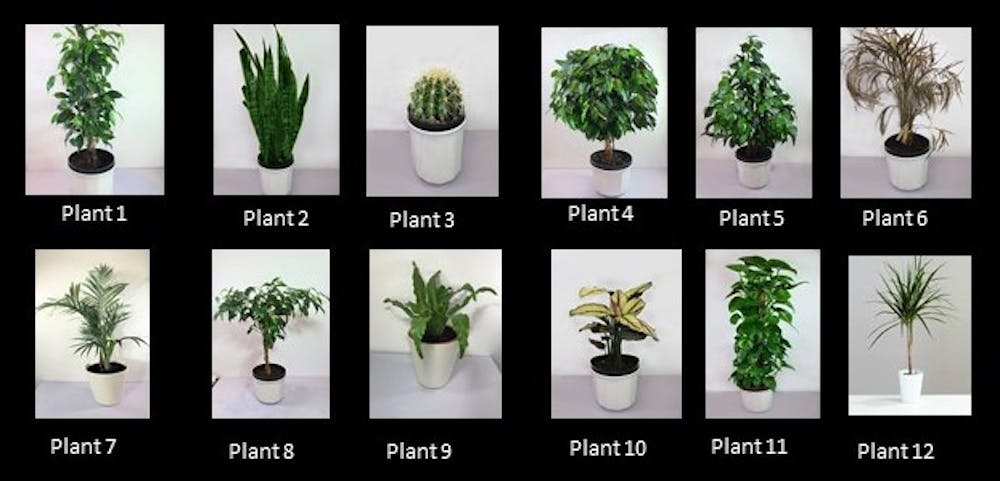
The participants identified their favourite and least-favourite plant. They then used scales comprising six pairs of contrasting adjectives to score different aspects of each plant’s appearance. They also rated how beneficial they perceived each plant to be for wellbeing and air quality.
The eight plant species included in our study were: weeping fig, mother-in-law’s tongue, cactus, prayer plant, bird’s nest fern, golden pothos (or devil’s ivy), dragon tree, and palm – both as a healthy and neglected plant. Each of these plants are found in homes and offices throughout the UK.
Overall, participants perceived that all green and healthy plants would benefit their wellbeing. But three plants in particular – pothos, weeping fig and palm – were believed to deliver the greatest sense of wellbeing. These benefits improved as plant attractiveness increased. In contrast, unhealthy plants were perceived negatively.
Our findings suggest that plants with lush green leaves, high leaf area and dense canopies are likely to give the biggest boost to your wellbeing. People also believe that these plants will provide greater benefits to air quality.
So, to keep plants looking attractive, consider purchasing those that are easy to maintain such as mother-in-law’s tongue, zamioculcas zamiifolia (commonly called the ZZ plant), pothos, or a spider plant. These can all tolerate a range of conditions and require little watering.
Leaf shape
Psychological studies have shown that curved objects elicit positive emotions in humans. Our research demonstrates that these outcomes also apply to houseplants.
Plants with rounded leaves such as weeping fig and pothos, or palm with its gentle arching canopy shape, were seen by participants of our study to be more beautiful and relaxing. Some plants, including palm, also evoked happy memories. This is because they are often associated with holidays or tropical destinations.
Plants with spikes, narrow pointed leaves and sparse canopies, such as cactus and dragon tree, were less preferred. This is possibly due to the association of sharp edges with danger.
However, sharp features can sometimes be advantageous. One study shows that houses surrounded by sharp-leafed plants were more expensive and evaluated as safer than houses surrounded by round-leafed plants.
What do you want from your plants?
Ultimately, the right houseplant for you depends on what you need it for and your room’s conditions.
Humans generally prefer looking at shapes which the brain can recognise quickly and process easily. When seeking a calming effect, choose plants that are sufficiently interesting to attract your attention – such as the pothos with its trailing vines – but select plants with striking patterns and bold colours in smaller numbers.
Plants with a dramatic appearance would be more appropriate as “feature plants”, to generate a focal point. Grouping different plant shapes and colours together in arrangements can further generate interest, while choosing decorative pots or planters can enhance the effect even more.
When deciding on the number of plants required for maximum benefit, more is not necessarily better – a single, carefully chosen houseplant may be all we need to lift our mood. Research from Japan found that the presence of leafy plants can enhance creativity in workplace tasks. But, if you are undertaking a task that requires focused attention, too many plants may prove a distraction.
Houseplants can benefit our mental health. But when choosing between plants, their appearance matters. For the biggest boost to your wellbeing, key aspects to consider are physical appearance, interestingness, beauty, and how healthy the plant looks. Keeping your plants green and healthy will help lift your spirits, so choose plants suited to your space that you can maintain easily.
This article is republished from The Conversation under a Creative Commons license. Read the original article.