Ayahuasca, a sacred drink made from the stem and leaves of a tree vine, has many names: psychedelic brew, hallucinogenic tea, mood medicine and more. It is even known as a teacher or a healer for its reported ability to help a person turn inward and come into alignment with past traumas.
The plant and the rituals associated with it have deep roots in South American shamanic traditions. But in the past few decades, stories about the spiritually enhancing magic of ayahuasca have made their way to Europe and North America.
Lauded for its transcendent healing powers by celebrities such as Lindsay Lohan, athletes such as Aaron Rodgers and successful businessmen such as Elon Musk, the psychotropic allure of the plant now calls to hundreds of thousands of non-Indigenous consciousness-seekers globally. More and more ayahuasca retreats are popping up around the world.
Indigenous peoples in South America – primarily in Peru, Brazil and other parts of what is considered the Upper Amazon – have been using ayahuasca for medicinal and religious purposes since at least 900 B.C.E. Hieroglyphic paintings depict the use of the sacred brew in a ceremony from the period of 900-250 B.C.E. Western interest in ayahuasca, however, has created some challenges for local Indigenous communities.
As a medical anthropologist, I have spent the past quarter century studying the ways in which culture affects how people view and make decisions about their bodies.
Through researching the connections between sexuality, drugs and cultures, I have come to understand the role of plant medicines like ayahuasca for individuals and communities.
Dying to awaken
Anthropologist of shamanism Michael Winkelman describes ayahuasca as a “psychoindicator,” a substance that integrates emotion and thought processes.
According to Western scientific interpretations, the primary function of the substance allows a stripping away of a person’s egocentric, conscious understanding of the world. Seekers “die unto themselves,” is what a shaman told me.
In an altered state of consciousness, it is believed that the person can tap into their true wants and experiences and begin the process of deeper healing, awakening or spiritual cleansing.
Traditionally, anthropologists note that ayahuasca has been used in South America to unlock information coming from unseen realms. Specifically, it was often called upon for divination, artistic inspiration, strategic insights, healing and shamanic journeys.
Plant medicine
While thousands of tourists flock to South America from all over the world each year in search of an “authentic” ayahuasca ritual, the exact tenets of the ritual today are somewhat under debate, though a few common themes do emerge.
Most scholars and Indigenous and non-Indigenous healers agree that the plant should be cared for and treated by a plant expert called an “ayahuascero,” who after a lengthy eight- to 10-hour brewing process prepares a mudlike tea for consumption.
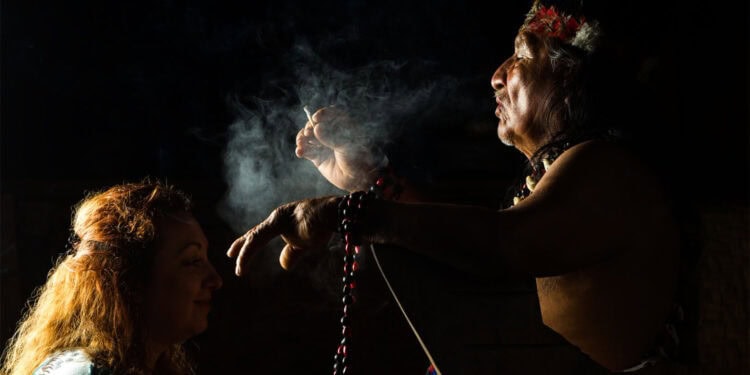
The medicine is brought to the seekers during a ceremony, typically held in the evening around a sacred fire. A healer called a “curandero” calls to the spirit worlds for protection at the start of the ceremony. The healer then faces the four directions of north, east, south and west and uses a branch of the vine along with a rattle made of the ayahuasca tree to sing the “icaros,” or healing songs.
Typically, purging begins after 20 minutes to an hour. For some people, this purging takes the form of vomiting or bowel voiding. The purging of energy that some experience physically, others experience emotionally in the form of laughter, crying, shaking or screaming into the wind. This is then sometimes followed by a movement into hallucination or a connection with the inner self where the outer world starts to fall away.
And while each person describes slightly different experiences, recurring themes include ego death – wherein people see themselves without attachment to material things or status – visions of past selves and lives, waves of healing energy, and painful moments of reckoning with past wounds.
Cultural quagmire
In the spring of 2018, a double murder in the Peruvian Amazon rocked the ayahuasca shamanic community and cast a dark shadow on the hallucinogenic brew. Olivia Arevalo, a beloved 95-year-old curandero, was killed by a Canadian ayahuasca tourist named Sebastian Woodroffe. The death of Arevalo, heralded as the grandmother of the Shipibo-Kobibo tribe, caused outrage among the community, and Woodroffe was lynched by a mob.
These incidents sparked widespread debates about non-Indigenous tourists flocking to the Amazon to imbibe the psychedelic tea: Spiritual seekers don’t always respect boundaries and processes set by local healers – the above incident being an extreme example.
Namely, as anthropologist Veronica Davidov points out, as the use of ayahuasca increases among non-Indigenous individuals, the creation of “entheogen tourism” – travel for the purposes of spiritual awakenings – raises questions about the importance of spiritual contexts in these ceremonies.
As Peruvian archaeologist and healer Ruben Orellana argues, ayahuasca rituals were developed within particular cultural contexts for Indigenous peoples. Without context, non-Indigenous seekers can veer into the territory of cultural appropriation at best, while also exposing themselves to the mental and physical health risks of the psychedelic brew.
Spiritual tourism critics also note that many of the lodges are not owned by locals and that the influx of tourists has had a negative effect on the ecosystem. Local economies don’t always benefit from the capital flowing into the area when outsiders become the middle man, even while local resources are being consumed.
Not only are the intricacies of the cultural experience not always respected or appreciated, but the ecosystem suffers from this entheogen tourism when demand for the plant results in overharvesting of the Banisteriopisis caapi vines of the ayahuasca trees.
Harmonizing and healing
While worries about cultural appropriation are not necessarily misplaced, scholars such as Mark Hay note that none of this means that Westerners need to avoid the plant medicine altogether.
Hay and others note that the mental health benefits of the plant are many and can be combined with Western approaches to illnesses such as treatment-resistant depression. Similarly, the healing powers of ayahuasca can be harmonized with Western approaches to mental health treatment and spirituality.
This harmonization is not unlike the many urban Catholic Brazilians who combined Indigenous rituals with Christianity. In the early 20th century, at least three new and distinct ayahuasca religions were born in Brazil: The Santo Daime, the Barquinha and the Uniao do Vegetal came to areas where shamans had been practicing ayahuasca rituals for hundreds of years before Christianity arrived. These religions fused Christianity with earth-based spirituality as they emphasized the role of the Holy Trinity in giving humans healing plants.
Church leaders also emphasized that the plants allowed them to get closer to God, noting that Christ spoke to them through the psychedelic brew. As a result, the practices took root with Indigenous and non-Indigenous communities living in South America.
These adaptations can provide a road map to approach ayahuasca with the appropriate reverence for its cultural and spiritual grounding.
This article is republished from The Conversation under a Creative Commons license. Read the original article.