Subscribe
The latest psychology and neuroscience discoveries.
My Account
  • Mental Health
  • Social Psychology
  • Cognitive Science
  • Neuroscience
  • About
No Result
View All Result
PsyPost
PsyPost
No Result
View All Result
Home Exclusive Cognitive Science

Channel makeover bioengineered to switch off neurons

by National Institute on Mental Health
April 27, 2014
in Cognitive Science
Share on TwitterShare on Facebook

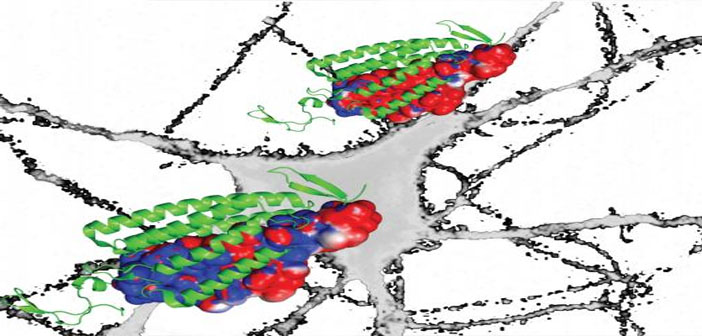
Scientists have bioengineered, in neurons cultured from rats, an enhancement to a cutting edge technology that provides instant control over brain circuit activity with a flash of light. The research funded by the National Institutes of Health adds the same level of control over turning neurons off that, until now, had been limited to turning them on.

“What had been working through a weak pump can now work through a highly responsive channel with many orders of magnitude more impact on cell function,” explained Karl Deisseroth, M.D., Ph.D., of Stanford University, Stanford, Calif.

It is like going from a squirt to a gushing hose.

Deisseroth and colleagues report on what is being hailed as a marvel of genetic engineering in the April 25, 2014 issue of the journal Science.

“This latest discovery by the Deisseroth team is the type of neurotechnology envisioned by President Obama when he launched the BRAIN Initiative a year ago,” said Thomas R. Insel, M.D., director of the National Institute of Mental Health, a funder of the study. “It creates a powerful tool that allows neuroscientists to apply a brake in any specific circuit with millisecond precision, beyond the power of any existing technology. This will be vital for understanding brain circuits involved in behavior, thinking, and emotion.”

Deisseroth’s team had pioneered the use of light pulses to control brain circuitry in animals genetically engineered to be light-responsive – optogenetics. Genes that allow the sun to control light-sensitive primitive organisms like algae, melded with genes that make fluorescent marker proteins, are fused with a deactivated virus that delivers them to specific types of neurons which they become part of – allowing pulses of light to similarly commandeer brain cells.

When a neuron fires depends on the balance of ions flowing across the cell membrane, so being able to experimentally control this cellular machinery is critical for understanding how the brain works. But until now, the optogenetic tools for turning off neurons have been much less powerful than for turning them on – a weak inhibitory pump, moving only one ion per photon of light, versus an efficient excitatory channel.

Stanford bioengineers and their colleagues recently discovered the crystal structure of channelrhodopsin, the protein borrowed from algae to achieve optogenetic control of neurons. To transform this excitatory channel into an effective inhibitory channel, the team systematically introduced mutations into the channel’s gene, gradually reshaping its structure through molecular engineering into one with optimal inhibitory properties. To become an effective inhibitory channel, its central pore needed to be lined with positive instead of negatively charged amino acids to be converted from a cation (positive ion)-conducting into an anion (negative ion) -conducting channel.

Google News Preferences Add PsyPost to your preferred sources

It turns out that there are economies of scale afforded by the transformed channel – the more the inhibition, the less light required to achieve the desired biological effect. This raises possible future therapeutic applications, such as in the management of pain, said Deisseroth.

Previous Post

More should be done for female parolees

Next Post

Researchers reveal relationships between rare languages in the Colombian Amazon

RELATED

Researchers identify two psychological traits that predict conspiracy theory belief
Cognitive Science

The hidden brain benefit of getting in shape that scientists just discovered

March 11, 2026
Scientists use “dream engineering” to boost creative problem-solving during REM sleep
Cognitive Science

Genetic factors drive the link between cognitive ability and socioeconomic status

March 10, 2026
Scientists use “dream engineering” to boost creative problem-solving during REM sleep
Cognitive Science

Everyday mental quirks like déjà vu might be natural byproducts of a resting mind

March 10, 2026
Scientists use “dream engineering” to boost creative problem-solving during REM sleep
Cognitive Science

Scientists use “dream engineering” to boost creative problem-solving during REM sleep

March 10, 2026
Researchers identify two psychological traits that predict conspiracy theory belief
Artificial Intelligence

Brain-controlled assistive robots work best when they share the workload with users

March 8, 2026
How common is anal sex? Scientific facts about prevalence, pain, pleasure, and more
Cognitive Science

New psychology research reveals that wisdom acts as a moral compass for creative thinking

March 6, 2026
Hemp-derived cannabigerol shows promise in reducing anxiety — and maybe even improving memory
Alcohol

Using cannabis to cut back on alcohol? Your working memory might dictate if it works

March 5, 2026
Chocolate lovers’ brains: How familiarity influences reward processing
Cognitive Science

A single dose of cocoa flavanols improves cognitive performance during aerobic exercise

March 4, 2026

STAY CONNECTED

LATEST

Ashwagandha shows promise as a treatment for depression in new rat study

Early exposure to a high-fat diet alters how the adult brain reacts to junk food

How sexual orientation stereotypes keep men out of early childhood education

Your personality and upbringing predict if you will lean toward science or faith

Veterans are no more likely than the general public to support political violence

People with social anxiety are less likely to experience a post-sex emotional glow

The extreme male brain theory of autism applies more strongly to females

A newly discovered brain cluster acts as an on and off switch for sex differences

PsyPost is a psychology and neuroscience news website dedicated to reporting the latest research on human behavior, cognition, and society. (READ MORE...)

  • Mental Health
  • Neuroimaging
  • Personality Psychology
  • Social Psychology
  • Artificial Intelligence
  • Cognitive Science
  • Psychopharmacology
  • Contact us
  • Disclaimer
  • Privacy policy
  • Terms and conditions
  • Do not sell my personal information

(c) PsyPost Media Inc

Welcome Back!

Login to your account below

Forgotten Password?

Retrieve your password

Please enter your username or email address to reset your password.

Log In

Add New Playlist

Subscribe
  • My Account
  • Cognitive Science Research
  • Mental Health Research
  • Social Psychology Research
  • Drug Research
  • Relationship Research
  • About PsyPost
  • Contact
  • Privacy Policy

(c) PsyPost Media Inc