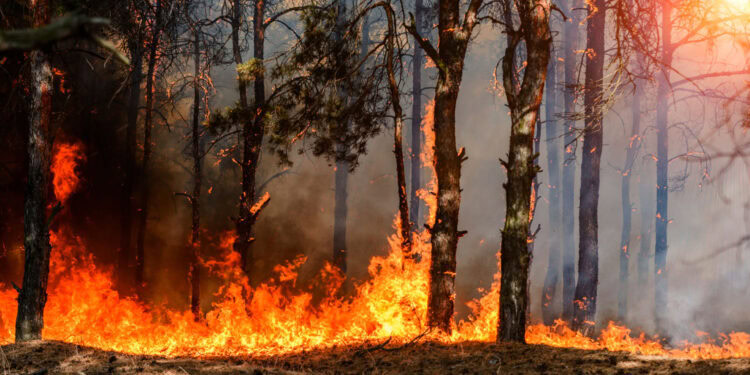

As the frequency and intensity of wildfires increase due to climate change, their impact extends beyond environmental degradation and economic loss. A recent study published in the International Journal of Public Health reveals exposure to wildfire smoke is associated with impaired cognitive health, particularly math and language skills.
While the physical health consequences of wildfires, such as respiratory and cardiovascular issues, are well-documented, the cognitive effects remain underexplored. Cognitive abilities are fundamental to decision-making, behavior formation, and economic development, making it crucial to understand how environmental factors might impair them. By investigating the cognitive costs of wildfires, the researchers aimed to provide a more comprehensive understanding of the socio-economic impacts of climate-related disasters.
For their study, the researchers utilized data from the China Family Panel Studies Database, focusing on individuals aged 10 years and older, and conducted cognitive ability tests in 2014 and 2018. The cognitive tests included word and math assessments, standardized to ensure comparability across individuals and over time. The wildfire data were sourced from the Visible Infrared Imaging Radiometer Suite (VIIRS) satellite, which provided detailed, high-resolution information on wildfire locations and intensities.
To isolate the impact of wildfires on cognitive health, the study used a wind direction model to differentiate between areas exposed to upwind and non-upwind wildfires. This approach allowed the researchers to control for confounding factors such as socio-economic conditions and other environmental pollutants. By comparing cognitive test scores from areas affected by upwind wildfires to those from non-upwind wildfire areas, the study aimed to identify the specific impact of wildfire smoke and pollutants on cognitive abilities.
The researchers also included several control variables to enhance the robustness of their findings. These controls included meteorological factors such as average precipitation, temperature, wind speed, and humidity. Additionally, individual-level variables such as gender, total family income, social status, and medical insurance status were considered.
The study revealed significant negative impacts of wildfire exposure on cognitive abilities. Specifically, it found that for every 10 additional upwind wildfires, individual scores on word and math tests decreased by 0.235 and 0.236 standard deviations, respectively. This decline highlights the detrimental effect of wildfire pollutants on cognitive health, suggesting that exposure to wildfire smoke and related air pollution can impair thinking and language skills.
A notable finding was the greater susceptibility of younger individuals to the cognitive impacts of wildfires. For individuals under 50 years old, a 10-unit increase in upwind wildfires resulted in a 0.325 standard deviation decrease in word test scores and a 0.461 standard deviation decrease in math test scores. This suggests that younger people, who may spend more time outdoors and have developing physiological systems, are more vulnerable to the adverse cognitive effects of wildfire exposure.
The study also examined the role of socio-economic factors in moderating the impact of wildfires on cognitive health. It found that individuals with lower defensive expenditures (money spent on activities and products aimed at protecting their health and well-being) experienced more severe cognitive impacts.
For the low-defense spending group, every 10 additional upwind wildfires led to a decrease of 0.712 and 1.008 standard deviations in word and math test scores, respectively. This indicates that socio-economic disparities play a critical role in determining an individual’s ability to mitigate and recover from the cognitive impacts of wildfires.
To understand the underlying mechanisms, the researchers analyzed the relationship between wildfire exposure and air pollution levels. They found that every 10 additional upwind wildfires increased PM2.5, PM10, AQI, and NO2 levels by 19.5%, 21.1%, 14.7%, and 22.2%, respectively.
PM2.5 refers to fine particulate matter with a diameter of 2.5 micrometers or smaller, PM10 refers to particulate matter with a diameter of 10 micrometers or smaller, AQI (Air Quality Index) is a standardized measure used to communicate how polluted the air currently is or how polluted it is forecast to become, and NO2 (nitrogen dioxide) is a toxic gas produced by combustion processes that can harm respiratory health.
“The results show that exposure to wildfires leads to a significant reduction in the cognitive abilities of individuals,” the researchers wrote. “This finding underscores the serious public health implications of wildfires. The observed negative outcomes align with previous research on the adverse health effects of climate change and disasters.”
“Our research has also shown that wildfires produce large amounts of air pollution particles that can affect an individual’s cognitive abilities. Wildfires release a complex mixture of air pollutants, including particulate matter, volatile organic compounds, and solid particulate matter. The harmful pollutants can deeply penetrate the respiratory system, entering the bloodstream and potentially reaching the brain, which can have an impact on cognitive function.”
“Particulate matter, especially ultrafine particles (PM2.5), can have significant neurotoxic effects, impacting respiratory and cardiovascular health, as well as cognitive function,” the researchers concluded. “The cognitive impacts of wildfires have far-reaching consequences, affecting not only immediate wellbeing but also long-term health outcomes and community resilience in the face of natural disasters. Understanding these impacts is crucial for developing effective public health policies, and disaster response strategies, and enhancing community resilience in light of the disasters caused by climate change.”
The study, “Climate Disaster and Cognitive Ability: Evidence From Wildfire,” was authored by Ran Du, Ke Liu, Dangru Zhao, and Qiyun Fang.