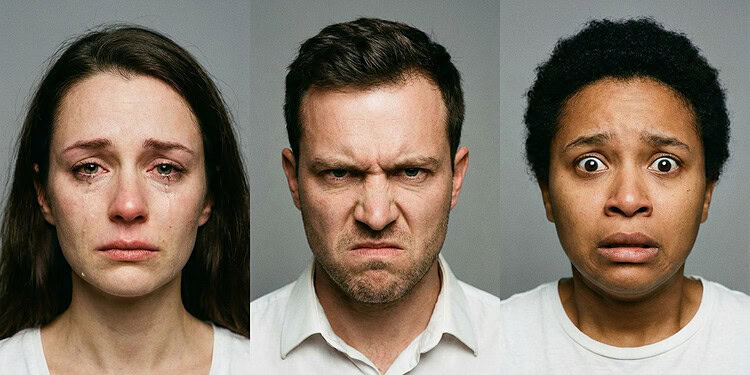

A study in Sweden found that people with psychotic spectrum disorders had more difficulty recognizing emotions in others than healthy people, and that those who also had a history of interpersonal aggression had the most difficulty of all. People in the aggression group were also more likely to mistake negative emotions for positive ones. The paper was published in Schizophrenia.
Recognizing emotions in other people is essential for successful social interaction because facial expressions, tone of voice, and body movements provide important clues about how others feel. When these signals are misunderstood, communication can break down and inappropriate social responses may become more likely.
Difficulties with emotion recognition are common in psychotic spectrum disorders, which in this study included schizophrenia, schizoaffective disorder, delusional disorder, and bipolar disorder with psychotic features. Research has shown that people with these disorders tend to have trouble identifying emotions from faces, voices, and body movements, even when these expressions are presented dynamically rather than as static images. These difficulties appear to be especially pronounced for negative emotions, but are present with positive emotions as well.
People with schizophrenia, for example, often confuse one negative emotion with another or interpret neutral expressions as negative. Such errors may reflect broader problems in perception, memory, language, and other cognitive processes involved in understanding emotional information. Researchers have also investigated whether impaired emotion recognition is related to interpersonal aggression in people with psychotic disorders, but the findings have been mixed.
Study author Gabriela Gavalova of Karolinska Institutet and colleagues investigated how well people with psychotic spectrum disorders recognize a wide range of emotions conveyed dynamically through facial, vocal, and bodily expressions. They compared three groups: people with psychotic spectrum disorders and a history of interpersonal aggression, people with these disorders but no history of interpersonal aggression, and healthy individuals.
They hypothesized that misclassification of emotions would be greatest in people with psychotic spectrum disorders and a history of interpersonal aggression, intermediate in people with these disorders but no history of aggression, and lowest in healthy individuals.
The study included 79 people with psychotic spectrum disorders and a history of interpersonal aggression, recruited from Forensic Psychiatry Stockholm; 72 people with these disorders but no history of interpersonal aggression, recruited at psychiatric outpatient clinics in Stockholm; and 86 healthy individuals recruited through Sweden’s State Person Address Registry. The groups were matched by age and gender, with men making up between 69% and 75% of each group and average ages ranging from 35 to 39 years. Participants with psychotic disorders had been clinically stable, with no changes in medication, for at least three months before testing.
Most participants with psychotic spectrum disorders had schizophrenia (79% in the aggression group and 86% in the non-aggression group). Information about the type and number of aggressive acts was obtained from crime reports, forensic psychiatric assessments, hospital case records, and participants’ self-reports. Acts of interpersonal aggression were defined as threats to life, assault, grievous bodily harm, or murder or manslaughter; about half of the participants in the aggression group had committed assault, and about a third had been convicted of grievous bodily harm.
The groups also differed in other ways. More than three-quarters of the aggression group had a history of alcohol or substance abuse, compared with a third of the non-aggression group and 7% of healthy participants, and more than half of the aggression group had not completed education beyond primary school, compared with 15% of the non-aggression group. The aggression group also scored lower on a test of fluid intelligence than the non-aggression group.
Participants completed psychiatric screening, a test of fluid intelligence (the Matrix Reasoning subtest of the Wechsler Adult Intelligence Scale-IV), and a test of psychomotor speed. To assess how well they knew the words used to name emotions, they picked synonyms for 14 emotion words. They then completed the Emotion Recognition Assessment in Multiple modalities test, in which they watched and listened to short clips of actors expressing 12 different emotions through their faces, voices, and bodies while speaking nonsense sentences. Clips were presented as video only, audio only, or video with sound, and participants chose the emotion being expressed from a list of all 12.
As expected, people with psychotic spectrum disorders and a history of interpersonal aggression performed the worst. Depending on the emotion, their accuracy ranged from 25% for despair to 54% for anger. Participants with psychotic spectrum disorders but no history of aggression performed somewhat better, with accuracies ranging from 29% for despair to 66% for anger, and healthy participants performed the best, with accuracies ranging from 39% to 68%.
All three groups performed well above chance, and the gaps between the groups were similar across emotions and across video, audio, and combined presentations. The authors suggest this points to general cognitive and perceptual difficulties rather than problems specific to particular emotions or senses. Across groups, emotions were recognized best when presented with both video and sound.
The most distinctive finding involved the kinds of errors people made. Participants in the aggression group misread negative emotions as positive ones in 14% of cases, about 1.2 times as often as the non-aggression group and twice as often as healthy participants. The authors speculate that such errors could lead people to miss signs that their behavior is upsetting others, removing a social cue that might otherwise stop an escalating interaction.
Among participants with psychotic disorders, the strongest predictors of emotion recognition were fluid intelligence and understanding of emotion words, followed by gender, with women outperforming men, and educational attainment. Unexpectedly, a history of substance abuse was linked to better performance once other factors were accounted for, a result the authors say may be a statistical artifact and should be interpreted with caution. A history of aggression still predicted poorer emotion recognition after these factors were taken into account, although it explained only about 2% of the additional variation in performance.
“In summary, individuals with PSD [psychotic spectrum disorder] and a history of interpersonal aggression exhibit more pronounced deficits in emotion recognition than those with PSD alone. This underscores the potential value of incorporating emotion recognition assessment and training into clinical interventions to reduce aggression risk and improve social functioning in individuals with PSD,” the study authors concluded.
The study contributes to the scientific understanding of the links between emotion recognition abilities and mental health. However, it should be noted that the design of the study does not allow any causal inferences to be derived from the results. The groups also differed in education, intelligence, and substance use history, and other unmeasured differences between them cannot be ruled out.
Participants were tested while clinically stable, so the study could not capture emotion recognition during acute psychosis or agitation. The emotions were portrayed by actors rather than expressed spontaneously, and the clips, which were developed in Switzerland and featured white European actors, may have been interpreted differently by participants from other backgrounds.
The paper, “Emotion recognition misclassification patterns in individuals with psychotic spectrum disorders and history of interpersonal aggression,” was authored by Gabriela Gavalova, Petri Laukka, Lennart Högman, Malin V. Källman, Marianne Kristiansson, Märta Wallinius, Håkan Fischer, and Anette G. M. Johansson.