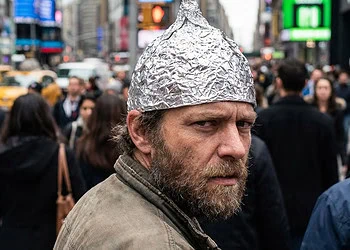
A recent study looked at how people who tend to believe in conspiracy theories responded to false information about COVID-19. The researchers found that individuals with a strong inclination towards conspiracy thinking were less likely to fall for COVID-19 misinformation if they were in a fulfilling romantic relationship. Having a positive romantic connection provided these individuals with a sense of safety and security, reducing their need to seek safety through embracing false information about COVID-19.
The study was published in Current Research in Ecological and Social Psychology.
Conspiracy theories are explanations that suggest secret plots, hidden agendas, or suppressed information to explain real-world events. They often involve beliefs that powerful entities or groups are conspiring against the public. However, the most interesting aspect for scientists is the belief in conspiracy theories that lack credible evidence and are considered fringe beliefs by mainstream society.
Throughout history, it has been beneficial for individuals to be able to recognize and uncover real plots or schemes. Those who could quickly detect signs of unfolding plots were better able to protect themselves, their families, and their social groups. They could prevent others from harming their loved ones, stealing their belongings, and forming alliances to counteract their competitors and enemies. However, these benefits don’t come from believing in plots that don’t actually exist.
Studies have shown that people who believe in one (non-existent) conspiracy, also tend to believe in others, even when stories of such conspiracies e.g. conspiracy theories are logically inconsistent. This suggests that conspiratorial thinking is not connected to the appeal of any specific belief. What it might be connected to is the general trust in the members of the society.
Research indicates that people who feel insufficiently accepted or outright rejected by the society are more prone to conspiratorial thinking. Embracing conspiracies allows them to cope with the anxiety they feel about their connection to society by sharing beliefs with others who endorse the same conspiracies. This shared belief acts as “social proof,” validating their view of reality through the collective agreement of others. This, in turn, helps them believe that their interactions with others will be positive, reducing their anxiety about social connection.
Study author Sandra L. Murraya wanted to investigate whether a romantic relationship could improve the social connection of individuals prone to believing in conspiracies, thereby reducing their susceptibility to such beliefs. The researchers were interested in understanding how people, in general, and conspiracy-prone individuals, in particular, adjusted their beliefs and behavior regarding COVID-19 misinformation circulating in the community during the study.
Study participants were 555 adults recruited by Qualtrics, required to be living with their romantic partner at the time of the study. Their average age was 43 years. 268 were men and 363 had children (2 years old on average). Participant were from across the U.S., but most often from California, North Carolina, Indiana, Vermont and Hawaii. The study was conducted in May and June 2020, during the height of the COVID-19 pandemic. Participants were asked to provide reports by answering to online surveys prepared by the researchers every other day for 3 weeks.
The study involved 555 adults who were recruited through Qualtrics and were living with their romantic partner at the time. The participants’ average age was 43 years and they were from various parts of the U.S., with a higher representation from California, North Carolina, Indiana, Vermont, and Hawaii. The study took place in May and June 2020, during the peak of the COVID-19 pandemic. Participants were asked to complete online surveys every other day for three weeks.
The researchers hypothesized that by increasing the participants’ sense of social connectedness, especially those prone to conspiracy thinking, their need to validate their connection to society through believing in widespread COVID-19 misinformation would decrease. To test this, they divided the participants into two groups.
In the first group (experimental), participants were shown pictures of puppies, sunsets, or positive words associated with their romantic partner’s name during the surveys (excluding the first one). This intervention aimed to enhance the participants’ sense of social connectedness. The second group (control) was shown their partner’s name or role paired with neutral stimuli.
In the initial survey, participants completed an assessment of their general susceptibility to believing in conspiracy theories. Throughout the study, the researchers monitored social media and gathered daily assessments of the U.S. public’s susceptibility to COVID-19 misinformation, negative sentiment towards the White House coronavirus task force, Google searches for COVID-19 myths/hoaxes and “Chinese virus,” and the percentage of residents staying at home in each state.
During the surveys throughout the study period, participants rated various factors, including their trust in fellow community members, their trust in potential acquaintances (strangers shown in pictures), their endorsement of personal beliefs about COVID-19, their trust in government and public health officials, mainstream media, the time spent with mainstream media, their level of concern about COVID-19, their trust in social distancing measures, and their effort in practicing recommended health behaviors (e.g., handwashing, social distancing).
The results showed that, as expected, participants in the experimental group reported higher trust in their fellow community members compared to those in the control group. This difference was especially significant among participants highly prone to believing in conspiracy theories. There was no difference among individuals who were not prone to endorsing conspiracy beliefs in the two groups.
This finding supported the hypothesis that there is a link between proneness to conspiracy beliefs and the feeling of social connectedness. When people prone to conspiracy thinking felt more socially connected, they placed more trust in their fellow community members.
Participants with a high inclination towards believing in conspiracy theories adjusted their level of belief in COVID-19 misinformation based on the daily susceptibility of the U.S. public to such misinformation, as assessed by the researchers. On days when public susceptibility was higher, these participants tended to decrease their personal belief in the information provided by health officials about COVID-19. However, this pattern was only observed among highly conspiracy-prone participants in the control group, while it was absent among those in the experimental group.
“People low and high on conspiratorial thinking share the same strong need to be immersed in rewarding social interactions, not just with friends and family, but with the broader collective community. However, the latter need is especially likely to be frustrated for people prone to conspiratorial thought because they espouse unpopular opinions,” the study authors concluded.
The study sheds light on some of the psychological underpinnings of beliefs in conspiracy theories. However, it should be noted that the study was based on self-reports and on a number of indicators specifically created for this study. It is possible that different decisions about the creation of society-level indicators would produce different study results.
The study, “A moth to a flame? Fulfilling connectedness needs through romantic relationships protects conspiracy theorists against COVID-19 misinformation“, was authored by Sandra L. Murray, Ji Xia, Veronica Lamarche, Mark D. Seery, James McNulty, Dale W. Griffin, Deborah E. Ward, Han Young Jung, Lindsey Hicks, and David Dubois.