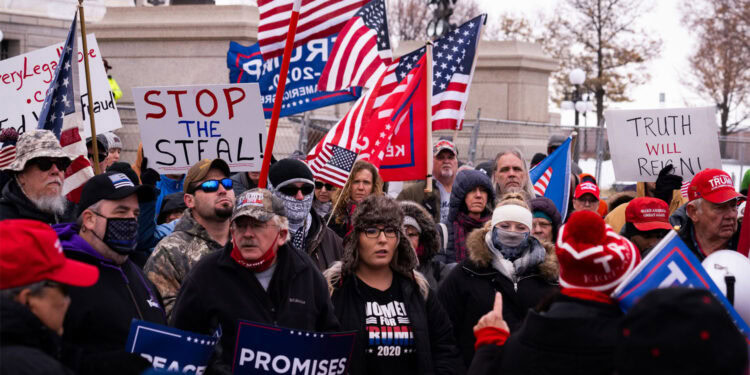

A recent study published in American Politics Research has uncovered a significant relationship between allegations of election fraud by politicians and increased support for political violence among Republican partisans. The findings suggest that such allegations, particularly when made by political elites, can erode democratic stability by making political violence more acceptable to certain groups.
The study aimed to scientifically test whether partisans are more likely to justify political violence when their political rivals are accused of election fraud. This question is critical given the increasing instances of political elites in the U.S. questioning the legitimacy of election outcomes without evidence. Democracies rely on the concept of “loser’s consent,” where those who lose elections accept the results and continue to participate peacefully in the democratic process.
“The violent attack on the U.S. Capitol on Jan 6, 2021 sparked my interest in learning more about what prompts ordinary people to endorse, tolerate, or otherwise support the use of political violence. Of course, the threat of political violence is very salient today in the United States,” said study author James A. Piazza, a professor of political science at The Pennsylvania State University.
Between September 6 and 16, 2021, Piazza conducted an online experiment involving 139 self-identified Republican participants. These participants were recruited through the Lucid Theorem panel and ranged in age from 18 to over 65, with a median age of 52. The sample was predominantly white and Christian, reflecting the demographic characteristics of many Republican voters. Participants were randomly assigned to one of two groups: a control group and a treatment group.
In the control group, the participants read a letter from a fictitious congressional candidate discussing bipartisan issues like protecting Social Security and Medicare, expanding prescription drug coverage, and investing in infrastructure.
In the treatment group, participants read the same letter but with an additional paragraph alleging that Democratic politicians engage in election fraud. This paragraph claimed that Democrats conspire to commit election fraud and question their commitment to the American system of government.
After reading the letters, participants reported the extent to which they agreed or disagreed with five statements about political violence (e.g., “Some of the problems citizens have with the government could be fixed with a few well-aimed bullets”).
About 33.1 percent of the Republican participants rejected all forms of political violence, while fewer than nine percent of the sample exhibited a moderately high or high level of support for all forms of political violence.
But Republican participants exposed to allegations of Democratic election fraud were significantly more likely to express support for political violence. Specifically, the exposure to such allegations increased their support for political violence by approximately 18.6 percent. This finding was consistent across various models and statistical tests.
Increased mistrust of racial and religious outgroups mediated the relationship between exposure to fraud allegations and support for political violence. About 25 percent of the effect of fraud allegations on support for political violence was explained by heightened mistrust of racial and religious “others.” This suggests that allegations of election fraud activate underlying prejudices, making political violence more acceptable to those who harbor such distrust.
The findings indicate that “the words and behaviors of politicians have a significant impact on democratic stability and the peaceful conduct of politics in the United States,” Piazza told PsyPost. “When politicians allege that rivals have engaged in election fraud, without evidence, they are normalizing political violence by eroding partisan trust in democratic institutions and, in the case of Republicans, tapping into volatile racial and religious resentments that further normalize political violence.”
In a separate but similar study, Democratic participants were exposed to a letter that included allegations of Republican election suppression, manipulation, and disenfranchisement. This treatment letter claimed Republicans would “stop at nothing to win,” engaged in voter suppression, excluded legal ballots, and enacted legislation to restrict voting rights.
Interestingly, Piazza found an asymmetrical effect when comparing responses from Republican and Democratic partisans. While allegations of election fraud by Democrats increased support for political violence among Republicans, similar allegations against Republicans did not have the same effect on Democratic partisans.
“I was a bit surprised that the main effect – that allegations of election fraud by politicians prompt co-partisans to express more support for political violence – was not reciprocal across the parties,” Piazza said. “This effect is only found for Republicans. Not Democrats.”
Piazza controlled for gender, age, racial identification, religion, household income, education, level of political engagement, media consumption habits, social media consumption, and political ideology. But, as with all research, there are some caveats to consider.
For instance, the study relied on self-reported attitudes, which may not always translate into actual behavior. Future research could explore the real-world implications of these findings by examining whether exposure to fraud allegations leads to actual instances of political violence.
The study was conducted before several significant events, such as the hearings and release of the final report of the U.S. House of Representatives select committee investigating the January 6, 2021, assault on the U.S. Capitol and the 2022 elections. These events may have further shaped partisan attitudes toward election fraud and political violence, warranting updated research to assess current trends.
“I would like to rerun the study after the 2024 election to see if the results still hold and whether or not the non-reciprocal finding discussed above is still evident,” Piazza said. “In my ongoing research, I am still investigating predictors of individual support for political violence in the U.S., including democracy skepticism, resistance to social and demographic change, sexism and masculinity, etc.”
The study, “Allegations of Democratic Election Fraud and Support for Political Violence Among Republicans,” was published June 23, 2024.