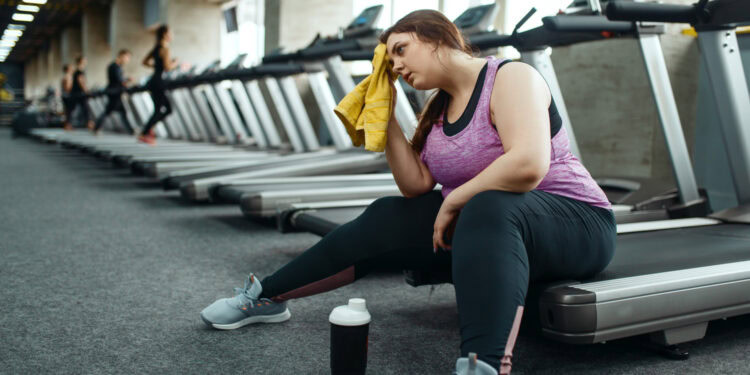

A new study finds that women who wear plus-size exercise clothing experience a contingent relationship between their apparel and physical activity motivation, with dissatisfaction leading to avoidance of exercise. This research was published in Sex Roles.
Previous research has shown that women with larger bodies face significant stigma, both in broader society and within the fitness industry. Exercise apparel for plus-size women often lacks availability, comfort, and functionality, which can discourage physical activity. Further, women are made to feel that their bodies do not belong in fitness settings, which can lead to negative psychological experiences such as body surveillance and social physique anxiety. These experiences can further hinder physical activity participation.
Researchers Christy Greenleaf and Caitlyn Hauff recruited 130 women who wore a U.S. clothing size of 14 or larger and engaged in physical activity at least two days a week. Participants were primarily White (89.2%) and on average 40.5-years-old. They completed several measures related to clothing size and satisfaction, as well as psychological experiences during physical activity.
To measure satisfaction with plus-size exercise clothing, participants responded to eight items that assessed the availability of options, cost, sizing, fashionability, and functionality of exercise apparel in both in-store and online settings, rated on a 5-point scale. Participants responded to prompts about how their clothing affected their emotions during physical activity and their body image, assessing both positive and negative emotions.
Participants also completed the Body Surveillance Subscale of the Objectified Body Consciousness Scale, which evaluated the extent to which they focused on their body’s appearance rather than its function during physical activity. Social physique anxiety, or the fear of how others perceive one’s body, was measured using the Social Physique Anxiety Scale. Lastly, exercise avoidance motivation was assessed using four items that captured participants’ discomfort in public exercise settings and their tendency to avoid activity due to their body image concerns.
In addition to the quantitative measures, the researchers incorporated a qualitative component. Participants were asked two open-ended questions: how their exercise clothing positively influenced their physical activity and how it negatively influenced it. A coding team consisting of the authors and a research assistant categorized the responses into themes related to clothing characteristics (such as fit, comfort, and style) and psychological responses (such as confidence, motivation, and feelings of belonging).
Women who expressed satisfaction with their clothing reported higher levels of body confidence and more positive emotional experiences while exercising. They described feeling comfortable, happy, and proud when their clothing fit well and performed effectively during physical activity. In contrast, women who were dissatisfied with their exercise apparel experienced higher levels of body surveillance and social physique anxiety. These women reported that poorly fitting or uncomfortable clothing heightened their self-consciousness, leading to negative feelings such as frustration, embarrassment, and discomfort during exercise.
Further, dissatisfaction with plus-size exercise apparel was a strong predictor of exercise avoidance motivation. Women who were unhappy with their clothing were more likely to avoid public exercise spaces, such as gyms or outdoor settings, due to concerns about how their bodies were perceived by others. Negative feelings were linked to poorly fitting or unfashionable clothing, which made participants feel out of place in fitness environments.
Qualitative responses from participants highlighted a contingent relationship between clothing and exercise: when their exercise attire was functional, comfortable, and stylish, they were more motivated to participate in physical activity. However, when their clothing was ill-fitting or uncomfortable, they experienced greater anxiety and a tendency to avoid exercise altogether.
One limitation is that the study did not include a diverse range of clothing sizes, as most participants wore sizes 1X to 3X.
Overall, this research highlights the importance of well-designed, comfortable plus-size exercise clothing in encouraging physical activity among women with larger bodies. Clothing that fits well and aligns with fashion trends can foster confidence and motivation, while poor-quality apparel may act as a barrier to exercise.
The research, “When It Fits Wrong, I’m So Self-Conscious I Want to Die! Women’s Experiences Wearing Plus-Size Exercise Clothing”, was authored by Christy Greenleaf and Caitlyn Hauff.