Subscribe
The latest psychology and neuroscience discoveries.
My Account
  • Mental Health
  • Social Psychology
  • Cognitive Science
  • Neuroscience
  • About
No Result
View All Result
PsyPost
PsyPost
No Result
View All Result
Home Exclusive Cognitive Science

Extended use of a neuromusculoskeletal bionic hand does not remap the brain’s sense of touch

by Eric W. Dolan
January 2, 2021
in Cognitive Science
Share on TwitterShare on Facebook

A new study that examined people who used a neuromusculoskeletal prosthesis suggests that the brain has a more limited ability to to reorganize sensory input than previously thought. Researchers found that the perceived location of touch on a bionic hand did not change despite daily use over an extended period.

The findings appear in the journal Cell Reports.

“I focused my work on restoring sensorimotor function after traumatic events such as an amputation. Creating prosthesis that can provide sensory information intuitively to the user, as our biological hands do, is important to increase their function,” said study author Max Ortiz Catalan (@MaxOrtizCatalan), an associate professor at Chalmers University of Technology and director of the Center for Bionics and Pain Research.

“There is a new concept on artificial limbs called neuromusculoskeletal prostheses which are interfaced with the user’s nerves, muscles, and skeleton. These prostheses can provide intuitive sensory feedback by stimulating the nerves that were severed due to the amputation and used to be connected to the missing limb.”

But surgeons can’t be sure whether their placement of the electrodes will generate a sensation in the correct location. “It is difficult for surgeons to place the implanted electrodes exactly in the nerve fibers that used to be connected to specific parts of the hand. It can be done roughly, but not precisely,” Ortiz Catalan told PsyPost.

Three participants with above-elbow amputations were equipped with high-tech neuroprosthetic devices that were affixed directly to their humerus bone. The users could control the prosthetic device thanks to signals received from electrodes implanted in the residual arm muscles, and received sensory feedback via another set of implanted electrodes. A sensor located on the prosthetic thumb triggered stimulation of the nerve, which in turn elicited a touch sensation.

Even after a full year of using the devices, however, the participant’s subjective sensation never shifted to match the location of the touch sensors on their prosthetic devices. The participants did not report feeling the sensation on the thumb, but rather in other hand locations, such as their middle finger or the palm. “This fixedness is especially surprising given that the prosthesis was used on a daily basis and the sensory feedback was behaviorally relevant,” the researchers said.
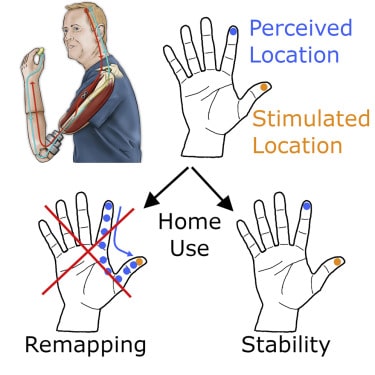
The participant’s subjective sensation never shifted to match the location of the touch sensors on their bionic hand. (Source: Cell Reports)

“We hoped that the brain would change and adapt to the new location seen by the user in daily life use, but it didn’t — the location of the perceived sensation remained stable elsewhere in the hand since the beginning. If we want a more precise targeting of locations, we need neural interfaces with higher resolution or novel surgical methods,” Ortiz Catalan explained.

Google News Preferences Add PsyPost to your preferred sources

The findings suggest that sensory maps are highly stable in adulthood and the nervous system has a limited ability to adapt to different sensory input.

“There’s been this idea that the nervous system is really plastic, so if you see a mismatch between what you see and what you feel, it’s a great opportunity for neural remapping,” said co-author Sliman Bensmaia. “For example, if you sew two fingers together and look at how that’s represented in the brain, they seem to have merged.”

“But I think that this idea has been vastly overstated. It’s less like you’re reorganizing a room and more like you’re just hearing echoes bouncing around an empty chamber,” he continued. “You might get some overlapping sensation from adjacent limbs, but it’s just because the area of the brain that used to respond to sensation is empty, and activating the neurons around it leads to an echo through the emptiness.”

The study, “Chronic Use of a Sensitized Bionic Hand Does Not Remap the Sense of Touch“, was authored by Max Ortiz-Catalan, Enzo Mastinu, Charles M. Greenspon, and Sliman J. Bensmaia.

Previous Post

Americans with authoritarian tendencies are less inclined to wear masks amid the COVID-19 pandemic

Next Post

New research shows online dating can cultivate a rejection mindset

RELATED

Vivid close-up of a brown human eye showing intricate iris patterns and details.
Cognitive Science

How different negative emotions change the size of your pupils

April 11, 2026
The surprising way the brain’s dopamine-rich reward center adapts as a romance matures
Cognitive Science

Longitudinal study links associative learning gains to later improvements in fluid intelligence

April 10, 2026
Scientists observe “striking” link between social AI chatbots and psychological distress
Cognitive Science

Why some neuroscientists now believe we have up to 33 senses

April 9, 2026
Casual sex is linked to lower self-esteem and weaker moral orientations in women but not men
Cognitive Science

Fake medicine yields surprisingly real results for older adults’ memory and stress

April 9, 2026
Sorting Hat research: What does your Hogwarts house say about your psychological makeup?
Cognitive Science

Teenage brains process mechanical and academic skills differently across the sexes

April 8, 2026
Your brain might understand music theory better than you think, regardless of formal training
Cognitive Science

Your brain might understand music theory better than you think, regardless of formal training

April 8, 2026
Cognitive Science

Intelligent people are better judges of the intelligence of others

April 6, 2026
A surprising body part might provide key insights into schizophrenia risk
Cognitive Science

Brain scans reveal how a woman voluntarily enters a psychedelic-like trance without drugs

April 4, 2026

STAY CONNECTED

RSS Psychology of Selling

  • Should your marketing tell a story or state the facts? A massive meta-analysis has answers
  • When brands embrace diversity, some customers pull away — and new research explains why
  • Smaller influencers drive engagement while bigger ones drive purchases, meta-analysis finds
  • Political conservatives are more drawn to baby-faced product designs, and purity values explain why
  • Free gifts with no strings attached can boost customer spending by over 30%, study finds

LATEST

How different negative emotions change the size of your pupils

Artificial intelligence makes consumers more impatient

Stacking bad habits triples the risk of co-occurring anxiety and depression in teenagers

When the pay gap is wide, women see professional beauty as a strategic asset

Scientists discover intriguing brainwave patterns linked to rhythmic sound meditation

Drumming with friends increases oxytocin levels in children, study finds

Cognitive dissonance helps explain why Trump supporters remain loyal, new research suggests

Crying during a conflict damages your opponent’s reputation at a cost to your own

PsyPost is a psychology and neuroscience news website dedicated to reporting the latest research on human behavior, cognition, and society. (READ MORE...)

  • Mental Health
  • Neuroimaging
  • Personality Psychology
  • Social Psychology
  • Artificial Intelligence
  • Cognitive Science
  • Psychopharmacology
  • Contact us
  • Disclaimer
  • Privacy policy
  • Terms and conditions
  • Do not sell my personal information

(c) PsyPost Media Inc

Welcome Back!

Login to your account below

Forgotten Password?

Retrieve your password

Please enter your username or email address to reset your password.

Log In

Add New Playlist

Subscribe
  • My Account
  • Cognitive Science Research
  • Mental Health Research
  • Social Psychology Research
  • Drug Research
  • Relationship Research
  • About PsyPost
  • Contact
  • Privacy Policy

(c) PsyPost Media Inc