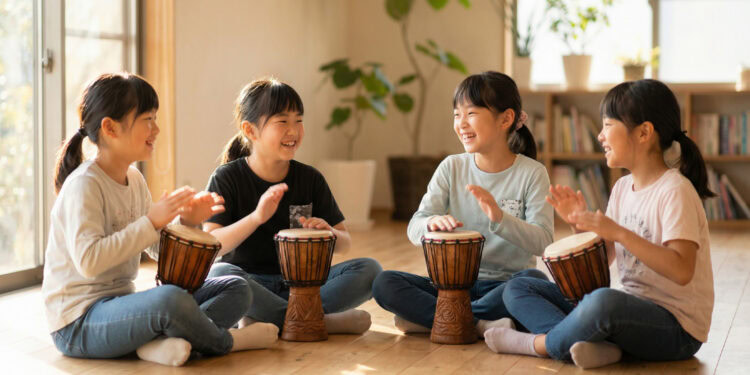

A study in Japan found that elementary school girls show an increase in the levels of the hormone oxytocin in saliva when they participate in drum circles with their friends. Participation in drum circles with strangers did not affect oxytocin levels. Cortisol levels did not change after these activities. The paper was published in Brain and Behavior.
Oxytocin and cortisol are two important hormones that play key roles in how the body responds to social situations and stress. Oxytocin is sometimes called the “love hormone” because it is involved in bonding, trust, and social connection. It is released during activities such as hugging, childbirth, breastfeeding, and positive social interactions. Oxytocin tends to promote relaxation, reduce anxiety, and strengthen interpersonal attachment.
Cortisol, in contrast, is known as the “stress hormone” and is released in response to physical or psychological stress. It helps mobilize energy by increasing blood sugar and preparing the body for a “fight-or-flight” response. Short-term increases in cortisol are adaptive and help individuals cope with immediate challenges. However, chronically elevated cortisol levels can have harmful effects, including impaired immunity, sleep problems, and increased risk of disease. Oxytocin and cortisol tend to have opposing effects, with oxytocin dampening stress responses and cortisol heightening them.
Study author Mitsuru Kikuchi and his colleagues wanted to assess oxytocin and cortisol responses in children participating in facilitated drum circle activities for the first time. They hypothesized that children who participate in such circles with friends would show higher oxytocin levels than those participating with strangers.
Study participants were 28 girls, aged 9 to 10 years, attending an elementary school in Japan. Study authors divided them into two groups of 14 girls. One group participated in a drum circle with friends, while the other participated with strangers.
The drum circle was based solely on drumming without singing or background music. Drums were placed in a circle, and the children chose a drum they liked and sat by it. The facilitator and assistant led the children and organized them to play “Call and Response,” “Drum Circle Freeze,” and “Drum Jam” on the drums.
The children in the group participating in the drum circle with friends were girls attending the same school and playing together outside school hours. The other group (strangers) were girls who did not know each other. There were three drum circles for the group of strangers, each with either 7 or 4 participants. There were four drum circles with 3-5 participants for the friends group.
Before and after the drum circle, participants gave saliva samples, allowing study authors to measure their cortisol and oxytocin levels. They also completed assessments of the quality of life (the Kid-KINDL), autistic symptoms (the Social Responsiveness Scale-Second Edition), anxiety (the Spence Children’s Anxiety Scale), and depression (the Depression Self-Rating Scale for Children). They also rated their emotional states before and after the drum circle using visual analogue scales.
Results showed that salivary oxytocin levels increased after drum circles in the friend group, but not in the group that participated in drum circles with strangers. Salivary cortisol levels did not change after drum circles. Participants’ happiness and relaxation ratings improved significantly in the strangers group after the drum circles, while the friends group reported no change. However, after the activity, the overall mean emotional scores were high and similar between the two groups.
“Our current data suggest that participation in facilitated drum circles with friends may lead to an increase in OT [oxytocin] levels in children, and that preexisting bonds may influence the neuroendocrinological response,” the study authors concluded.
The study contributes to the scientific understanding of the physiological effects of social activities. However, it should be noted that the study was conducted on a small group of elementary school girls. Results on other age and demographic groups might differ.
The paper, “Differences in Oxytocin Response Between a Group of Friends and a Group of Strangers Following Facilitated Drum Circle Activities,” was authored by Mitsuru Kikuchi, Sanae Tanaka, Kazumi Furuhara, Haruhiro Higashida, and Chiharu Tsuji.