 The idea that females are more resilient than males in responding to stress is a popular view, and now University at Buffalo researchers have found a scientific explanation. The paper describing their embargoed study will be published July 9 online, in the high-impact journal, Molecular Psychiatry.
“We have examined the molecular mechanism underlying gender-specific effects of stress,” says senior author Zhen Yan, PhD, a professor in the Department of Physiology and Biophysics in the UB School of Medicine and Biomedical Sciences. “Previous studies have found that females are more resilient to chronic stress and now our research has found the reason why.”
The research shows that in rats exposed to repeated episodes of stress, females respond better than males because of the protective effect of estrogen. In the UB study, young female rats exposed to one week of periodic physical restraint stress showed no impairment in their ability to remember and recognize objects they had previously been shown. In contrast, young males exposed to the same stress were impaired in their short-term memory.
An impairment in the ability to correctly remember a familiar object signifies some disturbance in the signaling ability of the glutamate receptor in the prefrontal cortex, the brain region that controls working memory, attention, decision-making, emotion and other high-level “executive” processes.
Last year, Yan and UB colleagues published in Neuron a paper showing that repeated stress results in loss of the glutamate receptor in the prefrontal cortex of young males.
The current paper shows that the glutamate receptor in the prefrontal cortex of stressed females is intact. The findings provide more support for a growing body of research demonstrating that the glutamate receptor is the molecular target of stress, which mediates the stress response. The stressors used in the experiments mimic challenging and stressful, but not dangerous, experiences that humans face, such as those causing frustration and feelings of being under pressure, Yan says.
By manipulating the amount of estrogen produced in the brain, the UB researchers were able to make the males respond to stress more like females and the females respond more like males.
“When estrogen signaling in the brains of females was blocked, stress exhibited detrimental effects on them,” explains Yan. “When estrogen signaling was activated in males, the detrimental effects of stress were blocked.
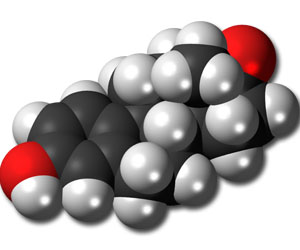
“We still found the protective effect of estrogen in female rats whose ovaries were removed,” says Yan. “It suggests that it might be estrogen produced in the brain that protects against the detrimental effects of stress.” In the current study, Yan and her colleagues found that the enzyme aromatase, which produces estradiol, an estrogen hormone, in the brain, is responsible for female stress resilience. They found that aromatase levels are significantly higher in the prefrontal cortex of female rats.
“If we could find compounds similar to estrogen that could be administered without causing hormonal side effects, they could prove to be a very effective treatment for stress-related problems in males,” she says. She notes that while stress itself is not a psychiatric disorder, it can be a trigger for the development of psychiatric disorders in vulnerable individuals.