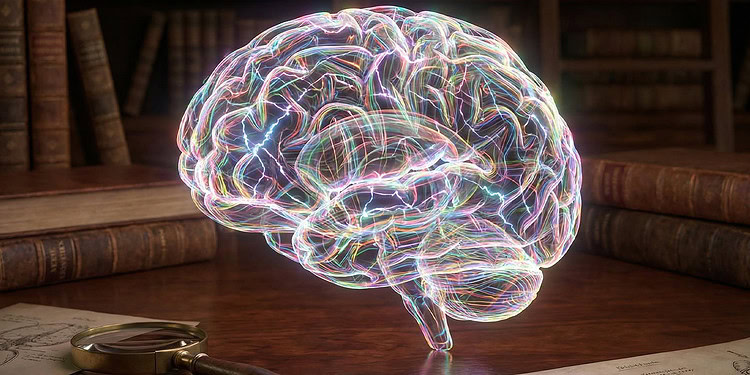

New research published in BMC Psychology suggests that the structural wiring of the brain may play a significant role in how people solve problems through sudden insight. The study indicates that individuals who frequently experience “Aha!” moments tend to have less organized white matter pathways in specific language-processing areas of the left hemisphere. These findings imply that a slightly less rigid neural structure might allow the brain to relax its focus, enabling the unique connections required for creative breakthroughs.
For decades, scientists have studied the phenomenon of insight, which occurs when a solution to a problem enters awareness suddenly and unexpectedly. This is often contrasted with analytical problem solving, which involves a deliberate and continuous step-by-step approach.
While previous studies using functional MRI and EEG have mapped the brain activity that occurs during these moments, there has been little understanding of the underlying physical structure that supports them. The researchers behind the new study aimed to determine if stable differences in white matter—the bundles of nerve fibers that connect different brain regions—predict an individual’s tendency to solve problems via insight.
“For over two decades, neuroscience has mapped what happens in the brain during these moments using EEG and fMRI. We know from prior research that insight feels sudden, tends to be accurate, and involves distinct functional activation patterns — including a burst of activity in the right temporal cortex just before the solution reaches awareness,” said study authors Carola Salvi of the Cattolica University of Milan and Simone A. Luchini of Pennsylvania State University.
“But one major question remained open: what structural features of the brain might make some people more likely to experience insight in the first place?”
“Most previous white matter studies of creativity did not specifically focus on Aha! experiences. They measured how many problems people solved, or how creatively, not how they solved them (with or without these sudden epiphanies). Yet insight and non insight solutions are phenomenologically and neurally distinct processes.”
White matter acts as the communication infrastructure of the brain, transmitting signals between distant regions. To examine this structure, the researchers employed a technique called Diffusion Tensor Imaging (DTI). This method tracks the movement of water molecules within brain tissue.
“We wanted to know whether stable white matter microstructure — the brain’s anatomical wiring — differs depending on whether someone tends to solve problems through sudden insight or through deliberate step-by-step reasoning (non insight solutions),” Salvi and Luchini explained. “Diffusion tensor imaging (DTI) allowed us to examine this structural dimension directly.”
In healthy white matter, water tends to move along the direction of the nerve fibers, a property known as fractional anisotropy (FA). High FA values generally indicate highly organized, dense, and well-insulated fibers, which are typically associated with efficient signal transmission and strong cognitive performance.
The study involved 38 distinct participants, after excluding those who did not meet specific criteria or failed to complete the task correctly. These participants engaged in a standard test used to measure creative potential known as the Compound Remote Associates (CRA) task. In this activity, individuals viewed three words, such as “crab,” “pine,” and “sauce,” and were asked to find a fourth word that forms a common phrase with all three, in this case, “apple.”
After each successful solution, participants reported whether they arrived at the answer through a step-by-step analysis or a sudden insight. This self-reporting method allowed the scientists to quantify an “insight propensity” for each person. The researchers then analyzed the DTI scans to see how white matter integrity correlated with this propensity, controlling for variables such as age and gender.
The findings offered a counterintuitive perspective on brain connectivity. The analysis revealed that participants who solved more problems via insight exhibited lower fractional anisotropy in the left hemisphere’s dorsal language network. This network includes the arcuate fasciculus and the superior longitudinal fasciculus, pathways that connect brain regions responsible for language production, comprehension, and semantic processing.
“One striking finding was that people who more frequently experienced insight showed lower fractional anisotropy in specific left-hemisphere dorsal language pathways, including parts of the arcuate fasciculus and superior longitudinal fasciculus,” Salvi and Luchini told PsyPost.
“At first glance, that might sound counterintuitive. Fractional anisotropy is often interpreted as reflecting the coherence or organization of white matter pathways. In many cognitive domains, higher fractional anisotropy is associated with better performance.”
“But insight may operate differently. The left hemisphere is typically involved in focused, fine-grained semantic processing — narrowing in on dominant interpretations of words and concepts. The right hemisphere, by contrast, is thought to support broader, ‘coarse’ semantic coding — integrating more distantly related ideas. Slightly lower fractional anisotropy in left dorsal language pathways may reflect a system that is less tightly constrained by dominant interpretations.
“In other words, it may allow a partial ‘release’ from habitual patterns of thought and it is in line with other studies where lesions in the left frontotemporal regions have been shown to increase artistic creativity,” Salvi and Luchini continued. “Taken together, these findings imply that left hemispheric regions play a regulatory role in creativity and that their disruption lifts this constraint, thus promoting novel ideas.”
“That release effect is fascinating. In simple words It suggests that creativity sometimes emerges not from strengthening control, but from relaxing it just enough to let weaker, more remote associations surface. When the brain is less locked into its most obvious interpretations, it may be more capable of restructuring the problem — and that restructuring is the heart of an Aha! moment.”
It is worth noting that no significant structural associations were found for the step-by-step analytical problem solving style. This suggests that the neural architecture supporting insight is distinct and specific. Analytical solving may rely on dynamic brain activity rather than the stable structural traits identified for insight.
This concept of sudden recognition is being explored in other sensory domains as well. A separate study recently conducted by researchers at NYU Langone Health examined “one-shot learning,” which is the visual equivalent of an “Aha!” moment.
In that study, participants viewed blurred images that became recognizable only after seeing a clear version. The NYU team found that the high-level visual cortex stores “priors,” or memory templates, which the brain accesses to suddenly make sense of ambiguous visual information.
While the NYU study focused on visual perception and the current study focused on linguistic creativity, both highlight a similar cognitive phenomenon: the brain’s ability to reorganize information suddenly to form a coherent whole. The NYU findings suggest this happens through accessing stored memory templates, while the current study suggests that linguistic insight relies on structural flexibility that permits distant connections to surface.
There are some limitations to the current study that warrant mention. The sample size of 38 participants is relatively small, though it is typical for technically intensive DTI studies. Additionally, the study establishes a correlation but does not prove causation. It remains unclear whether people are born with this structural connectivity or if engaging in creative thinking alters the white matter over time. Demographic factors such as education level were also noted as potential influences on white matter integrity.
Future research will likely focus on larger and more diverse groups to verify these results. Scientists may also attempt to combine structural imaging with functional tracking to see how these white matter highways are utilized in real-time during the moment of insight. By understanding the physical architecture of creativity, science moves closer to demystifying how the human brain generates novel ideas.
“In many areas of cognition, greater microstructural organization (as indexed by higher fractional anisotropy) is associated with stronger performance. Here, greater insight propensity was linked to lower fractional anisotropy in specific left dorsal pathways,” the researchers added.
“This challenges a simple ‘more organized white matter equals better cognition’ view. Instead, it suggests that the neural architecture supporting insight may involve a delicate balance between constraint and flexibility. Too much structural rigidity could reinforce dominant interpretations. A slightly less constrained system may allow the mind to wander just far enough to discover something unexpected. That idea — that brilliance can emerge from loosening control rather than tightening it — is both scientifically intriguing and deeply human.”
The study, “The white matter of Aha! moments,” was authored by Carola Salvi, Simone A. Luchini, Franco Pestilli, Sandra Hanekamp, Todd Parrish, Mark Beeman, and Jordan Grafman.