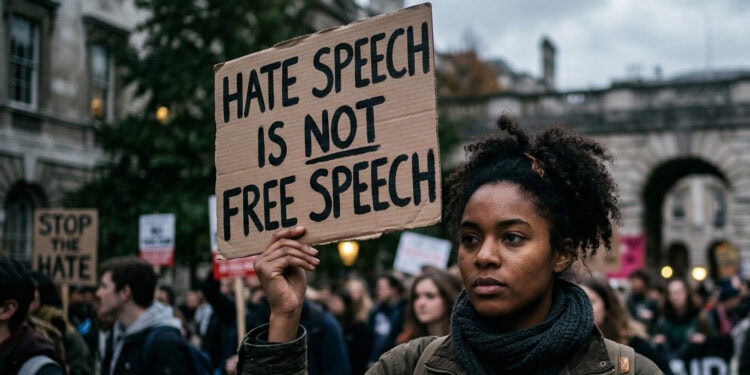

A survey of over 4,000 individuals found that Gen Z Americans tend to be more accepting of shoutdowns, blockades, and violence as methods to suppress speech than their older compatriots, regardless of whether they are asked about these tactics in the abstract or against speech they find personally offensive. Young liberals tended to be more supportive of these methods compared to conservatives when asked abstractly worded questions, but this ideological gap disappeared when the questions referred to suppressing specific, highly offensive ideas. The paper was published in PS: Political Science & Politics.
Free speech is a cornerstone of democratic society. However, people do not always agree about what should happen when speech is considered offensive or harmful. One of the personal and social characteristics that allows free speech to exist is political tolerance. Political tolerance involves allowing people to express ideas that we strongly oppose. In this way, controversial speech is an important test of a person’s commitment to the principles of political tolerance.
Recent research suggests that attitudes toward free speech in the United States may be changing, particularly among younger generations. Younger and more progressive Americans appear increasingly likely to weigh concerns about equality, inclusion, and harm against an unrestricted commitment to freedom of expression. The issue becomes especially complicated when protests themselves are intended to prevent other people from speaking. Although Americans generally support peaceful protest, support falls considerably when protesters employ disruptive, coercive, or violent tactics.
Study author Kevin Jay Wallsten explored the American public’s views on speech-suppressing, disruptive protest tactics. He noted that previous research generally examined tolerance in one of three ways: by exploring abstract support for free speech; by exploring how much people tolerate speech from groups the researchers believe are broadly unpopular, such as communists or racists (the “fixed-group” approach); and by exploring tolerance toward a “least-liked group” that the respondents previously selected from a list.
He notes that the first two approaches can overestimate tolerance because they do not measure whether respondents would actually extend civil liberties to groups they find disagreeable. Researchers using the fixed-group approach do not definitively know if their respondents actually find the groups they are asking about disagreeable, or to what extent. They only gauge the general view of the public.
To address this, Wallsten conducted a nationally representative survey of 4,188 Americans. Study participants were randomly assigned to one of two conditions. In the first condition (the “non-group” or abstract approach), participants were asked: “How acceptable [always/sometimes/rarely/never] would you say it is for people to engage in the following action to protest a public speaker?: (1) shouting down a speaker to prevent them from speaking; (2) blocking other people from attending a speech; and (3) using violence to stop a speech.”
In the second condition (the “most-offensive-idea” approach), participants were first asked to select the statement they found most offensive from a list (e.g., “All whites are racist oppressors” or “America got what it deserved on 9/11”). They were then asked whether the protest tactics described in the first condition would be acceptable when used against a speaker advocating the specific idea they just selected.
Results showed that the idea participants found to be most offensive depended heavily on their political ideology. For example, the statement “January 6th was a peaceful protest” was selected as the most offensive by almost 25% of liberals, but only 1% of conservatives. On the other hand, statements like “All whites are racist oppressors” were much more frequently selected by conservatives. Interestingly, the shares of conservatives and liberals who selected “America got what it deserved on 9/11” and “All immigrants should be arrested and deported” as the most offensive were relatively similar.
Results further showed that the three tactics the survey asked about were not equally endorsed. Participants were most accepting of shouting down a speaker and least accepting of using violence. Overall, the youngest participants (Gen Z) tended to be more accepting of all three methods of suppressing speech than older generations. Furthermore, the study found no significant difference between Gen Z respondents who attend college and those who do not, suggesting this acceptance is a generational shift rather than a result of higher education socialization.
Ideological differences also depended entirely on how the question was asked. Young liberals tended to be more supportive of these methods compared to conservatives and moderates only in the abstract condition where the speaker’s statements were not specified. However, when respondents evaluated tactics used against a speaker making a statement they personally found offensive, acceptance increased among conservatives and moderates, completely erasing the ideological gap.
“These analyses reveal important generational differences in how people think about speech-suppressing shoutdowns, blockades, and violence. Members of Gen Z consistently express more permissiveness about these tactics than older cohorts,” the study author concluded.
“Although previous research suggests that young liberals are particularly supportive of disruptive protest actions, this study demonstrates that ideological polarization is present only when survey respondents are asked abstractly worded questions. When asked to evaluate disruptive acts targeting speakers that they find personally offensive, ideological gaps between liberals and conservatives close.”
The study contributes to the scientific understanding of political tolerance in the U.S. However, it should be noted that all data came from self-reports (asking people how acceptable certain actions are to them in theory) rather than observing their behavior in real-world situations. This leaves room for self-reporting bias—where people answer how they think they should feel rather than how they would actually act—to have affected the results.
The paper, “Generational and Ideological Divides in Support for Speech-Suppressing Protest,” was authored by Kevin Jay Wallsten.