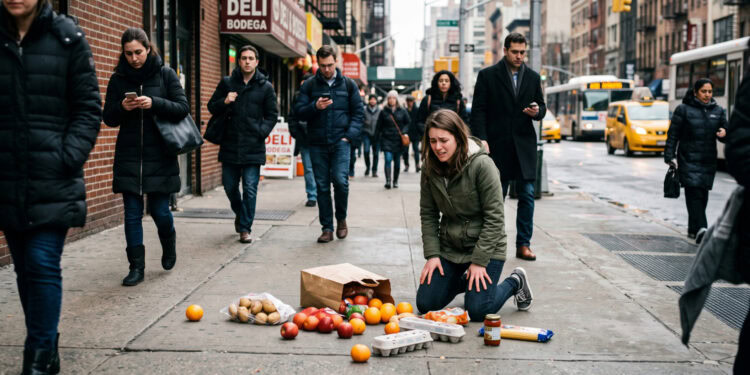

A recent study published in Cognition and Emotion indicates that feeling grateful increases a person’s willingness to help others, even in group settings. However, experiencing gratitude does not make individuals immune to the bystander effect, a psychological phenomenon where people are less likely to intervene when more potential helpers are present. The findings suggest that gratitude boosts overall helpfulness but does not change our tendency to hold back when responsibility can be shared with a crowd.
Gratitude is a positive emotion triggered when someone receives a benefit from another person. This feeling often transforms receivers into givers by motivating them to act in a prosocial manner. Prosocial behavior refers to actions intended to benefit others, such as donating money or assisting a stranger. Past studies provide evidence that gratitude promotes these helpful behaviors more effectively than a neutral mood or other positive emotions.
Most earlier experiments focused on situations involving just one potential helper and one person in need. In everyday life, people frequently encounter situations where multiple individuals could step in to provide assistance. When multiple people are present, the bystander effect often takes hold, describing how individuals become less likely to offer help as the number of potential helpers increases.
People hesitate in groups because of a diffusion of responsibility, meaning they feel less personally accountable when others are around. They also experience uncertainty about whether someone else will act or if their own intervention is even needed. The authors designed their experiment to see if the motivational power of gratitude could overcome this hesitation.
“While the prosocial benefits of gratitude are well-documented, previous studies have mainly focused on simple bilateral situations,” said Ryuji Oguni, a psychology lecturer at Shujitsu University and visiting researcher at Ritsumeikan University. “In daily life, however, helping opportunities often occur in groups where multiple people could intervene. We wanted to bridge this gap by examining whether gratitude continues to promote helping in complex group contexts where people become less likely to help as the number of available helpers increases, a phenomenon known as the bystander effect.”
The authors recruited 867 participants through a Japanese crowdsourcing platform. Participants were randomly assigned to one of three emotional states: gratitude, calm, or neutral. To induce these emotions, the scientists asked participants to write about specific past experiences for five minutes.
Those in the gratitude group recalled a time they felt sincerely thankful for someone’s help. The calm group recalled a relaxing time spent with someone else, which controlled for general positive feelings, low arousal, and the presence of others in the memory. The neutral group wrote about their standard morning routine.
After the emotion-induction exercise, participants completed a resource allocation task. The researchers assigned all participants the role of a potential helper who received ten digital points. They were paired with a hypothetical person in need who had zero points. Participants had to decide whether to give five of their points to the receiver or keep all ten points for themselves, knowing these points would later translate to real monetary compensation.
To test the bystander effect, the task varied the number of potential helpers. Participants made decisions in three separate scenarios: one where they were the only potential helper, one where there were three potential helpers, and one where there were five. The researchers explicitly informed participants that only one person’s contribution was needed to help the receiver.
If multiple people chose to give five points, the extra points would be wasted, and the givers would still lose their points. The participants made their choices privately, without knowing what the other potential helpers decided to do.
The results demonstrated a bystander effect across all participants. As the number of potential helpers increased from one to three to five, the likelihood of a participant giving away their points steadily declined. This indicates that participants evaluated their personal responsibility based on group size, choosing to help less frequently when others could theoretically take on the cost.
The scientists also found that gratitude promoted helpfulness. Participants in the gratitude condition were more likely to give away their points compared to those in the neutral condition. An exploratory analysis of the data indicated that individuals who reported higher levels of gratitude were generally more willing to share their resources, regardless of group size.
The calm group also experienced a slight increase in gratitude during the memory exercise. Recalling a pleasant social experience inadvertently brought up feelings of appreciation. This moderate increase in gratitude slightly elevated their helping behavior compared to the neutral group.
The study did not find evidence that gratitude moderates the bystander effect. The drop in helping behavior as group size increased was nearly identical across the gratitude, calm, and neutral groups. Being in a grateful state increased the overall baseline of giving, but it did not change how participants reacted to the presence of other potential helpers.
This finding suggests a separation between how people feel and how they calculate their role in a group setting. “We were particularly intrigued to find that emotional motivation and cognitive evaluation may operate somewhat independently,” Oguni told PsyPost. “Gratitude appears to increase people’s motivation to help, while the tendency to adjust helping based on group size remains.”
Even with this limitation, the authors note that applying these findings to daily life still offers benefits. “Although gratitude does not eliminate the bystander effect, its positive main effect may nevertheless have practical relevance,” Oguni explained. “In group settings where responsibility is diluted, cultivating gratitude may raise the baseline probability that someone will step up. Over repeated daily interactions, even small shifts in helping behavior could potentially have meaningful cumulative effects.”
The researchers caution against viewing positive emotions as a standalone solution for increasing cooperation in organizations. “A potential misinterpretation would be assuming that gratitude eliminates bystander hesitation altogether,” Oguni noted. “Although gratitude may be a relatively simple way to encourage helping, relying on emotional cultivation alone might not suffice in large group settings. In workplaces or communities, gratitude cultivation may be most effective when complemented by structural changes that explicitly define individual roles and responsibilities.”
The experimental design introduces certain constraints on how these findings apply to real-world scenarios. The study used an anonymous online point system where only one person’s help was required and excess help provided no extra benefit. In everyday life, emergencies often require cooperative efforts from multiple people, and a person in need might visibly benefit from all available assistance.
The online task also prevented participants from seeing whether the other bystanders chose to help or do nothing. This lack of visibility is something the authors plan to address in upcoming studies. “In this study, participants couldn’t observe or communicate with other bystanders,” Oguni said. “In real-world environments, we often observe whether others are stepping up or staying passive. My next steps involve exploring how real-time social feedback and the ability to observe other bystanders’ behavior alter gratitude’s influence in group contexts.”
The study, “Does gratitude moderate the bystander effect? A registered report,” was authored by Ryuji Oguni, Yukari Jessica Tham, and Chikara Ishii.