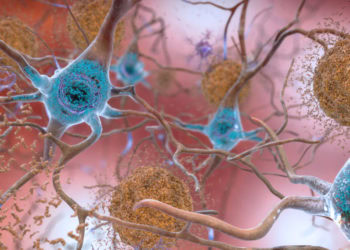
A new study suggests that the communication patterns within the brains of individuals with Alzheimer’s disease are less stable than in their healthy peers. This increased “neural flexibility,” particularly within the brain’s visual system, may also help predict which individuals are likely to transition to dementia. The findings were recently published in the Journal of Alzheimer’s Disease.
The human brain can be thought of as a complex and dynamic network, where different regions constantly communicate to support our thoughts and actions. Scientists map these communication pathways using a technique called functional magnetic resonance imaging, or fMRI, which tracks blood flow as an indirect measure of brain activity. This allows them to identify “functional networks,” which are groups of brain regions that consistently activate together, much like a team of colleagues working on a project.
Traditionally, research has examined these networks in a static way, creating a single snapshot of the brain’s overall connectivity pattern. However, brain activity is not static; it changes from moment to moment. A team of researchers from the University of Michigan and Columbia University sought to explore these dynamic changes in the context of Alzheimer’s disease. They were interested in a specific measure called neural flexibility, which quantifies how frequently a brain region switches its allegiance from one functional network to another over a short period.
The research team, led by Seonjoo Lee, an expert in mental health data science at Columbia University, investigated whether this measure of network instability could offer new insights into Alzheimer’s disease. They hypothesized that the breakdown of brain structure associated with the disease might lead to higher neural flexibility. They also explored whether this measure could serve as an early indicator for individuals at risk of developing dementia.
To conduct their analysis, the scientists utilized data from the Alzheimer’s Disease Neuroimaging Initiative, a large-scale project that tracks the progression of the disease over many years. Their study included 862 older adults who were categorized into one of three groups: cognitively normal, having mild cognitive impairment (MCI), or having a diagnosis of Alzheimer’s disease (AD). Each participant underwent a resting-state fMRI scan, where they lay quietly in the scanner without performing any specific task.
The researchers analyzed the brain scan data using a “sliding-window” method. Instead of looking at the entire scan at once, they broke it down into many short, overlapping time segments. For each segment, they identified the distinct communities of brain regions that were actively communicating. By comparing these communities from one window to the next, they could calculate a neural flexibility score for each brain region, representing how often it changed its network membership.
The results showed that, on a global level, the brains of individuals with Alzheimer’s disease exhibited significantly higher neural flexibility than the brains of cognitively normal participants. This indicates a greater degree of instability in their brain network organization. This pattern of increased flexibility was also observed in six of the twelve specific functional networks the team examined, including networks involved in attention, memory retrieval, and sensory-motor functions.
The team then turned its attention to predicting the progression to dementia. They focused on the 617 participants who did not have dementia at the start of the study, a group composed of both cognitively normal individuals and those with mild cognitive impairment. Over a follow-up period of more than 11 years, 53 of these participants transitioned to a diagnosis of Alzheimer’s-related dementia.
When analyzing the initial brain scans for predictors of this transition, the researchers identified a specific signal. Higher neural flexibility in the visual network at the beginning of the study was associated with a greater likelihood of a future dementia diagnosis. This suggests that dynamic changes within a network typically affected later in the disease’s progression could serve as an early warning sign. The authors propose that as core cognitive networks begin to degrade, other systems, like the visual network, may need to reorganize more frequently to help maintain function.
The researchers acknowledge several limitations to their work. The number of participants who converted to dementia was relatively small, which means the predictive finding, while statistically significant, did not survive a more stringent correction for multiple comparisons and should be interpreted with caution. The study population was also overwhelmingly non-Hispanic White, so it is unclear if these patterns would apply to more diverse groups.
Future research could build on these findings by examining neural flexibility in different populations and by using brain imaging with higher temporal resolution. It would also be beneficial to investigate the biological mechanisms underlying these changes, for example, by correlating neural flexibility with the presence of Alzheimer’s-related proteins in the brain. Despite these caveats, the study introduces a promising method for understanding the dynamic brain changes that occur in Alzheimer’s disease and offers a potential new avenue for identifying individuals at risk.
The study, “Neural flexibility is higher in Alzheimer’s disease and predicts Alzheimer’s disease transition,” was authored by Eleanna Varangis, Jun Liu, Yuqi Miao, Xi Zhu, Yaakov Stern, Seonjoo Lee, and For Alzheimer’s Disease Neuroimaging Initiative.