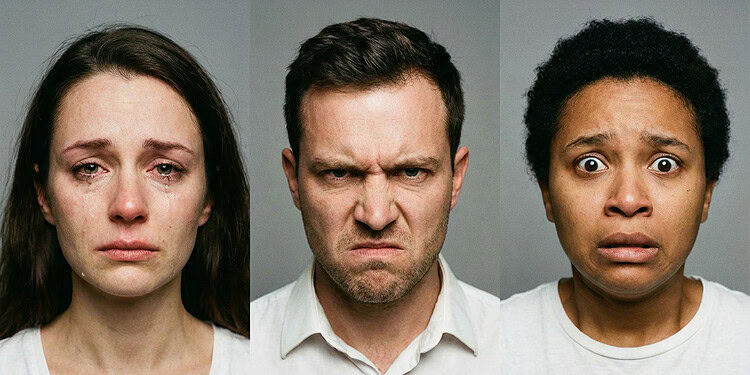

A study conducted in Sweden found that individuals with psychotic spectrum disorder were less accurate in recognizing the emotions of others compared to healthy controls. Moreover, among participants with psychotic spectrum disorder, those with a history of interpersonal aggression tended to be less accurate than those without such a history. The paper was published in Schizophrenia.
Emotion recognition is a basic part of human social interaction, helping people understand what others are feeling from facial expressions, tone of voice, and body movements. When this ability is impaired, social situations become harder to interpret and misunderstandings become more likely.
Such difficulties are especially relevant in psychotic spectrum disorders. Psychotic spectrum disorders are a group of mental disorders characterized by symptoms such as delusions, hallucinations, disorganized thinking or behavior, and impaired reality testing. These include schizophrenia and related conditions. The emotion recognition impairments found in individuals suffering from these disorders are not limited to static facial expressions, but can also appear when people interpret changing facial expressions, body movements, or other dynamic social signals.
Difficulties in recognizing emotions in these individuals tend to be particularly pronounced for negative emotions, although positive emotions can also be misidentified. People with schizophrenia may, for example, confuse one negative emotion with another or sometimes interpret neutral or positive expressions as negative. These problems usually reflect broader disturbances in perception, memory, attention, language, and other cognitive processes that contribute to understanding social information.
Study author Gabriela Gavalova and her colleagues wanted to compare the emotion recognition abilities of healthy individuals and those suffering from psychotic spectrum disorders. They also wanted to compare individuals with psychotic spectrum disorders who have a history of interpersonal aggression with individuals without such a history. Additionally, they wanted to see whether their recognition abilities depend on the way emotions are presented. With this in mind, they conducted a study in which they used three modes of presenting emotions to be recognized: visual (videos presented without sound), auditory (sound only), and multimodal (videos presented with sound).
Study participants were 79 individuals suffering from psychotic spectrum disorders and a history of interpersonal aggression (recruited from Forensic Psychiatry Stockholm, Sweden), 72 participants with psychotic spectrum disorders but without a history of interpersonal aggression (recruited from psychiatric outpatient clinics in Stockholm), and 86 healthy individuals (recruited via the State Person Address Registry in Sweden). The study authors note that the healthy control group had a higher level of education than the two psychotic spectrum disorder groups.
All participants underwent a short semi-structured demographic interview and were asked about the presence of the studied psychiatric disorders in first- and second-degree relatives, prior interpersonal aggression, as well as prior alcohol and substance abuse. Healthy participants and those without a history of interpersonal aggression also completed assessments of alcohol and drug use disorder symptoms.
The study authors collected data about the type and number of aggressive acts for the group with a history of interpersonal aggression from crime reports, forensic psychiatric assessments, hospital case reports, and participants’ own self-reports. Participants completed an intelligence test to measure fluid intelligence, which is the ability to reason and solve novel problems, a psychomotor speed test to measure the physical speed of responses to cognitive processing, and an assessment of their semantic understanding, or knowledge of the meaning, of emotion words using a synonym test.
Finally, participants completed a series of emotion recognition tasks called the Emotion Recognition Assessment in Multiple modalities test. These tasks contained 72 unique emotional stimuli displaying 12 different emotions. The participants’ task was to select the emotion being presented in the stimulus.
Results showed that participants from all three groups were able to recognize emotions in the emotion recognition task better than chance, meaning their responses were not random guessing. All three groups tended to misclassify some emotions. For example, they all tended to misclassify pride as happiness or interest, happiness as relief or as fear and despair, irritation as anxiety, and anger as irritation. Some other misclassifications were common as well.
Participants with a history of interpersonal aggression tended to also uniquely misclassify happiness as anxiety. The psychotic spectrum disorder group without a history of interpersonal aggression tended to misclassify pride as irritation, while healthy participants tended to mistake interest for anxiety. Crucially, the researchers found an unexpected and clinically significant pattern: participants with a history of interpersonal aggression were much more likely to misclassify negative emotions as positive emotions compared to both the non-aggressive psychotic spectrum group and the healthy controls. The authors suggest this could lead these individuals to miss negative social cues and fail to withdraw from escalating situations.
Healthy participants were much more accurate in recognizing emotions compared to the two other groups. In particular, participants with psychotic spectrum disorder and a history of interpersonal aggression were much less accurate in recognizing emotions than participants with psychotic spectrum disorder but without a history of interpersonal aggression.
Other than this, participants were more successful in recognizing emotions when they were presented with both video and sound compared to situations when one of these was missing. Overall, among individuals with psychotic spectrum disorder, participants with higher fluid intelligence, those who knew more words for emotions, and those who had better education tended to be better at recognizing emotions. Within this group, women and those without a history of interpersonal aggression tended to be better at recognizing emotions. Interestingly, when controlling for other factors, those with a history of alcohol or substance use disorder in remission also tended to score higher. However, the researchers caution that this might be a statistical anomaly known as a suppression effect, rather than proof that past substance abuse improves emotion recognition.
“In summary, individuals with PSD [psychotic spectrum disorders] and a history of interpersonal aggression exhibit more pronounced deficits in emotion recognition than those with PSD alone. This underscores the potential value of incorporating emotion recognition assessment and training into clinical interventions to reduce aggression risk and improve social functioning in individuals with PSD,” the study authors concluded.
The study contributes to the scientific understanding of the psychological specificities of individuals with psychotic spectrum disorders. However, it should be noted that all participants with these disorders were recruited from Stockholm, Sweden. Results in other cultural groups might differ.
The paper, “Emotion recognition misclassification patterns in individuals with psychotic spectrum disorders and history of interpersonal aggression,” was authored by Gabriela Gavalova, Petri Laukka, Lennart Högman, Malin V. Källman, Marianne Kristiansson, Märta Wallinius, Håkan Fischer, and Anette G. M. Johansson.