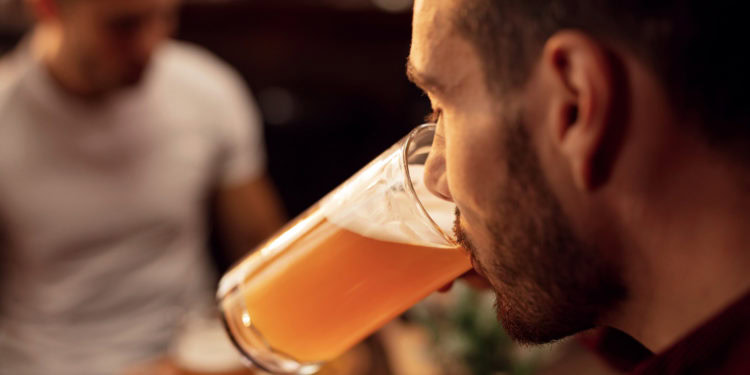

A study in a virtual reality bar setting assessed the effects of being subjected to painful heat on alcohol consumption. Results showed that men decreased intervals between sips of the alcoholic drink, but did not drink more in each sip. They only drank more rapidly. Women, on the other hand were not affected. The study was published in Experimental and Clinical Psychopharmacology.
Chronic pain is a problem experienced by about 20% of people in the United States. Estimates of the Centers for Disease Control and Prevention see chronic pain issues inflicting $560 billion dollars in health care and lost productivity costs annually.
Previous studies have indicated that experimental induction of pain increases the urge and intention to drink alcohol. Also, 73% of individuals seeking treatment for alcohol use disorder report experiencing moderate to severe pain within the last month. Roughly 25% of people endorse self-management of pain using alcohol.
Alcohol consumption has, on the other hand, indeed been shown to have the effect of increasing the pain threshold and reducing pain intensity. Unfortunately, research models state that pain and substance use, including alcohol consumption, form a positive feedback loop in which both conditions exacerbate over time.
“There’s substantial evidence that pain contributes to hazardous alcohol use for many people, including large epidemiological studies that many people with pain report using alcohol for pain relief and experimental studies showing that pain can increase people’s motivation to use alcohol,” said study author Jeff Boissoneault, an associate professor and co-director of the Center for Pain Research and Behavioral Health at the University of Florida.
“Our goal in this study was to determine whether pain would affect not just motivation to drink, but also how people drink alcohol. This is an important distinction because the way that someone drinks alcohol (for example, taking a shot vs. nursing a beer) can change the risks associated with drinking.”
“We expected that experiencing pain would lead to participants drinking faster, and that this effect would be strongest in men and people with certain personality traits, like a tendency to act impulsively to relieve distress (also known as ‘negative urgency’). We conducted the study using our new virtual reality bar software, called INTACT VR, which helps ensure that all participants experienced the same environment while they drank.”
Participants were 20 adults, all required to be current drinkers i.e., drinking at least one alcoholic beverage per month over the past 6 months, aged between 21 and 55. Participants included in the study needed to additionally fulfill a number of health criteria ensuring that they were in good physical health, with no major disorders, no history of drug or alcohol dependence, that they were not pregnant, planning to become pregnant, or breastfeeding.
Before the experiment started, participants completed a screening battery containing questions on demographics and assessments of typical alcohol use, alcohol use disorder symptomatology, pain attitudes, expectancies about pain reducing effects of alcohol and impulsivity. They also completed assessments of depression and anxiety. Additionally, they completed a urine-based drug and pregnancy screening and a baseline alcohol breath test.
After testing, participants were given a VR headset and goggles and immersed in a virtual reality bar environment. They were asked to drink a 12 oz bottle of beer or hard cider (5% alcohol content) at their own pace. During the session, a device was attached to their right calf that could create localized pain using heat of different intensity.
The researchers used two experimental conditions. In one condition, the participant’s calf was heated to 38 °C. This was unpleasantly warm, but not painful. In the other condition, participant’s calf was heated to a painful 44 °C. All participants went through both conditions, but in a randomized order. One session lasted 15 minutes.
Results showed that men significantly decreased the time between sips of their drink (beer or black cider) when exposed to painful heat compared to the condition when the heat was merely unpleasant. The experimental condition did not affect the sip volume i.e., how much beer/black cider they drank in each sip.
Surprisingly, the experimental condition did not change the drinking behavior of women. The effect of the painful heat condition was also found to be stronger “in individuals with higher levels of greater negative urgency but the opposite effect (was found) for pain catastrophizing,” the researchers noted.
“In my opinion, the most important takeaway from this study is that pain may not just increase a person’s motivation to drink alcohol, but also their rate of drinking,” Boissoneault told PsyPost. “This seems to be especially true for men and people with greater negative urgency. That in turn may lead to greater risk for alcohol-related consequences, including accidents or injuries, socio-legal problems, health issues, and developing alcohol use disorder. And unfortunately, although using alcohol may provide some pain relief in the moment, it can also make pain worse over time.”
The study sheds light on the links between drinking behavior and pain. However, it should be noted that the sample of the study was small and selected. Additionally, the study did not inflict serious pain, the pain was only acute and suffered for a very brief period. Results in people suffering from serious and long-lasting pain might not be the same.
“Although we had a sufficient sample to test our main hypotheses, larger studies will be needed to better understand the characteristics that might make individuals more likely to use alcohol to self-manage their pain,” Boissoneault said. “There is also a need to develop treatments or interventions that help break the link between pain and alcohol use in order reduce the risk of both chronic pain and alcohol use disorder.”
“Any readers concerned about their alcohol use or that of a friend or loved one living in the US should check out the National Institute of Alcohol Abuse and Alcoholism’s Alcohol Treatment Navigator (https://alcoholtreatment.niaaa.nih.gov/). I would also encourage them to consult a physician if they feel that pain is contributing the issue to help identify alternative pain treatment strategies. By the same token, physicians and other health care providers who work with people experiencing pain or who have alcohol use disorder should be aware that these conditions are often comorbid.”
The study, “Pain and Alcohol Consumption in Virtual Reality”, was authored by Christina Gilmour, Shelby Blaes, Nicholas J. Bush, Darya Vitus, Ryan W. Carpenter, Michael Robinson, and Jeff Boissoneault.