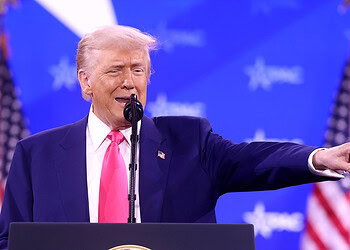
Masculine insecurity predicts endorsement of aggressive politics and support for Donald Trump, according to research published in the Personality and Social Psychology Bulletin. The researchers propose that masculine insecurity can lead men to adopt aggressive politics — like those of Donald Trump — in attempt to reaffirm one’s masculinity.
As the study’s authors Sarah H. DiMuccio and Eric D. Knowles say, scholars have observed overt displays of masculinity among men in politics for some time. It has been suggested that male political candidates often strive to appear masculine in order to attract voters, for example, by advocating for tough policies like harsh punishment for crime. Expressions of masculinity appear to be particularly prevalent among right-wing politicians and may be especially apparent when it comes to Donald Trump.
“Perhaps more than any politician in recent history, Donald Trump has rooted his political persona in traditional notions of masculinity,” DiMuccio and Knowles say, noting that Trump has presented himself as “dominant, unyielding, and virile.”
The researchers suggest that the attraction to this type of uncompromising politics might be partly explained by a psychological concept called precarious manhood (PM). This concept posits that men are motivated to preserve their masculinity. When masculinity is threatened, men will engage in certain behaviors to reaffirm that they are “real men.” One way they might do this is by increasing their support for aggressive political policies. In three separate studies, the researchers tested this idea.
A first study surveyed over 500 American men and found that a measure of precarious manhood predicted support for policies considered politically aggressive, such as increased military spending and enhanced interrogation techniques. Precarious manhood was measured using the GRDS, a subscale of the Masculine Gender Role Discrepancy Stress (MGRDS) scale that evaluates men’s concern over not meeting masculine norms. Importantly, scores on the GRDS were related to increased support for aggressive policies, even after accounting for conservatism, Social Dominance Orientation, and Right-Wing Authoritarianism.
In a second study, DiMuccio and Knowles developed a list of search terms likely to be popular among precarious men (e.g., how to get girls). They then obtained Google Trends data pertaining to searches for these terms in the year before the 2016 presidential election. The researchers found that Trump earned a higher share of the votes in markets with more PM-related Google searches. Interestingly, this same relationship was not found when researchers conducted a similar analysis using the vote percentages of 2008 and 2012 Republican candidates John McCain and Mitt Romney.
Finally, a third study compared the popularity of PM-related search terms to the success of Republic U.S. House of Representatives candidates in the 2018 mid-term elections. The researchers found that Republican candidates had higher vote share percentages in districts where PM-related terms were heavily searched. DiMuccio and Knowles point out that this link between precarious manhood and support for Republican candidates seems to be a new phenomenon, given that no such links were found when looking at 2008 and 2012 Republican votes. The researchers say this may be down to Donald Trump’s heightened power as standard-bearer of the Republican Party.
The authors express that all three studies found evidence that precarious manhood is linked to support for political aggressiveness — as measured by support for aggressive policies, Donald Trump, and Republican U.S. House of Representatives. “Taken together, our findings support the notion that men who are likely to doubt their masculinity may support aggressive policies, politicians, and parties, possibly as a means of affirming their manhood,” they say.
DiMuccio and Knowles emphasize that their results do not suggest that precarious manhood is only relevant when it comes to aggressive policies or support for the GOP. They propose that future research should consider whether PM shows itself among the political left, perhaps through support for “hardball” policies.
The study, “Precarious Manhood Predicts Support for Aggressive Policies and Politicians”, was authored by Sarah H. DiMuccio and Eric D. Knowles.