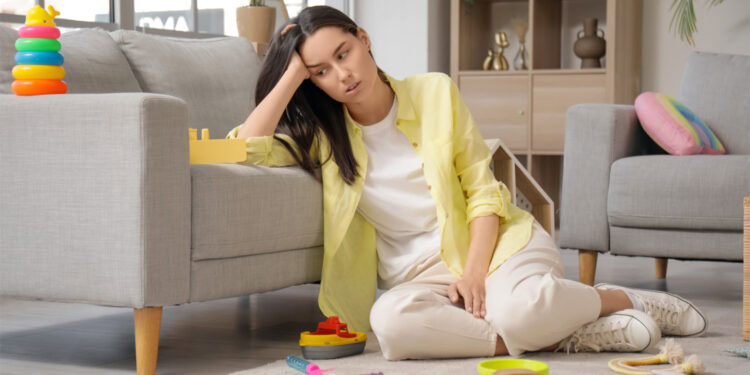

When you think about housework, you likely think of actions: scrubbing the dishes, running errands, chopping vegetables for dinner. And it’s not news to say that mothers often shoulder the burden for most of those activities.
But there’s an invisible dimension of household labor that unfolds behind the scenes: the cognitive effort that goes into anticipating needs, planning, organizing and delegating household tasks. In other words, someone has to remember to replace the dish soap and select which vegetables to chop.
Our new research found that this cognitive dimension of housework, often called the “mental load,” is divided even more unevenly within couples than the physical dimension – and it seems to take a particular mental health toll on women. According to the study we published in the Archives of Women’s Mental Health, mothers who take on a more disproportionate share of cognitive household labor report higher levels of depression, stress, relationship dissatisfaction and burnout.
Tracking who does what
We asked 322 mothers of young children about who in their family is responsible for 30 common household tasks. We collaborated with the creators of the Fair Play system – a book and card game designed to better quantify the division of labor within households – to divide each task into two dimensions: cognitive (anticipating, planning, delegating and thinking about household tasks) and physical (the hands-on execution of household tasks). We then examined how these tasks are shared between partners.
We found a striking gender disparity: Mothers not only performed more physical housework but also carried a significantly greater share of cognitive labor compared with their partners.
On average, mothers reported being responsible for about 73% of all cognitive household labor compared with their partners’ 27%, and 64% of all physical household labor compared with their partners’ 36%. Indeed, for every single task we examined, the gender difference was larger for the cognitive dimension than the physical execution dimension.
There was only one task in which fathers did more planning and execution: taking out the garbage. Fathers also carried out more home maintenance tasks, but mothers did more of the related planning.
Interestingly, while an unequal division of physical tasks was linked to worse couple relationship quality, it was the cognitive labor that had a more profound impact on women’s psychological well-being.
Family dynamics have societal impact
An unequal division of household labor is a key driver of global gender inequity, suppressing women’s full participation in the paid workforce and significantly affecting women’s health and well-being.
Our study is one of the first to investigate the cognitive dimension of household labor and its effects on maternal mental health. Cognitive labor may be particularly taxing for women because it often runs behind the scenes and goes unacknowledged or unappreciated by others. It also pulls mental energy away from other priorities.
Additional studies indicate that women experience more negative effects from child care and housework compared with men, such as higher depression rates, partly due to the heavier cognitive load they carry.
What still isn’t known
Our study was limited by its reliance on self-reported household labor and by the fact that we were able to collect data only from mothers in cohabiting, heterosexual couple relationships. Future studies can survey both partners and directly observe what chores couples do at home. They can also look at different kinds of relationship configurations, including gay and lesbian couples.
We also don’t know much about the long-term effects of the division of cognitive labor on women’s mental health and cognitive functioning.
The unfair division of housework is a frequent source of stress in relationships and often cited by women as a reason for divorce. The cognitive load may be an underappreciated aspect of the domestic workload that warrants more attention from couples therapists, mental health counselors and premarital relationship educators.
This article is republished from The Conversation under a Creative Commons license. Read the original article.