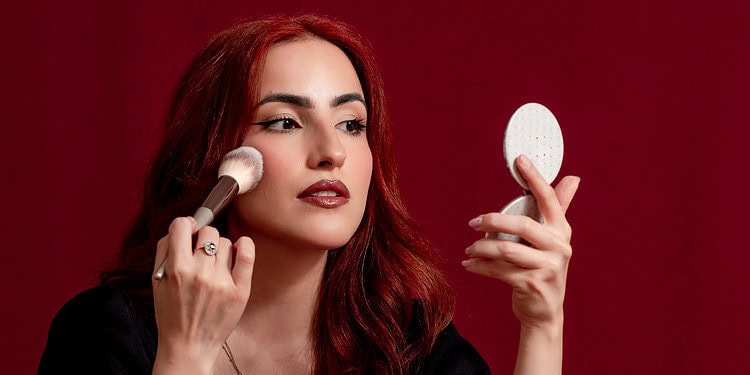

A recent study published in the Archives of Sexual Behavior sheds new light on the link between makeup use and personality traits among women. The research found that women who use more makeup tend to score higher in traits such as narcissism and extraversion, while women who score higher in psychopathy tend to use less makeup across various situations.
Makeup has long been used as a tool to enhance physical appearance, with many studies highlighting how it influences both self-perception and how others perceive the wearer. Women wearing makeup are often seen as more attractive, feminine, and dominant, which in turn can affect their social interactions. However, little was known about how different personality traits might influence the frequency and context in which women use makeup.
Personality traits, particularly those related to narcissism, extraversion, and traits within the so-called “dark triad” (narcissism, Machiavellianism, and psychopathy), have been linked to behaviors that seek to manage and enhance appearance. Narcissistic individuals, for instance, often seek admiration and attention, which could translate into higher makeup usage.
On the other hand, psychopathic traits, which are linked to lower concern for social norms and others’ perceptions, might result in less attention to makeup use. The researchers aimed to explore these connections, as well as how makeup usage might change depending on different social situations.
“We observed, in a previous study (Mafra et al., 2020), that many women use little or no makeup, while there are others who frequently use a lot of makeup. We became interested in understanding more about these variations in makeup use. Could it be related to personality, with more extroverted women using more makeup? Or could it be the social situation?” said study author Anthonieta Looman Mafra, a postdoctoral researcher in Experimental Psychology at the University of São Paulo.
The study involved 1,410 Brazilian women who were surveyed about their personality traits and makeup habits. Participants completed several questionnaires that measured their personality traits, particularly focusing on the “Big Five” traits (extraversion, sociability, neuroticism, conscientiousness, and openness) and the dark triad traits (narcissism, psychopathy, and Machiavellianism).
Participants were also asked about their makeup habits in different contexts, such as how often they wore makeup at home, while exercising, at work, or when meeting new people. They rated how much time they spent applying makeup, how much they spent on it each month, and how frequently they used it.
“The study shows that most women use less makeup when they are alone and more makeup when they are in social environments, with the situation where they use the most makeup being a first date,” Mafra explained.
One of the most consistent results was the positive association between narcissism and makeup use. Women who scored higher in narcissism, characterized by a strong need for admiration and attention, tended to spend more time applying makeup, use it more frequently, and invest more money in cosmetics. These women also modulated their makeup use significantly across different social settings, wearing more makeup in situations where they would meet new people or try to make a good impression, such as on first dates or at professional meetings.
Extraverted women, known for their sociability and preference for being the center of attention, were also more likely to spend money on makeup. They often used makeup to enhance their outgoing personalities, which helped them feel more confident in social interactions. However, extraverts did not show as much variation in makeup use across different settings compared to narcissistic individuals.
On the other hand, women scoring higher in psychopathy—a trait marked by impulsivity and a lack of concern for others—tended to have more stable makeup habits across different social contexts. Regardless of whether they were at home, at the gym, or out with friends, these women maintained a consistent level of makeup use, typically lower than women high in narcissism. This finding suggests that women with psychopathic traits may not use makeup as a tool for self-presentation or manipulation in social contexts as much as other personality types do.
“I did not expect to find a difference in makeup use among people with more psychopathic traits,” Mafra told PsyPost. “It’s important to emphasize that it does not mean that if someone doesn’t wear makeup, it makes them a psychopath.”
Another interesting finding was that women with high levels of neuroticism—who are more prone to emotional instability and anxiety—also showed larger differences in makeup usage depending on the context. Like women with narcissistic traits, they tended to use more makeup in social situations and significantly less when alone, possibly indicating that makeup provides them with a sense of control and security in social settings.
“People with more narcissistic and neurotic traits exhibited a greater difference in the amount of makeup they use in different social situations,” Mafra said. “In other words, they use much more makeup in some social situations and none in others.”
But as with all research, there are some limitations to consider. For one, personality traits did not explain a large portion of the variation in makeup habits. “The effect sizes are small, so caution should be taken when making generalizations,” Mafra said. “It is important to note that there are a lot of factors that may influence makeup usage, such as the requirement to wear makeup in certain professions, allergies, and religion.”
“Additionally, participants reported their makeup usage in different social situations compared to their normal use, but third-party perceptions may differ. For example, a woman who never wears makeup might consider that she uses a lot of makeup when going out to meet friends, but those friends might perceive that she wears little makeup.”
Future research could ask how friends, family, or even strangers perceive a woman’s makeup use in different situations and compare these perceptions to the woman’s own self-assessment.
“We intend to investigate how third-party perceptions of women align with self-assessments to see if women’s self-evaluations of makeup use are consistent with how others perceive them when they wear different levels of makeup,” Mafra explained. “This aspect of the research will provide valuable insights into social dynamics and how makeup use influences interpersonal perceptions and judgments.”
“Ultimately, our goal is to contribute to a more comprehensive understanding of the role of appearance management in everyday life and its psychological underpinnings. This research could also inform fields such as marketing, fashion, and mental health, helping professionals develop more targeted strategies to support individuals in making choices that enhance their well-being and authentic self-expression. By continuing to explore these themes, we hope to challenge stereotypes and misconceptions about makeup use and personality traits, promoting a more nuanced view of how personal grooming choices reflect and influence one’s and others’ perceptions.”
The study, “Makeup Usage in Women Is Positively Associated to Narcissism and Extraversion but Negatively to Psychopathy,” was authored by Anthonieta Looman Mafra, Yago Lukševičius de Moraes, Marco Antonio Correa Varella, and Jaroslava Varella Valentova.