

Spending time on Facebook is associated with increased grey matter volume in brain structures linked to the processing social information, according to new neuroimaging research published in the journal Social Neuroscience.
“I have been working on the ‘dark side’ of excessive use of technologies for almost a decade,” said Ofir Turel of the University of Southern California and California State University at Fullerton, the corresponding author of the study.
“What my colleagues and I noticed in a sequence of studies was that excessive social media use can be associated with brain morphology that in some respects resembles that of substance users, but also differs from it along other dimensions.”
“What was missing was an understanding of how normal, non-excessive use of social media — which is arguably something more prevalent than excessive use — may be associated with brain morphology. So this study sought to bridge this gap,” he explained.
Turel had observed that low to moderate levels of video gaming were associated with positive effects on various aspects of life, but excessive gaming was associated with negative effects. “So I thought it was possible that the same happened with social media use and the brain — it can be associated with positive brain changes at normal levels, but may be associated with increased problems when the use becomes excessive.”
“Examining possible positive aspects of normal social media use in terms of brain morphology is therefore another gap that we sought to address. This is important because if there are indeed such changes in the brain, this knowledge can be used for developing interventions to help people with deficits in these brain regions,” Turel told PsyPost.
In an initial survey of 276 Facebook users, Turel and his colleagues confirmed that people who spent more hours engaging with the social networking site reported viewing more faces and had to interpret facial expressions more often.
“Socialization has changed for many people from only face-to-face or over-the-phone twenty years ago to mostly — or at least largely — via social networking sites,” he explained.
“This means that social media users, on average, are now exposed to many more social situations and faces. They need to recognize social group members online, retrieve semantic associations for them, and interpret their states and motivations.”
The researchers then used magnetic resonance imaging to examine the brain structure of 33 Facebook users. Turel and his colleagues found that time spent on Facebook was positively related to grey matter volume in the left and right posterior superior and middle temporal gyri and left posterior fusiform gyrus.
In other words, people who spent more time on Facebook tended to have greater gray matter volumes in these brain regions compared to those who spent less time on Facebook.
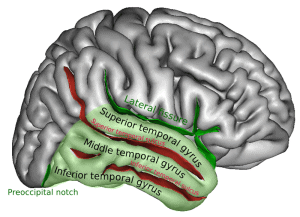
The brain regions are involved in social-semantic tasks, such as “recognizing social group members, retrieving semantic associations for them, and interpreting their states and motivations,” Turel explained.
“The size of these regions is positively associated with the level of social media use. On a broader scale, this means that it may be possible (after establishing directional causality) to employ normal (low-moderate) social media use to promote neural recovery in such regions,” he told PsyPost.
“Reduction in the volume of these regions is associated with, for example, schizophrenia, which is characterized by reduced and dysfunctional social behavior. So perhaps moderate use of social media can help people with suboptimal social behavior to improve social-semantic processes in the brain.”
However, the researchers still need to establish that increased Facebook use causes increased grey matter volumes in these regions of the brain.
“Like any research, this study has several limitations. The key one is that it was correlational in nature. We therefore cannot determine directional causality. We cannot say that social media use drove these brain changes, or that underlying brain differences drive different levels of social media use,” Turel said.
“We need to always remember the duality of technologies — their positive and negative effects on our lives. Social media use, like the use of many other technologies, can have negative effects when it is done excessively or improperly and irresponsibly (e.g., while driving, while in class),” he added.
“However, it is also possible that it produces positive effects when use is normal. This study presented an initial stride towards studying possible associations with positive brain changes. We call for more research on the associations between social media use and the brain.”
The study, “Social networking sites use and the morphology of a social-semantic brain network“, was authored by Ofir Turel, Qinghua He, Damien Brevers, and Antoine Bechara.