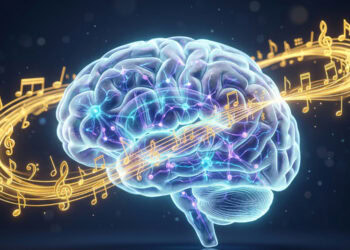
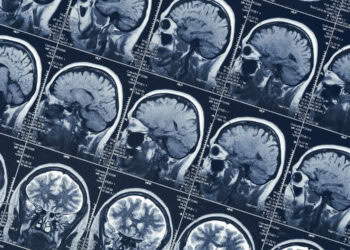
A new study by researchers at UC San Francisco provides insight into how the brain processes musical melodies. Through precise mapping of the cerebral cortex, the study uncovered that our brains process music by not only discerning pitch and the direction of pitch changes but also by predicting the sequence of upcoming notes, each task managed by distinct sets of neurons. The findings have been published in Science Advances.
Previous research had established that our brains possess specialized mechanisms for processing speech sounds, particularly in recognizing pitch changes that convey meaning and emotion. The researchers hypothesized that a similar, perhaps specialized, set of neurons might exist for music, dedicated to predicting the sequence of notes in a melody, akin to how certain neurons predict speech sounds.
“Music is both uniquely human and universally human. Studying the neuroscience of music can therefore reveal something fundamental about what it means to be human,” said lead author Narayan Sankaran, a postdoctoral fellow in the Kavli Center for Ethics, Science, and the Public at UC Berkeley, who conducted the study while a researcher in the lab of UCSF’s Edward Chang.
“In particular, we understand little about how the auditory cortex extracts musical information from a sound signal arriving at the ears. We were especially interested in the question of whether music is special in the brain – is the brain’s hardware for music specialized for music alone? Or does music rely on general-purpose machinery for sound processing? This question has been hotly debated in auditory-neuroscience over the past decade, but it has lacked a clear answer.”
To test their hypothesis, the researchers utilized an innovative approach to delve into the intricacies of how the human brain processes music. By recruiting eight participants who were already undergoing clinical monitoring for epilepsy treatment, the researchers were able to use high-density electrocorticography (ECoG) to achieve direct and precise recordings of brain activity. This method involves placing electrodes directly on the surface of the brain, offering a rare and detailed view of the neural dynamics at play during auditory processing.
The participants were exposed to a carefully curated set of 208 monophonic musical phrases, designed to encapsulate a wide range of pitch, pitch-change, and expectancy variations. These musical phrases, drawn from Western music, were complemented by spoken English sentences, allowing the researchers to compare the brain’s processing of music and speech in a controlled setting.
The researchers focused on three fundamental aspects of musical perception: the pitch of notes, the change in pitch between consecutive notes, and the predictability of each note within a sequence. By manipulating these variables across the musical phrases and analyzing the corresponding neural responses, the study aimed to dissect the auditory cortex’s role in parsing complex acoustic signals.
The researchers identified distinct neural populations within the superior temporal gyrus (STG) that are specialized for different components of musical perception. One set of neurons was responsive to the pitch of notes, aligning with the fundamental frequency of the sound.
Another group of neurons was tuned to detect changes in pitch, distinguishing between ascending and descending shifts.
Perhaps most intriguingly, a third set of neurons was found to be specifically involved in predicting the next note in a musical sequence, based on the notes that had preceded it. This predictive mechanism was more pronounced for music than for speech, suggesting a unique specialization within the brain for anticipating musical structures.
Furthermore, the researchers uncovered that while some aspects of music processing share mechanisms with speech — such as the encoding of pitch and pitch change — other aspects, notably the prediction of note sequences, are uniquely attuned to music. This delineation between shared and specialized processing pathways provides new insights into the brain’s auditory processing capabilities.
The findings indicate that “our brain extracts important musical information by recruiting both generalist and music-specialist neural populations,” Sankaran told PsyPost.
“The generalists detect properties of sound, regardless of whether that sound is music. When we hear melody, these generalists detect the pitch of notes, or whether a melody rises or falls from one note to the next.”
“Intriguingly, a different set of neurons are music-specialists that are only active during music-listening. These neurons detect the extent to which notes in melody are statistically expected, which is thought to be related to how music induces emotion.”
“Music is therefore special in our brains,” Sankaran explained. “However, we should remember that general sound-processing mechanisms are also doing a lot of the groundwork that ultimately allows us to appreciate music.”
The researchers also found that the neural populations responsible for encoding different musical features were not segregated into isolated regions but were instead interspersed within the superior temporal gyrus, indicating a complex, distributed network for music perception.
“Prior work has found a dedicated ‘music’ region in the auditory cortex,” Sankaran said. “However, we found no evidence of such a region. Instead, music-specific neural populations were scattered throughout the auditory cortex, intermixed with other sound-responsive neurons.”
Despite these insights, the study has its limitations. The sample size was relatively small, and participants were individuals undergoing clinical treatment, which may not fully represent the general population. Additionally, the study focused on Western music and English speech, raising questions about whether these findings are universally applicable across different cultures and languages.
“We were limited to presenting Western music to Western listeners,” Sankaran said. “I hope that future research extends to non-Western contexts, including listeners who possess a knowledge of multiple musical systems that span cultures.”
The research opens up numerous avenues for further exploration. Key questions remain about how these neural mechanisms develop over time, how they vary across individuals with different levels of musical training, and how they might be affected by hearing impairments or other neurological conditions.
“Detecting the statistical likelihood of notes requires knowledge about the statistical structure of music,” Sankaran added. “We still don’t know how exactly these neurons acquire such knowledge. This will be important for future research to solve.”
The study, “Encoding of melody in the human auditory cortex,” was authored by Narayan Sankaran, Matthew K. Leonard, Frederic Theunissen, and Edward F. Chang.