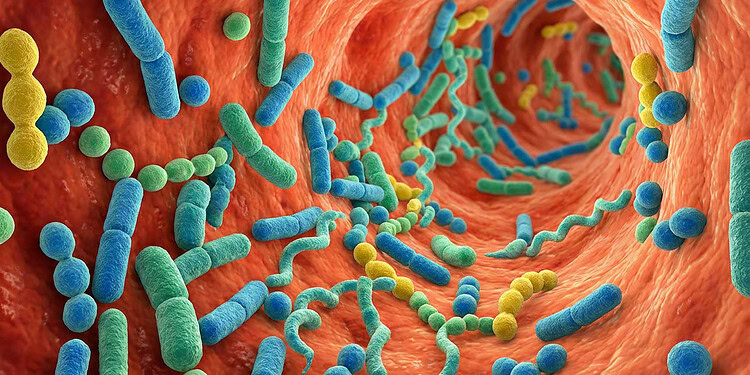

New genetic research has identified a direct causal chain connecting the microorganisms in the human digestive tract to the risk of developing severe psychiatric and neurodegenerative conditions. The findings suggest that specific gut bacteria influence the development of disorders such as depression and Alzheimer’s disease by altering the levels of fat molecules in the blood.
This discovery provides a potential biological roadmap for how the digestive system communicates with the brain. The study was published in the Journal of Affective Disorders.
The human gut hosts a vast community of microorganisms known as the microbiota. This ecosystem performs essential functions ranging from digestion to immune system regulation. Biologists describe the communication network between this community and the central nervous system as the gut-brain axis.
Previous observational research has frequently noted that patients with brain disorders tend to host different bacterial colonies compared to healthy individuals. However, these earlier observations could not determine the direction of the effect. It remained unclear whether specific bacteria caused the disease or if the disease itself altered the gut environment.
Biological lipids, or fats, are fundamental components of the brain’s structure. They form the membranes of nerve cells and facilitate signal transmission between neurons. Disruptions in how the body processes lipids often accompany neurological conditions.
The research team hypothesized that gut bacteria might influence brain health by manipulating these lipid levels. Nan Zhang from the Department of Neurology at the Seventh Clinical College of China Medical University led the investigation to test this theory.
To distinguish cause from effect, the researchers employed a statistical method called Mendelian randomization. This technique utilizes genetic variants as proxies for environmental exposures. Genes are randomly assigned at conception and generally remain unchanged throughout a person’s life. This random assignment mimics the conditions of a clinical trial. It allows scientists to bypass the external lifestyle factors that often confuse results in traditional observational studies.
The investigators analyzed summary data from large-scale genome-wide association studies. They examined genetic profiles related to the gut microbiome in over 7,700 individuals. They also utilized lipid data from a separate cohort of more than 7,000 people.
They compared these datasets against genetic risk profiles for seven major neuropsychiatric disorders. The conditions studied included Alzheimer’s disease, Parkinson’s disease, amyotrophic lateral sclerosis, and multiple sclerosis. The team also looked at schizophrenia, major depressive disorder, and bipolar disorder.
The analysis identified numerous specific bacteria that appear to act as either risk factors or protective agents. The results indicated 51 positive correlations where specific bacteria increased disease risk. They also found 47 negative correlations where bacteria seemed to lower the risk. For instance, the study suggests that the bacterial family Ruminococcaceae may increase the risk of Alzheimer’s disease. The analysis indicated that the Bacteroides family might reduce the risk of developing Parkinson’s disease.
The study also examined the genetic links between various lipids and these brain disorders. The team observed that distinct types of fat molecules have different impacts on disease risk. High levels of a lipid called sphingomyelin were genetically linked to an increased risk of Parkinson’s disease. In contrast, specific types of phosphatidylcholine appeared to lower the risk. These findings highlight that the chemical structure of a lipid determines its role in brain health.
A primary objective of the research was to determine if lipids serve as a bridge between the gut and the brain. The researchers performed a mediation analysis to investigate this possibility. This statistical approach calculates how much of an effect passes through a specific intermediate step. The team successfully identified a specific pathway involved in major depressive disorder.
The analysis revealed that a bacterium known as Bacteroides plebeius contributes to the risk of major depressive disorder. The study indicates that this bacterium exerts its influence partially by regulating the levels of a specific lipid. This lipid is identified as phosphatidylcholine (16:0_20:4).
The calculations suggest that this specific lipid pathway accounts for approximately 11 percent of the bacterium’s total effect on depression. This provides concrete evidence of a mechanism linking a specific microbe to a mood disorder via a metabolic product.
The researchers also investigated the possibility of reverse causality. They tested whether having a neuropsychiatric disorder might cause genetic changes that lead to altered gut bacteria or lipid levels. The statistical tests showed no evidence to support this reverse direction. This strengthens the conclusion that the microbiome alterations likely precede and contribute to the disease.
The study also shed light on amyotrophic lateral sclerosis, often called Lou Gehrig’s disease. The results pointed to a species called Bacteroides clarus as a potential risk factor. On the protective side, a bacterium known as Dorea appeared to lower the genetic risk for this condition. These specific associations offer new targets for researchers trying to understand the environmental triggers of this progressive disease.
In the context of schizophrenia, the team found that pathways involved in vitamin B1 metabolism might be protective. The analysis suggested that the body’s ability to salvage thiamin, or vitamin B1, is genetically linked to a lower risk of the disorder. This aligns with the understanding that metabolic efficiency plays a role in maintaining mental health. The bacterial families Ruminococcaceae and Bacteroides also appeared to reduce the risk of schizophrenia.
The research highlights the complexity of lipid interactions in multiple sclerosis. The analysis linked eight different lipids to the disease. Four of these lipids appeared to increase the risk, while the other four decreased it. This nuance suggests that broad dietary interventions might be too simple. Therapies may need to target specific lipid molecules to be effective.
While the use of genetic data provides stronger evidence for causality than observational studies, the research has limitations. The datasets used in the analysis were derived primarily from individuals of European ancestry. Genetic associations can vary significantly between different ethnic groups. This means the findings may not fully apply to populations with different genetic backgrounds.
The sample sizes for the gut microbiome data were relatively small compared to some other genetic studies. Genetic research relies on massive datasets to detect subtle effects. A smaller sample size can sometimes lead to false positives or miss weaker associations. The researchers acknowledged that larger cohorts in the future would help confirm these results.
Additionally, Mendelian randomization assumes a linear relationship between genes and outcomes. Biological systems often behave in non-linear ways. The current model may not capture complex interactions where the effect of a gene changes based on other factors. Future studies using more advanced statistical models could address this complexity.
The findings also require validation through experimental biology. Statistical associations provide a roadmap, but they do not explain the molecular details of the interaction. Scientists must now conduct experiments in laboratory models to observe how Bacteroides plebeius alters phosphatidylcholine levels. They must also verify that this lipid change directly affects brain function in a living organism.
Understanding these specific chemical pathways could eventually lead to new therapeutic strategies. Current treatments for neuropsychiatric disorders often focus on altering neurotransmitters in the brain. This study suggests that interventions in the gut could offer an alternative approach. Modifying the microbiome to encourage beneficial lipid production might serve as a complementary treatment.
Probiotics or prebiotics designed to support specific bacteria could one day be part of a treatment plan. Dietary changes aimed at providing the raw materials for beneficial lipids might also prove useful. However, any such treatments are still years away. The immediate value of this work lies in identifying specific targets for further investigation.
The study, “Causal relationship between gut microbiota, lipids, and neuropsychiatric disorders: A Mendelian randomization mediation study,” was authored by Nan Zhang and Xiaoyu Dong.